Crichton’s Jurassic Park: Chapter 13 “Airport” (Pages 79 – 81) Biosyn, Dodgson & Nedry

Biosyn, the corporate nemesis to InGen, hangs around for at least one more chapter. So much of the modern franchise depicts the ‘evils of InGen’ and follows derivative corporate greed with future movies talking about weaponizing dinosaurs, world-devouring-locusts, etc. – that the fact that the primary plot device created in the first Jurassic Park comes from one company paying another company’s employee to sabotage their primary asset.

If you’re in a competitive supply chain – even if you are acting rationally, it takes only one aggressive, evil, and/or dimwitted opponent to turn things upside down.

Best Writing, Quotes

“Also, Dodgson said “we think the island maintains constant radio contact with InGen corporate headquarters in California, so – ”

Dodgson to Nedry, Page 81 from Crichton’s Jurassic Park

Here, Crichton has created another reason for the big power outage that kicks off the movie franchise. When this is written about today, so much of the debate goes to ‘system failures’ and other problems – but really this all kicks off with corporate-to-corporate capitalistic greed.

Page by Page Highlights, Quotes

“Bioengineered DNA was, weight for weight, the most valuable material in the world.” Page 79

“That’s for all fifteen species, you remember.” Dodgson to Nedry, Page 80

Dodgson hands over half the cash – a paltry $750,000 in 1990, and the fake shaving cream cans that will be used to smuggle the embryos back to the US. The use of this device adds extra tension, as there is a countdown timer – even if it isn’t on the primary group. Crichton has added tension for the ‘bad guys’ in this scenario.

“Also, Dodgson said “we think the island maintains constant radio contact with InGen corporate headquarters in California, so – ” Again, Dodgson to Nedry, Page 81

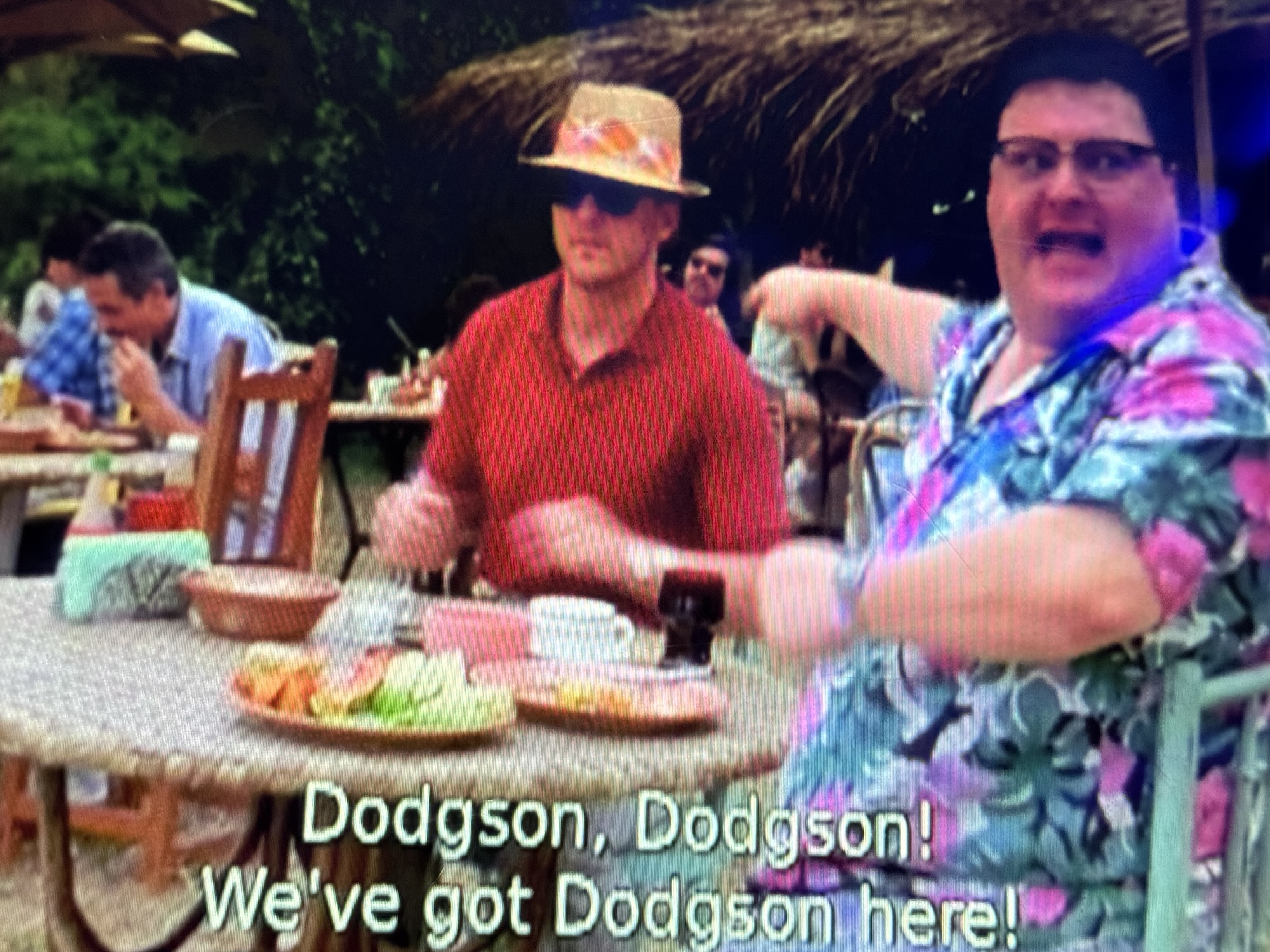
The original “Look, nobody cares” meme comes from Dodgon in the movie wanting to be incognito. Nedry calls him out.
Posted in Books, Michael Crichton | Tagged , , , , , , , , , , , | Comments Off on Crichton’s Jurassic Park: Chapter 13 “Airport” (Pages 79 – 81) Biosyn, Dodgson & Nedry

Crichton’s Jurassic Park: Chapter 12 “Target of Opportunity” (Pages 74 – 78) Corporate Competition from Biosyn, Nedry’s Employer

Companies almost never call emergency board meetings – the game of business occurs between board meetings. Board meetings are the whistle at the end of the quarter, or to close out the game and move to the next phase of a season. We find a sketchy geneticist, Lewis Dodgson, who has hired Nedry – the mole inside Jurassic Park. Crichton uses competitive intelligence to tell us more about InGen, rather than continuing with exposition.

From the outset, the reader has thought, “who are these madmen at InGen pursuing such a reckless plan?”

Here, Crichton shows us that they are relatively moderate compared to their competitors down the road. In fact, in a world without Biosyn, we never get the pending shutdown of the island’s IT systems which leads to the catastrophic failure. Were it not for corporate shenanigans, perhaps we create a universe where the park is peaceful and dinosaurs become a slow, incremental part of an alternate reality.

Best Writing, Quotes

“What they have done,” Dodgson said, “is build the greatest single tourist attraction in the history of the world. … And then there is the merchandising. [Italics are Crichton’s.] The picture books, T-shirts, video games, caps, stuffed toys, comic books, and pets.” –

Crichton’s Jurassic Park Page 77

If Crichton was genre-blind to what he was creating with this book, he certainly was able to see the future with this quote. The franchise has brought in over $7 billion across movies, merchandise, video games and more.

Page by Page Highlights, Quotes

“Depending on who you talked to, Lewis Dodgson was famous as the most aggressive geneticists of hsi generation, or the most reckless. Thirty-four, balding, hawk-faced, and intense, he had been dismissed by Johns Hopkins as a graduate student, for planning ene therapy on human patients without obtaining the proper FDA protocols. … he had conducted the controversial rabies vaccine test in Chile….” – Page 74

“InGen’s start-up in 1983, with Japanese investors. The purchase of three Cray XMP supercomputers. The purchase of Isla Nublar in Costa Rica. The stockpiling of amber.” Page 75

“Then in 1987, Ingen bought an obscure company called Millipore Plastic Products in Nashville, Tennessee. … plastic could be shaped into an egg and used to grow chick embryos.” – Page 76

“What they have done,” Dodgson said, “is build the greatest single tourist attraction in the history of the world. … And then there is the merchandising. [Italics are Crichton’s.] The picture books, T-shirts, video games, caps, stuffed toys, comic books, and pets.” – Page 77

“Nobody spoke. Nobody went on record. They just nodded silently.” – Page 78

Posted in Books, Michael Crichton | Tagged , , , , , , , , , , , | Comments Off on Crichton’s Jurassic Park: Chapter 12 “Target of Opportunity” (Pages 74 – 78) Corporate Competition from Biosyn, Nedry’s Employer

AI in Manufacturing: What Worked and What Did Not

With our small business we’ve used premium subscription services to several of the current top AI platforms to see what kind of impact we could have. With less than $10 million in revenue and ~25 employees, this was an opportunity to see what was possible with limited resources.

As artificial intelligence gains traction in every corner of industry, manufacturers are understandably eager to capture its promised efficiencies. But in the real world of small and midsized manufacturing businesses, AI’s impact is far from uniform. We set out to apply AI tools across both sales and operations—and quickly learned that not all use cases deliver equal value. In operations, where processes are bounded and data is more structured, AI proved transformational by leading to shorter production times and faster shipment of products. In contrast, its impact in sales was limited, providing insights but no financial gains. What follows is our firsthand account of what worked, what didn’t, and where other manufacturers can expect the biggest – and fastest – returns.

Context & Current Systems

Our only IT systems are MS Office (Outlook, .xlsx) and QuickBooks. We’ve got a wonky CRM that is largely used by account managers to track their own activity – it has little ability to generate reports or allow for sales director oversight. There is no ERP, MRP or CRM. The business produces sewn filters for industrial sites and pharmaceutical manufacturers. We purchase raw materials – filter media (fabrics, felts, wovens, meshes, nonwovens, membranes, etc.) slit them, cut them, and then form them into final products. Our site is largely produce-to-order, we carry minimal inventory. Sourcing can be quite sophisticated to bring in products for life science customers that meet their compliance requirements.

Over the past two years we’ve sold ~1,000 SKUs to ~300 accounts.

Sales

What worked: We were able to use current AI capabilities to create calling lists for account managers. Some of our end markets are very specific and regulated, so the accounts are well known. In one market there are 4,000 relevant plants in the US. Using AI we were able to build thorough lists of contacts in the market. We were able to use those lists to dramatically improve account manager effectiveness at major trade shows – identifying who was already buying from us, who our major competitors were at target accounts, and this created more effective selling strategies.

What did not work: Automated digital outreach had little to no impact. Prior to our engagement the company was spending ~$60k per year on Google Ads spending with no results. We took that spend down to $0 and instead brought in a contract email outreach firm at a cost of $1,800 per month ($21.6 k per year / ~1/3 the cost of the previous approach). While we were successful in using AI to map the market and understand the opportunity set, this engagement led to <10 meetings and $0 in revenue.

Operations

In both sales and operations, we were new to the business and our primary goal in using AI was first to get a better understanding of what was really going on with the business. While we had a goal in sales of “grow revenue” that was secondary to the initial goal of “understand current sales and customers.” In operations we had a similar primary goal – with no ERP/MRP or systems and with a QuickBooks implementation focused on monthly results, our cadence was simply too slow for the market we are in. The initial goal was “understand our current operations metrics” followed by a ‘Goal 1.1’ of “convert our important metrics from monthly outlook to a rolling weekly output.”

Within operations we needed first to understand what we were doing on our shop floor, we then needed to communicate operational metrics into something that was actionable for the entire team in order to improve throughput.

Initial Blindspots in Operations

  • Not tracking time to produce each SKU. The plant is high-flex and almost all products in the end markets are customized. Further, we had two dramatically different markets – life sciences and heavy industry. Because of previous cost accounting decisions, time to produce each item was ignored. This was identified in our second week at the site – thereafter we set about each day identifying most complex / most simple products on each side of the business and working with the production team to calculate production times. On the industrial side this ranged from 30 seconds to 90s. On the life science side this ranged from 90s to 4.5 days per part! From a fixed variable approach, it was right to ignore the costs, as the skilled labor could not be easily replaced – however, time is a constraint. The team could easily focus on 4.5 days-to-complete parts which would then constrain revenue and free cash flow.
  • Ship times not tracked, ship times too long. In previous years when the order backlog grew, the company simply added it to the end of the production cycle rather than figuring out how to pull in production to meet customer expectations. Customers prefer the products be shipped immediately, however they recognize that with customization this is not feasible. The site’s lead times had stretched out as far as 16 weeks! We worked with the operator crews to let them know that this was unacceptable and would limit their own earning potential. It was crucial to convert orders into products as fast as possible, acknowledging that we were build to order with limited ability to stock inventory due to the customization required. This would become a key area to use AI.
  • Sandbagging revenue / artificial financial smoothing / monthly focus. The company’s lenders looked at reports on a monthly basis. In the hand off from previous management, there had been an emphasis on ‘smooth and predictable’ revenue – however, our experience in the industry and manufacturing led us to question that necessity. We brought this issue up with the banks, who acknowledged that their goal, like ours, was improved performance on a quarterly and annual basis. Smoothing did not benefit their goals. We prepared them for the impact of a move to throughput accounting and proceeded to implement a weekly focus on the production floor to match the cadence expected from buyers.

AI in Operations

What worked: We focused first on lead times, and with the better data made possible from AI, we were able to get leadtimes from 16 weeks down to three weeks. The company has been at three weeks now for the past 90 days. We used AI to take standard QuickBook order entry reports that were used to generate our production schedule and individual travelers that rode with production orders, and create more insights as to possible constraints. We could prioritize constraints based on revenue, cash generation, raw material availability, and complexity as soon as we began to use the tool. AI gave us an extra level of insight compared to what we were then getting out of QuickBooks. We used the AI to write python scripts that compared existing reports and created new automated reports with improved pivot-tables and functionality. We spent two weeks playing with the existing reports and then a week writing the scripts. Once the new code was written we were able to immediately run comparisons quickly multiple times per day dramatically improving the sophistication of our production planning using data we already had by adding an information layer.

What did not work: When we talked with other small and medium businesses (“SMBs”) we had a perception we would be able to simply upload our existing reports and ask for insights. That did not work at all. ChatGPT’s spreadsheet functionality has never worked as is currently claimed. Other systems were not much better. However, we were comfortable enough coding that the ‘low-code’ capability made possible by the AI tools we evaluated were very successful.

Conclusions

We attempted to use AI in a manufacturing business in both the sales and operations functions. For both, the initial phase was analysis. The results were much better in operations where the questions were more bounded and our access to data more structured. We showed that improved reporting in a poor MRP/ERP environment greatly improved using low-code software and cut ship times significantly – from 16 weeks down to three. Sales results helped in analyzing the customer universe, but ultimately made no financial impact. From conversations with other SMBs, we believe that this will hold true in other businesses – manufacturers will see the greatest and fastest payback from the use of AI in operational improvements. This improvement, when used to focus on results that benefit customers through lower costs and superior quality, can then lead to improved sales.

Posted in Business, Disruption, Innovation, Manufacturing, Supply Chain, Marketing | Tagged , , , , , , | Comments Off on AI in Manufacturing: What Worked and What Did Not

Beyond Bottlenecks: Using Goldratt’s The Goal to Guide AI in Manufacturing

Industrial AI has some amazing claims and lackluster performance. If we use AI as a plot device in manufacturing’s most well known novel – Goldratt’s The Goal – it helps us see where the hype cycle is too far gone, and where modern industry can expect to get payback from this new tool. The best way to look at AI is as a ‘super-excel’ that enables better distributed decision making throughout the organization, especially in specific sandboxes that are data rich that are not covered by current enterprise software systems.

Goldratt’s contempt for robots – what was then the ‘hot’ technology at the time he published The Goal in 1984 is palpable – we can feel him sneer every time the NCX-10 is mentioned. It’s a great literary device as the protagonist, Alex Rogo, realizes that upper management’s obsession with this one production step won’t improve his team’s performance. If anything, by spending time with the robot, his team is distracted from working on the major issues the business faces, and it prevents them from recognizing the system’s true constraints.

What if 1984 Goldratt had instead written science fiction and brought today’s AI back in time? Here are four ways I could see AI impacting the plotline based on what we’ve learned implementing AI solutions for a small manufacturing business.

1/ Like the NCX-10 Robot, AI Would be Useless.

The robot, the NCX-10, is introduced in the first chapter and is used to introduce constraints and other concepts in later chapters. In Chapter 17, we learn that the NCX-10 has a 25 unit max batch size, so other, previously retired production units, are brought back on line. When Rogo helps his team adopt Jonah’s approach to throughput accounting, they realize that the NCX-10 should simply be ignored.

Unfortunately, that’s also been our experience with several AI product claims. ChatGPT claims to have spreadsheet compatibility – that hasn’t worked for at least four weeks. We’ve trialed a number of different products and the claims have not matched reality. Like the robot, it’s not clear what an AI product really does – it’s a bunch of marketing hype with potential, but it isn’t necessarily the constraint within the system.

In the end, our view now in 2Q 2025 is that AI is a superior form of spreadsheet, or a way to introduce low-code solutions to a bigger portion of our workforce. A team member who is okay with coding can become very good. An adventuresome colleague who knows excel can dive deeper into python and automate more of their workflows. Activities that are repetitive are more easily automated, but AI is by no means a panacea. Rogo would likely have found the same.

2/ Could AI Replace Jonah? Absolutely Not.

Goldratt teaches us through the Socratic method. Alex Rogo derives his name from the latin verb ‘rogare’ which means to ask or to question, and is a clear stand in for the reader. Rogo’s mentor is Jonah, a transparent version of Goldratt himself.

Could a version of The Goal exist where the AI plays the role of Jonah? Unfortunately, this would be pure science fiction. No current AI model is capable of consistently answering these questions accurately. Models often lie. Models often make egregious factual errors. Even when confined to a single focused data set – which is surely what the Unico division of Uniware would have done.

3/ Was AI Ralph Nakamura’s Secret Weapon?

As a plot device, Rogo never wants for data. At every point when he faces a problem, Rogo never has to wait months to get an attempt at cost accounting or see recent production numbers. His jack-of-all trades from his team is Ralph Nakamura, who is always ready with the right information whenever he needs it.

Realistically, this is the best use of AI. If anything, Ralph’s solutions are always a little too convenient as a plot device in 1984 – maybe The Goal really is science fiction. Ralph should be running training sessions for the other team members and empowering them on how to use the tool. After all, MS Excel would not be introduced until September 1985 – after the book was first published.

4/ Improved Product Quality, a Happier Bucky Burnside and a Better ERP/MRP?

The book starts with a big customer, Bucky Burnside (not Bucky Barnes, Marvel’s Winter Solider) furious that his part 41427 which has experienced quality issues. This creates the typical ‘hot lot’ mentality at the plant, as Rogo and his crew work to locate, identify and produce the part. This is a good use of AI – in the same way that modern ERPs/MRPs are the most likely businesses to get disrupted by AI.

As a small domestic manufacturer of equipment for heavy industry, this is where we’ve seen AI be most useful. We are very systems lite. This is common in manufacturers of all sizes and scale – big manufacturers have sites that are poorly served by aged and brittle systems. Smaller companies have lightweight or non-existent systems that beg for more capabilities.

We’ve been successful in training our team to use Python and other software systems to automate reports and business processes that were previously done manually. For a small business with an office team of eight, we’ve identified over sixty hours in saved time per week created through AI automation. That’s a near 20% boost in productivity.

Conclusion: A Better Tool, Not a Magic Tool

Scenarios 3 and 4 are in line with our own experience testing out multiple AI platforms over the past two quarters. If we use it as a better version of excel, a better version of a CRM, and confine the use of the AI tool to data rich sandboxes, then the results are impressive. We can enable every team member to be their own Ralph Nakamura, and we can enable our organization to respond to every customer with the urgency that Rogo’s UniCo Great Barrington plant responds to Bucky Burnside.

AI can’t yet come close to replicating the 1984 productivity expectations of robotics or of Rogo’s Socratic mentor, Jonah. Just because the hype does not match reality in those areas doesn’t mean we should wait to implement these tools where possible.

The impact of AI will be reduced hiring of mid-level clerks and fewer outsourced AI jobs. For those coming in to the manufacturing industry, focus on learning how to work with the tools to automate work flows and make data-driven decisions.

Posted in Uncategorized | Tagged , , , , | Comments Off on Beyond Bottlenecks: Using Goldratt’s The Goal to Guide AI in Manufacturing

“Why do you want to work here?” Answering Interview Questions

Our children have summer jobs and we were recently talking about how to answer this question. The ideal answer includes, (1) the goals of the interviewer, the goals of the organization, (2) the goals of the person interviewing, (3) and an example of how getting a job offer benefits everyone.

This becomes an exercise of knowing everyone’s goals:

The Interviewer / The Hiring Organization

An Interviewer wants to fairly bring the hiring process to a close quickly in a way such that they are not embarassed. They may have other desires in regards to their alma mater – recruiting may get them travel and cache internally that they enjoy. By being known as a ‘good’ recruiter internally they may have faster access to new talent to help on their favored projects. It is rewarding to see people’s careers develop. Being known as the origin story in people’s careers creates influence and a following within corporate structures. Being good at hiring creates power; being bad at hiring creates liabilities.

How then to know the needs of The Hiring Organization?

  • Look at what they say about themselves online. Read, and believe, their mission statement. Read recent blog posts. Look at what charities they support.
  • Don’t stop with the corporate goals – if you know a specific site or office at which you will work, look at those. Interested in International Paper? Their local plants likely support local charities. Interested in McKinsey or Goldman? Different specialties in different regions will have different motivations – the more specific you can be in understanding their needs, the better you can map your capabilities to their needs.
  • A great way to know the needs of the organization is to talk with a recent intern, or a recent hire, who has ties to your alumni organization. “What did you like about working there?” Write down what they say.

Knowing Your Personal Goals

It can be hard going into a first ‘real’ job to state your personal goals. Years spent working summer jobs don’t translate easily to why somebody wants to work a summer programming, trading, or supporting a manufacturing site. Personal stories are a fine place to start, “when I was little, I always did [X], and as I started exploring career options in [highschool / youth volunteer activity], a career with EMPLOYER seemed like a great opportunity. Then when I [spoke with intern / looked at mission statement], it seemed like a really good fit.”

Your goals at an early stage in your career don’t have to be big. In fact, if they are too big, you will look like a crazy person to the interviewer and then they will not hire you because it could be potentially embarassing.

  • “My goal is to start my career in process engineering, and a summer job at your location works really well for me.”
  • “All of the faculty members said this is a great place to work, and I’ve been researching your company – I’ve got a lot to learn, but I know I can contribute.”
  • “My parents got a great first summer internship, and they wound up working with that firm for 10 years – I see many of your team members do the same.”
  • “There are a lot of alumni from SCHOOL at EMPLOYER, and I really want to be a part of that culture – I’m young and I know I want to prove I can contribute in that environment.”
  • “It’s important to me that my academic knowledge be something that I can put to work in a commercial setting, EMPLOYER is known for providing good work opportunities at SITE.”
  • “EMPLOYER is known to be at the forefront of SKILLSET, which is my real focus here in school – I want to get my foot in the door and show that I can be a part of this in the work world.”

Map Personal Goals to Corporate Goals

In sales training it is common to talk about “win-win” results – or even “win-win-win”. Showing that your personal goals are in line with the corporate goals shows that the interviewee is low risk. Companies realize that they can’t expect life long fealty or obedience. The interviewer wants there to be a shot that you, even at the young age of 18 – 20, could potentially be a life long employee. The reason companies run summer internship programs is because it leads to full time employees (“FTEs”). Internships don’t recover the cost of their training.

Tying the goals of the person to the company doesn’t have to be rhetorically pretty or involve precisely accurate logic. “I really am interested in FIELD OF STUDY, your program has a great reputation for that, I want to support it – and I really like where the job is located.”

That’s it, that’s enough. There doesn’t have to be a great tie in between the logical claims – the interviewer wants to hear you’ve thought about it. That’s enough.

“I used to live in X and always liked it there, and my demonstrated interest through pursuing this FIELD OF STUDY, is in line with your stated corporate goals / mission statement.”

What if Your Goals Are Wrong?

Sometimes companies aren’t really accurate about their mission statement. Sometimes there are production sites that have radically different cultures. Be honest about what you want – and it is okay if they don’t pick you. As an extreme example, imagine an employer who has the mission statement of, “we never harm animals.”

A young intern interviewer shows up and says, “I’m studying to be a vet, you have a great reputation, and your mission statement of never harming animals matches my values.”

Now, if the person running the interview knows that they will only have jobs that require someone to harm animals – you’re not going to get the job, and that’s okay! Who wants a job outside of your own goals? However, you may not learn that for a while. It could be two years later and a friend confides, “hey that job you wanted that I got? I had to harm animals all summer.”

Your personal goals don’t have to be fancy or elaborate, “I want a good summer internship to fulfill the co-op requirements of my degree program – and I love the products made at this site.” Run those goals by a faculty member or adviser.

Posted in Business, Industry, Methods | Tagged , , , , , , , | Comments Off on “Why do you want to work here?” Answering Interview Questions

Crichton’s Jurassic Park: Chapter 11 “Choteau” (Pages 72 – 73) Patronage and Science

Dr. Grant and Dr. Ellie Satler wait for John Hammond’s jet and then join him to travel to Costa Rica with a stop off in Dallas. Hammond claims the trip will be short and simple.

Best Writing, Quotes

“Although many fields of science, such as physics and chemistry, had become federally funded, paleontology remained strongly dependent on private patrons. Quite apart from his own curiosity abou the island in Costa Rica, Grant understood that, if John Hammond asked for his help, he would give it. That was how patronage wroked – how it had alwasy worked.”

Crichton’s Jurassic Park Page 69

Crichton’s description of patronage, through the eyes of the character who becomes the franchise protagonist shows how aware he is of; (i) the corrupting influence of federal investment, and (ii) the quid pro quo that scientists know they must participate in in order to be successful.

Page by Page Highlights, Quotes

“Although many fields of science, such as physics and chemistry, had become federally funded, paleontology remained strongly dependent on private patrons. Quite apart from his own curiosity abou the island in Costa Rica, Grant understood that, if John Hammond asked for his help, he would give it. That was how patronage wroked – how it had alwasy worked.” Page 72

“Take my word for it,” Hammond said, turning to Grant, “We’ll be down there no more than forty-eight hours.” Page 73

Posted in Books, Michael Crichton | Tagged , , , , | Comments Off on Crichton’s Jurassic Park: Chapter 11 “Choteau” (Pages 72 – 73) Patronage and Science

Crichton’s Jurassic Park: Chapter 10 “Hammond” (Pages 67 – 72) Meet the Miniature Marketing Elephant

We’ve met Hammond three chapters earlier, and his surname will also serve as the title of Chapter 56 in the ‘7th Iteration’ towards the close of the book. Donald Gennaro, who works for InGen’s counsel, prepares to skip his daughter’s birthday party to join the emergency ‘safety audit’ of the park and is debriefed by John Hammond about what to expect. The chapter takes place in the InGen offices and on the flight to Choteau.

Crichton has an elaborate and thorough back story for InGen, the funds they’ve raised, the holes in their business plan, and the deceptive practices used to procure funding. Hammond uses a miniature elephant (a miniature dinosaur is used in a similar fashion as an homage to Crichton by Zebrowski in 1994’s The Killing Star) as a marketing tool. Crichton bombards the reader with specifics to make the story real from the get go. Behind every fact lies pages of documentation. Every turn of the car leads to a boulevard, we find no dead-ends, no cul-de-sacs.

The reader is still in the ‘team-building’ phase of the book, the trope we’re following is “Avengers Assemble.

Best Writing, Quotes

“Hammond also concealed from prospective investors the fact that the elephant’s behavior had changed substantially in the process of miniaturization.”

Crichton’s Jurassic Park Page 69

Investors assume that because it looks like an elephant, that it acts like an elephant, which Hammond doesn’t correct. Hammond allows a lie of omission – one of at least three that Crichton uses to show his slippery behavior. However, by changing the form of the beast, the animals temperament is also different.

Page by Page Highlights, Quotes

“Saturday was Amanda’s birthday, and Elizabeth had invited twenty screaming four-year-olds to share it, as well as Cappy the Clown and a Magician. His wife hadn’t been happy to hearthat Gennaro was going out of town. Neither had Amanda.” – Page 67, wherein Crichton tells us of the mundane, but wealthy life of Gennaro and his family’s names

“.. But if there’s a problem on that island, burn it to the ground.” Ross says to Gennaro on Page 67 – again foreshadowing that everyone realizes this could be a real problem with big consequences. Crichton is also showing us the over confidence that humanity has, that we believe the genie can be put back in the bottle, when this will no longer be an option for the characters in this Jurassic Universe – not in this first book, nor in any of the subsequent written stories or films.

“Hammond was flamboyant, a born showman, and back in 1983 he had an elephant that he carried around with him in a little cage. The elephant was nine inches high and a foot long, and perfectly formed, except his tusks were stunted.” Page 68

“The elephant was always a rousing success; its tiny body, hardly bigger htan a cat’s, promiseduntold wonders to come from the laboratoyr of Norman Atherton, the Stanford geneticist who was Hammond’s partner in the new venture.” Page 68 – Norman, not Hammond, is the genius

“For example, Hammond was starting a genetics company, but the tiny elephant hadn’t been made by any genetic procedure; Atherton had simply taken a dwarf-elephant embryo and raised it in an artificial womb with hormonal modificaitons.” Page 68

“Also, Atherton hadn’t been able to duplicate his miniature elephant, and he’d tried.” Page 69 – Atherton can’t repeat the trick!

“Hammond also concealed from prospective investors the fact that the elephant’s behavior had changed substantially in the process of miniaturization.” Page 69 – everyone assumes that because it looks like an elephant, that it acts like an elephant, which Hammond doesn’t correct. It’s a lie of omission. However, by changing the form of the beast, he’s also changed its temperment.

“Between September of 1983 and November of 1985, John Alfred Haymond and his “Pachyderm Portfolio” raised $870 million in venture capital to ifnance his proposed corporation, International Genetic Technologies, Inc.” Page 69

“Two hundred and thirty-eight… How many species?”
“Fifteen different species, Donald.”
Page 70 – Donald Gennaro and Hammond discuss what to expect on the island, and foreshadow how specific numbers foreshadow the problems they will encounter.

“And the secret to making money in a park,” Hammond said, “is to limit your personnel costs. The food handlers, ticket takers, cleanup crews, repair teams. To make a park that runs on minimal staff. That was why we invested in all the computer technology – we automated wherever we could.” – Page 71, Hammond foreshadows how the computers which are to help with Jurassic Park will actually create the enterprise’s downfall.

“Yes, there were several accidents,” Hammond said. “And a total of three deaths.” Page 72

Posted in Books, Michael Crichton | Tagged , , , , | Comments Off on Crichton’s Jurassic Park: Chapter 10 “Hammond” (Pages 67 – 72) Meet the Miniature Marketing Elephant

Six Signs You Should Explore Growth with Healthcare Buyers

Originally posted to LinkedIn. Full list of 17 LinkedIn articles – all are found here at this blog as well.

Everybody wants to live longer and feel better, nobody enjoys seeing another human suffering or in pain. Demand for products that help create healthier, longer lives will continue to grow. If you’re producing an industrial good these markets are always enticing – but they are scary to enter. The regulatory alphabet soup is complex, the fear of product recalls is real. The accelerated growth, higher margin, and greater customer lock-in is offset by higher quality costs, greater warranty reserves, and increased labor costs.

With current global macroeconomic uncertainty, interest rate volatility, and confusion – everyone is looking for ways to grow. Here are six signs that healthcare supply chains might be a good area to explore.

6/ There’s a Clear Goal

Plans work best with a clear goal, for example – “This product will lower the cost of production for mABs (proteins) by a factor of four, so we want it in lab scale pilots with CDMOs in four years, leading to scale production in 2030.” This clarity can continue, “given the bill of materials for the production system, we can sell at [$s] leading to revenue and EBITDA of [$s].”

This clarity is crucial in working backwards to identifying the gaps to where you are today. Without clarity, the goal is to create clarity. Once you have that big end goal identified, you’ll find that the product that can hit that goal will also be valuable in many other interim markets that can turn an attractive long term healthcare product goal into an even larger nearer term goal with applicability in other higher quality industries.

If your product improves profitability for proteins in healthcare, it’s going to do the same for food, beverage and water. Industrial enzyme, nutraceutical, and cosmetic products will also benefit. It starts with that big goal, because that’s what will guide your development and documentation efforts.

If the best goal you can come up with is, “hey, we’d like to make more money” – then that’s not specific enough. Know how your product improves ROI for specific products and have an understanding of the long term outlook for that product.

5/ You’ve Got Time

Healthcare markets take time. Procurement teams are desperate for new vendors, but they are also cautious in managing new entrants that scale up will take a while. This often leads to a whipsaw, where shortly after qualification demand moves from “far in the future” to, “we need a lot now.”

It’s important that a business can manage itself through the evaluation and adoption phase. This can be done by laddering your way into the market and addressing interim markets with faster adoption curves while waiting on healthcare penetration. If you need revenue next quarter, then that is too short of a time horizon to make entry into healthcare supply chain part of your planning.

4/ Your QMS is Good Enough

“Will the team have to wear hairnets? Does this mean we’ll have to be an FDA registered site?” Your production team will have many legitimate question before beginning this journey. Confusion about GMPs and HACCPs will grow before they become a comfortable part of life once you’re in production.

Your quality management system (“QMS”) does not have to be perfect on day 1. These supply chains are growing and they need vendors – your goal is to be top half, and then top quartile – not top 10% from day one. A big part of the initial process is knowing when to admit you don’t know what your gaps fully are, and when to provide more clarity.

For industrial businesses that depend on trade secrets and shop floor know-how in their production process, the degree of transparency required by a healthcare audit team can be nerve-wracking. The end regulators – most often the FDA or EMA, require a degree of transparency far beyond what can be practiced in the automotive or microelectronic supply chains. Many vendors fall apart at this stage and kill their pipeline by refusing to provide the needed transparency in order for supplier auditors to coach them up.

3/ Reference Documentation Exists

Going back to the example in #6, if you’re going to be part of a protein supply chain, your product will benefit from a validation guide – commercial / technical documentation used for the production of therapeutics (example from Pall’s Supor membranes).

Your buyer won’t expect you to have all of that information on day 1, but just as with your QMS, you need to be working towards the goal. Like a tourist learning a new language, fluency isn’t required – but a good guest knows basic communication in the local language.

A trap that many businesses fall into when entering into more tightly regulated markets is that they try to stair-step into the product. For example, if they want to be in healthcare, they plan first to enter food, then beverage, then cosmetics, then nutraceuticals, and then finally get to healthcare. The vision is one of sequential market entry, adding capabilities as gaps become known.

This stair-step approach fails because it takes too long and chews up too much cash as the long adoption cycles in each market consume time. Investors lose faith because of a lack of clarity and nearer term opportunities create distractions for management.

Instead, the team must build a ladder – whereby they know the top rung and the entire build out of the right QMS and documentation is known from the outset. By having an integrated device – the ladder – as opposed to a bespoke construction project (is it a spiral staircase? how big are the steps?), the team is able to march towards the end documentation goals of the highest level of documentation while clearing the expectations of lower quality / compliance expectations in earlier markets.

If we’re using Moore’s Crossing the Chasm as a framework and apply his bowling pin analogy – the top rung is like the back pin. We won’t hit it first, but we’ve got to know that knocking it over is part of our goal in creating a high score.

2/ There is a Reference Account

For many high tech and industrial good vendors with good basic documentation there is already a healthcare buyer in their portfolio. These industries have brilliant people and ample funding – if your product solves a problem, they will find you. Early in the product life cycle a clever engineer, physician or plant manager saw how the product could produce better patient outcome and integrated the product into their processes and products.

Somewhere in the company a helpful customer service or sales team member helped them get their additional documentation needs completed. These buyers are probably known as “difficult” and are paradoxically often cited as reasons that the company cannot formally enter healthcare markets, “because we know how difficult those guys are.”

Often times this reference account is often asking for additional help, regular audits, and much greater visibility into quality processes and raw materials selection. They never complain about price increases or non-recoverable engineering (“NRE”) fees, because they’ve built a whole set of shadow QMS infrastructure for the product within their organization to keep the vendor in compliance. There is great lock-in.

The key then is to re-engineer these relationships socially – to go with hat in hand and enlist their coaching to be a better vendor. It is easy for this to be met with skepticism by the buyer – they’ve trained you up, they get the benefit of your product – now the last thing they want is to enable you to go to their competition. If you can grow the business with this reference account, that is the first place to begin the journey.

1/ Healthcare Supply Chain is Trying to Buy It

A great CRM tool is used to make your sales team more effective – that doesn’t always happen. With increased pressure to perform and greater macroeconomic uncertainty, a canny account manager learns to enter into the tool the kinds of opportunities that are truly sellable. The information within your CRM becomes a subset of what your account managers are willing to spend time on.

“We keep getting calls about whether the product can meet these FDA claims – and I know those take forever to answer, so I just tell them ‘No’ and don’t put it in the CRM.”

Your Account Manager When Asked About Healthcare Opportunities

These are the answers you’ll hear if your product is a fit for this market when you talk with your AMs. They know the product can work – but without the right corporate infrastructure, they don’t get paid to persuade you to address these gaps, they’ve already got enough day to day pressure. The answer is to start looking at the documentation gaps mentioned above in [3] and to pick a few of the more enthusiastic AMs to go back and call some of the accounts they’d previously said “no” to.

You’ll be surprised to learn of accounts with sophisticated purchasing teams that have been trying to buy your products year after year, because their growth forces them to constantly pursue new vendors. By finding ways to say “yes” to these buyers where you don’t break the bank by incurring high up front costs, you can quickly put your products on a path to being in higher growth, higher margin healthcare markets with high lock-in.

Often, when the ‘Reference Account’ from (2) is not exactly in healthcare, but in a technically adjacent space, that can be enough for healthcare supply chains to start exploring use of the product. This is common in protein production where a seemingly innocuous innovation in microbial control for food, beverage, wine or beer can demonstrate effectiveness for pharma applications. Finding that the supply chain is already trying to purchase shows that the cost of market entry will be lower and that vetting proof of concept can be faster than anticipated.

Closing

These are six signs I look for – what else indicates that the effort is worth it for positioning industrial products into a healthcare supply chain?

[FYI – LinkedIn Banners are 1920 x 1080 Pixels – this image was produced using Canva.]

Posted in Business, Innovation, Liquid, Manufacturing, Supply Chain, Marketing, Theory | Tagged , , , , , , , | Comments Off on Six Signs You Should Explore Growth with Healthcare Buyers

Michael Crichton’s Jurassic Park: Deconstructing the Literary Launch of a Franchise – Chapter 9 “Plans” (Pages 59 – 66)

Chapter 9 returns us to Alan Grant’s velociraptor excavation site where he is provided information about Isla Nubar that lacks any context or clarity. He imagines the velociraptor they excavate as a living organism, hunting in packs and deadly to all. Humorously, he explains that they are likely pack animals and wonders if they will be led by an alpha male. Ingen, we learn later, has engineered all of their animals to be female to control the population.

Best Writing, Quotes:

“The cover was marked: ISLA NUBLAR RESORT GUEST FACILITIES (FULL SET: SAFARI, LODGE).”

Michael Crichton’s Jurassic Park, Page 59

This book is full of epistles, and this is a great example – it is referenced, but not part of the text. Also, Grant has no context for the document, it is simply a set of plans. How can Grant be any use auditing a site about which he knows nothing? It is also a lesson in human conceptualization and imagination – this idea is so foreign, how could anyone possibly imagine what InGen is doing, if one of their ‘trusted experts’ is himself totally unfamiliar with their plans?

How could anyone expect such activity to be safe, or to be vetted for ‘safety’ – if nobody outside of the set of people who profit from the idea – are even able to conceptualize what they’re attempting to do?

Page by Page Highlights:

59

“The cover was marked: ISLA NUBLAR RESORT GUEST FACILITIES (FULL SET: SAFARI, LODGE).” The blueprints are given to Grant ahead of his tour in a neatly folded book, serving as an epistle.

60

“I don’t get it,” Grant said. 

How can Grant serve as a safety inspector at a site which he knows nothing about?  The blueprint mean nothing.

61

“Is there an explanation for the codes?” she said.

The codes are abbreviations of dinosaur names.

62

“You know,” Ellie said, “some of these dimensions are enormous….”

She compares it to a zoo with the scale of a military fortification.

63

“Once you begin exposing a fossil you had to continue, or risk losing it.”

64

“But the kids claimed that within a few year it would be possible to generate an image so detailed that excavation would be redundant.”

65

“Pound for pound, a velociraptor was the most rapacious dinosaur that ever lived.”

66

“Perhaps the velociraptor hunting pack was also ruled by a dominant male.”

Posted in Michael Crichton, Uncategorized | Tagged , , , , , , , , , , , , | Comments Off on Michael Crichton’s Jurassic Park: Deconstructing the Literary Launch of a Franchise – Chapter 9 “Plans” (Pages 59 – 66)

Michael Crichton’s Jurassic Park: Deconstructing the Literary Launch of a Franchise – Chapter 8 “Cowan, Swain and Ross” (Pages 57 – 59)

The book’s Introduction is a pseudo-epistle of a legal memo, Chapter 8 brings us back to the lawyer’s office where we hear counsel discuss their client, Ingen and their plans for Jurassic Park. Counsel will be sending an attendee along with the audit that is bringing Alan Grant and Ian Malcolm to the island.

A common author method is to introduce a major character, or major plot point, in a belittling, condescending way. Nedry brings down the park while attempting to steal dinosaur DNA in camouflaged shaving cream cannisters. His faulty designs are at the heart of the chaos that Ian Malcolm predicts will emerge from this effort. His designs are faulty because he’s the low bidder – because his requests for more funding are denied, Ingen drives him to sell their secrets.

Nedry – an obvious anagram for ‘N E R D Y’ – is obviously not a ‘just’ anything. He’s the lynchpin for Crichton’s warnings about technology and the heart of multiple plot mechanisms that lead to the horrors on Isla Nubar. However, neither Crichton nor the movie directors attempt to make him sympathetic – he’s simply a cog in the wheel of a machine, and the readers can immediately tell that this is the cog that will fail.

Best Writing, Quotes:

“Just a technical person: the computer system analyst [Nedry].  Review the park’s computers and fix some bugs.”

Michael Crichton’s Jurassic Park, Page 58

Page by Page Highlights:

“We can’t trust Hammond any more.” Gennaro says to Ross.

57

“We’ve got to inspect that island right away.”

58

“Just a technical person: the computer system analyst.  Review the park’s computers and fix some bugs.” Here we meet Nedry, whose actions will doom the park and these visitors.

59

“Perhaps I can even get it delivered to the island while you’re all down there,” Gennaro said.  Gennaro wants to get the Compsognathid specimen from the bite attack away from the risk of public exposure. 

Posted in Michael Crichton, Uncategorized | Tagged , , , , , , , , , , , | Comments Off on Michael Crichton’s Jurassic Park: Deconstructing the Literary Launch of a Franchise – Chapter 8 “Cowan, Swain and Ross” (Pages 57 – 59)