3D Printing: Not Past the Hype Until 2025

Tech News Today host Tom Merritt brought up the outlook for 3D printing in their year end Forecast Show – the technology continued go get a lot of press in 2012 and Mr. Merritt’s outlook for 2013 was optimistic but measured.  I think he’s right to be measured, and that we’re still a good 12 years away from seeing significant adoption of 3D printing in an industrial setting.

We’re really bad at forecasting how industrial technologies are adopted.  It is always great to see industrial technologies get covered alongside their more glittery information tech colleagues on shows like this.  However, even the most high profile industrial technologies such as batteries and cleantech in general are still over-covered and over-hyped.  We’re used to technologies following a hype cycle – industrial technologies seem to do even worse than others.
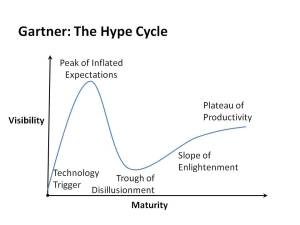
Gartner's Hype Cycle is a well known framework for understanding technology adoption.

Gartner’s Hype Cycle is a well known framework for understanding technology adoption.

The Gartner Hype Cycle is a great framework for explaining new technologies and how they are adopted.  We’re still really bad at forecasting most technologies, but with many areas of IT, particularly those that are more consumer focused, we’ve gotten better at understanding when something is over-hyped and hasn’t yet reached its full potential.

Industrial technologies move slowly.  It takes them longer to get adopted and it takes them longer to reach the plateau of productivity – the point at which they are no longer viewed as ‘new’ and at which point they are as widely adopted as the early promoters had anticipated they would be.
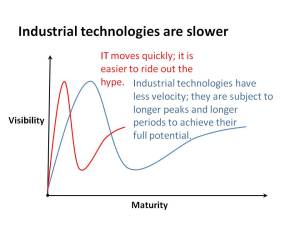
Industrial technologies move slower than information - that makes their progression through the hype cycle slower as well.

Industrial technologies move slower than information – that makes their progression through the hype cycle slower as well.

There aren’t many playbooks for how to win in industrial technologies.  Because they are slow moving their adoption often spans the careers of many individual contributors.  We know the stories of the great winners like Ford, Edison or Wallace Carothers with Nylon.  But even though the automobile, electricity and modern chemistry are at their heart industrial goods with heavy industry behind them – much of their success came from identifying consumer markets with low price point high performance goods that benchmarked well to current consumer needs.  Ford beat out the horse and buggy with improved reliability and speed.  Edison brought light to the home that was cheaper and far safer than the dangerous gas lighting of the time.  Military needs gave Nylon its market share, but improved durability gave the polymer its initial beachhead market in ladies stockings.

What is that beachhead market and application for 3D printers?  Enthusiasts and hobbyists don’t fit the modern definition of a market – as defined by Moore’s Crossing the Chasm as buyers who can reference one another in a known application.  Right now there is no clear market fit for 3D printing – it is a lower capex option for people who need to make extruded products for low quantity or custom product runs.

It looks very pretty, but it is a long way off from being practical.

3D printing’s strengths are in areas where there aren’t many products – it enables things that are intriguing, but not immediately useful.  Every article you see shows a pretty trinket or references high end toy manufacturing.  Baubles are not markets.   For 3D printing to make it, there will need to be reference designs, known good products and eager end markets that require its use.

My prediction is that it isn’t until 2025 that 3D printing products are in regular use in automobile lines selling over 50,000 units per year or electronic goods selling over 200,000 units per year.  With a lot of work and good fortune, management of these printers might be able to pull that in by 8 years at the most.

March 2013 Update

There have been several other blog posts outlining and/or agreeing with this thesis, although their continue to be many that believe 3D printers are the next “Big Thing.”  This post by @JonasBentzen outlines the challenges created from size and the numerous types of raw material inputs needed.  Make Magazine – which is a frequently cited proponent of 3D printers is doing the best it can to dampen the wild oscillation of the Hype Cycle with this article about the Complex Reality of 3D Printing.  Make cites the difficulties of learning CAD software, the challenges of mechanical engineering and the same challenges of multiple materials inputs referenced in the Jonas Bentzen blog.

April 2013 Update

Here’s a great GigaOm article titled, “3-D Printing: Putting a Factory on Every Corner”, in which the author makes use of some great research by Gartner showing that the costs of the printing setups will fall dramatically through 2016.   What the author misses is that factories require inputs and complex supply chains – for us to find 3D printers on every corner in 3 years, we’ll need logistics and IT infrastructure that can get raw materials of sufficient quality to each of those printers.  The infrastructure for this vision to be achieved is still a long way away.

June 2013 Update

“3D Printing Arbitrage is the New Hotness” screams a June 21 TechCrunch article which provides some insight into the current state of the industry.  Shapeways is focused on being vertically integrated.  MakerBot has an estimated 22,000 units in the field.  Major retailers like Tesco and Staples are discussing putting units in their stores, similar to the way they brought in conventional paper copying and printing activities.  The article focuses on businesses that are attempting to earn revenue by matching those in need of 3D printing services and those who have the printers – no mention is made of what kinds of things they’ll make.

Interesting addition from Tech News Today, Episode 784, a video report (below) that mentions that there are many 3D printers at a Microsoft hosted event, “but are these just going to go the way of the 3D television?”  The hosts were enthusiastic this wasn’t the case – with Iyaz Akhtar stating, “3D printers will be like the photograph printers – some people will have them, but a lot of people won’t.”


Posted in Business, Disruption, Industry, Innovation, Invention, Materials Science | Tagged , , , , , , , | Comments Off on 3D Printing: Not Past the Hype Until 2025

New and Improved is Coming to Advertising

20120624-180906.jpg

Sean Connery as Duke Anderson.

The Anderson Tapes, a 1971 crime thriller, foresaw the impact of a surveillance society, and in the introduction to our protagonist thief Duke Anderson, he exclaims, “What is advertising but a legalized con game?” With the myriad of tools now in the hands of anyone working in marketing, abuse of advertising appears to be on the rise.

Modern advertising is frustrating in several ways.

1. Vague claims. “New and improved” has been replaced by, “Improved performance.” Precise quantification of such claims is often hard to nail down. Working with industrial technologies it is common for more common materials which are sold between businesses to have very vague claims associated with them. There are times early in the life of a new product where it is difficult to quantify performance, however, continuing to make vague claims should be considered an indicator that the product has not matured and that the maker of the good is itself uncertain of the value that customers place on their product.

2. It increases the price of things I’m already planning to purchase. Expensive advertising campaigns add to the cost of goods; removing that cost could instead be passed on to customers to lower their cost of ownership. (I’ve talked about this in financial services here.) If a customer is searching on line for new shoes, advertising which clearly helps alert them to technical differences between products is valuable; a 5 minute branding campaign is much less so. Look to examples like Costco, who know that the 2% savings they can pass on to customers by minimizing advertising add up over the long term.

Mizuno makes a great running shoe; even with a specific search it can be tough to find on major sites.

3. Clutter. Ads, be they billboards, posters about town, videos on Youtube or elaborate online campaigns don’t go away. Digital clutter is clearly easier to avoid, but it confuses search results and makes it difficult to understand the status of a current product. Even looking at Amazon, which is extremely well organized, for a product as simple as a shoe demonstrates this problem. Even with a very specific search older products are thrown back in the result pool. Anyone who has spent time in developing countries is familiar with the difficulty of interpreting which businesses are at a physical location; the hundreds of old signs covering a business can make it difficult to tell what is being sold, even if the owners are inside.

4. Branding often gets in the way of technical clarity. In its early days Salesforce.com made a push by encouraging customers to make use of the ‘blowfish effect.’ Small customers could use online services, like professional logo design, hosted email, CRM tools, and outsourced receptionists to look bigger than they were. Flashy branding costs much less to develop than quantifiable benefits and technical bench-marking to competitive products.

For now, companies are able to get away with simply pushing their materials in front of customers and ignoring the troubles caused by these points. It’s okay to simply distract and attract, rather than creating quantifiable reasons for a customer to switch to your product. That trend won’t continue.

Over the coming years the increases in computing power and an increasingly savvy public will make it possible to sell quantifiable value to the public. The methods won’t always be perfect, and many charlatans will abuse the new tools, but the days of “New and Improved” are behind us.

Posted in Uncategorized | Comments Off on New and Improved is Coming to Advertising

Nonwovens and Battery Anodes: Applying the Materials Science Framework

Callister on Amazon.com.

Dr. Yi Cui of Stanford and founder of battery company Amprius, recently published a paper outlining a new structure for battery anodes.  Graphite is the most commonly used anode material, durability constraints have prohibited adoption of silicon, despite the fact that silicon should in theory improve battery performance when incorporated into the anode.  Historically, silicon anode material has been too fragile.  The thermal cycling of battery charging and energy dissipation has caused the anode materials to crack, shortening the life of any battery that used silicon anode materials.

Let’s break down the components of Dr. Cui’s material using the standard materials science framework used in Callister.  Process => Structure => Properties => Performance.

Process

Popular press coverage rarely contains any kind of detail on the process by which new materials are made.  We’re fortunate here to have a well-written scientific article and some good detail from Physorg.  First, sacrificial polymeric nanofibers are formed.  Nanofibers are commonly used in porous materials as they are known to have very high surface area, have a large body of scientific literature and numerous industrial scale production methods (see youtube video below for an example).  Polyacrylonitrilie (PAN) is commonly used as a polymeric precursor if the goal is to produce carbon nanofibers.  Second, the polymeric nanofibers are heated to the point of oxidation – at which point they have been reduced to carbon.  This is a common method of manufacturing carbon nanofibers – they will typically have 70% of the fiber diameter of their polymeric precursor.  Determining the correct thermal ramp and cooling process to get the desired material requires significant attention.  The remaining carbon nanofibers are able to survive the third step, in which silicon is deposited into the carbon scaffold.  In the fourth and final step, the carbon is removed through what is loosely described as a ‘hot air process.’

Structure

The resulting anode structure is described in Dr. Cui’s paper as a, “Double-walled silicon nanotube”, or DWSN.  Equally important to the structure of the individual nanotube, is the structure formed by the nanotubes.  Here, we can look at the nanofibrous antecedent to get a feeling as to how the DWSNs are laid out.  Most nanofiber processes are known to produce a nonwoven nanofibrous mat; the fibers are randomly aligned.  The fibers can be built up to varying levels of thickness, depending on the end performance target.  The heat-based formation of the DWSNs most likely moves the material from feeling like a synthetic mat, or membrane, to behaving more like dust or powder.  The DWSNs are likely formed into microscopic flakes with nano-scale surface area.  It is these flakes, or powder, that are then used to create the anode structure within the battery.

Properties

The primary property which will enable the DWSN to work well as an anode is its electrical performance within the battery.  Also important, given that it has historically precluded silicon’s use in anodes, is the thermal performance of the material. The DWSNs must survive normal battery operations without experiencing the cracking and structural degradation historically associated with silicon based materials.  From a product development and marketing standpoint, this is an important new criteria; the DWSNs must; (1) perform as well as or better than other anode materials within the cell, (2) must show the promised superior performance of silicon to graphite, and (3) accomplish all of this without showing the historical weaknesses of silicon.

Performance

Exhibit from Dr. Cui’s paper.

The final component is performance – how does the new material perform?  From this standpoint, we should focus on performance in system.  Does the battery’s performance improve with the presence of the new material?  How does it improve?  Dr. Cui’s paper touts that the anode is able to cycle over 6,000 times while maintaining over 85% of their initial capacity.  This is a significant performance advantage over current materials.

Scaling and Complexity

The two greatest challenges to commercial realization of the improvements offered by DWSNs are scaling challenges and the inherent complexity of a battery system.  Batteries are often initially tested as coin cells – those tiny little batteries used in watches and hearing aids.  One of the major challenges in the performance of electric vehicles (“EVs”) has been that the size of batteries needed is much, much larger.  Batteries have moved from coin cells to notebooks to now car trunks.  The challenges encountered at making DWSNs at manufacturing scale may hinder their performance, make them economically unattractive or, if we’re lucky, it may work perfectly.

It’s a long way from an improved anode to a vehicle with improved performance at a charging station at an affordable price.

The components required to innovate within a new battery are significant.  The parts are numerous; anode, cathode, separator, electrolyte, package, control system, end application and socioeconomic system.  The increased focus on cleantech and energy technologies has led to innovation throughout this system – this is great in that many new options are available, but it is also difficult to coordinate all of these new materials and the various entities and organizations which have created them.  Innovation in materials science takes a long time, much longer than it takes in software.  Dramatically increasing the number of options available increases the amount of physical product testing required to confirm performance.  To reach their end market DWSNs must be the winning component within the winning battery within a socioeconomic system that enables their success.

Posted in Disruption, Innovation, Invention, Materials Science, Textile | Comments Off on Nonwovens and Battery Anodes: Applying the Materials Science Framework

Quick Statistics on NC Amendment 1 Voting by County

Here are some quick graphs from the voting on NC Amendment 1.  The Amendment declares marriage to be between, “A man and a woman,” thereby making matrimony and civil union the exclusive domain of heterosexual couples.

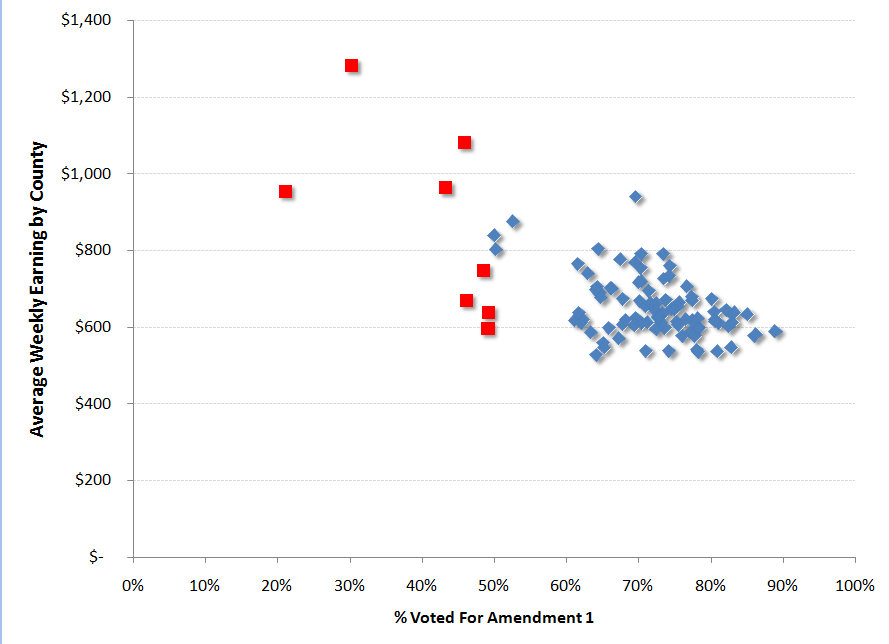
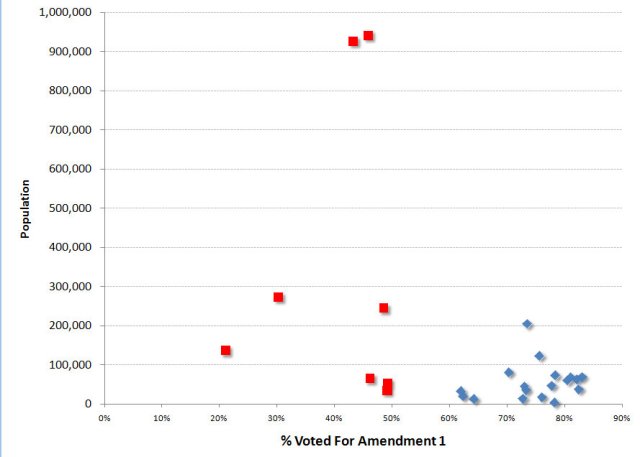
Red denotes the eight counties that voted against the amendment (I include Dare, however it looks like they will wind up being for).  These eight counties represent; (1) the highest weekly wages, (2) the largest counties, and (3) those that have experienced the largest population growth.

Graph 1 shows “% of County that Voted for Amendment” on the y-axis and “Average weekly wage” on the x-axis.  The average weekly wage data came from this August 2011 BLS press release.

Average weekly wage vs % of county voting for NC Amendment 1.

Graph 2 again starts with “% of County that Voted for Amendment” on the y-axis, but the X-axis is population from a provisional state estimate made in 2011.

County population vs % of county voting for NC Amendment 1.

Graph 3 is anchored again with “% of County that Voted for Amendment” on the y-axis, but the X-axis is growth in population by count from 2010 – 2011 from the same provisional state estimate made in 2011.

Posted in Uncategorized | Comments Off on Quick Statistics on NC Amendment 1 Voting by County

Corona and the U-2; The Components of Strategic Reconnaissance

Re-entry parameters for Corona film capsules.

President Eisenhower had granted the U-2 team at the CIA significant leeway in making their first flights in 1956; after over-flying Moscow and St. Petersburg in their first sorties on July 4 following Kruschev’s visit to the American Embassy the Soviets were very upset. The USSR had detected the U-2, despite initial beliefs that this would not have been possible.  However, the photographic analysis system that the CIA had put in place brought significant value from the flight – Eisenhower wanted more information but without the political risk.

The US was caught in a paradox; the strategic reconnaissance flights could not continue, but the information derived was extraordinarily value in the developing Cold War.  When the team at the Baikonur Cosmodrome put Sputnik into orbit on Friday, October 4, 1957 and the doctrine of space overflight was established, the answer became clear.  The US would commence the Corona program, directed by the CIA, which would utilize the system, cameras and films developed with the U-2, but make use of an orbital, rather than airframe, platform.

Re-entry and film recovery was a crucial component in enabling Corona.

Corona wasn’t the US’s first foray into satellite reconnaissance.  For years the US Air Force, following guidance from the RAND Corporation had pursued the WS 117L; a theoretical satellite platform far more advanced than what the initial Coronas would deliver.

The WS 117L was much more complex; (1) it developed the film in orbit, (2) that film was then beamed down via advanced electronics components and television systems, (3) over encrypted signals, to (4) a wide array of receiving stations.  Corona was far more simple and benefited from an advance Eisenhower showed the world on television; a re-entry vehicle.  The US had developed much more reliable methods of re-entry than the USSR.  By using less aerodynamic shapes which slowed re-entry and sacrificial layers which burned off to reduce heat, the US was confident it could not only send objects into orbit, but retrieve them as well.

The components which enabled the U-2, Corona and blocked the WS 117L.

To get to Corona, which was the right form factor and platform, two types of sub-components had to be identified.  First; the benefits of the systematic photographic analysis of the U-2 had to be realized.  This system, as seen through the eyes of President Eisenhower, was an enabling precursor.  It paved the way to see the value of strategic reconnaissance.  Equally, if not more, important was the development of a re-entry vehicle.  This system would allow film to be sent from the satellite platform and be retrieved over the Pacific Ocean.  These two enabling precursors allowed Corona to come into existence.

Second, impractical and blocking components in the WS 117L had to be avoided.  Without a re-entry vehicle (which had not been developed at the time of the initial RAND report), photos had to be developed in orbit and then transmitted to Earth via television signals.  This required a broad network of receiving stations (difficult to do and maintain secrecy) and encryption software; both of which were costly.  At this time the US had the benefit of having been an innovation participant, as opposed to an innovation observer.  As a participant, President Eisenhower and the CIA knew what was valuable and what was not. the casual observer could not know that the film packet, using the photographic and film systems devised for the U-2, when put in Corona, would be exceptionally valuable.  Because the US had attempted, engineered and developed solutions to the known problems as an actual innovation participant, they were able to make use of their knowledge to drive value in a situation that others would not have recognized.

Update: July 2013

Without rendezvous, a Soviet moon landing would have required at least two space-walks.

Without rendezvous, a Soviet moon landing would have required at least two space-walks.

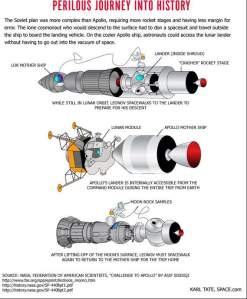
In the US space program, it was believed that the early refinement of rendezvous; the art and science of getting two objects to contact each other while in orbit, provided strategic advantages to those programs that hadn’t explored this capability.  Rendezvous was Buzz Aldrin’s field of study  This is illustrated by this Space.com infographic which outlined how the Soviet moon landing method required five stages, compared to the US’s three, as well as a space walk to access the moon lander by the lone cosmonaut.

Posted in Aerospace, Innovation, Invention | Comments Off on Corona and the U-2; The Components of Strategic Reconnaissance

The Textile Supply Chain

Like most mature industries, the textile supply chain is large and complex. Materials which the lay person might view as substitutes can have dramatically different end applications. The savvy industry participant can sell the same good to different end users with exponential differences in pricing.

Please excuse my pencil and graph paper first attempt.

There are six major parts of the supply chain;

  1. Raw materials. The major categories are; Agricultural, Synthetic and Other.
  2. Fiber formation. Here our major categories are; Yarn, Staple and Other.
  3. Rolled good formation. This is an area which accounts for the major differences between manufacturer – there are four main categories; Mechanical (Wovens and Knits), Paper/Wetlaid, Nonwoven, and Other (including Membranes).
  4. Rolled good treatment. This step is present mainly because of the historical importance of Dyeing and Finishing to the conventional textiles industry. Plasma and Other are also important categories. (Perhaps these categories should be divided into Wet and Dry.)
  5. Composite assembly. The primary categories here are; Lamination, Adhesive and Calendar.
  6. End application. End applications are split into two primary buckets; Conventional Textiles (Apparel and Household – any fabrics where fashion components are a primary ingredient in their selection), and Technical Textiles (here I frequently make use of the categories used by Techtextil).

One of the major activities within the industry over the past 50 years has been the introduction of nonwovens at industrial scale. By integrating the fiber formation and rolled good step and making use of polymers as a new source of raw materials; these fabrics were produced at much lower costs to their competitors. This allowed them to win many markets where cost was a primary concern by replacing cheap wovens and knits. Areas such as b-surfaces in vehicles, blankets and bedding where fashion was not an important element (such as on airplanes or mattress / furniture interiors) and the rag markets were quickly won over.

These nonwovens then went on to enable new markets; improved filters, as part of layers in increasingly sophisticated hygiene products, and finally wet wipes – a category which had previously not existed.

For the next 50 years the complexity of the industry will create opportunities for those companies capable of; (1) identifying the right end markets, and (2) the right spots in the supply chain to insert new production methods. Finally, as new materials come to the market, the importance of composite assembly will grow in importance. As new kinds of rolled goods come to market, they will show that they can be combined with other materials to enable best-in-class performance across a wide array of customer specifications.

Posted in Industry, Materials Science, Textile | Comments Off on The Textile Supply Chain

Disruption Promoters vs Actual Disruptors

RC_BusinessDisruption

Disruptors disrupt. Promoters improve the probability of a disruptor disrupting.

A disruption promoter is a facet of an activity that is believed to be disruptive; but that is viewed ex ante.  Since the event is ex ante, it is unknowable whether or not it will actually be disruptive.

A disruptor is a disruptive event, activity or endeavor.  It disrupts.  All disruptors fit into one of several buckets.  Historically, when mankind views an event as disruptive, it is from one of these categories.

Disruption Promoters (12):

  1. Insertion
  2. Penetration
  3. Compound / Geometric
  4. Emergent behavior
  5. Asymmetry ($s or Time)
  6. Cross application
  7. Paradigm shift
  8. Persistence / Longevity
  9. Secrecy
  10. Fragmented supply chain
  11. Social acceptance
  12. Reverse compatibility

Disruptors (10):

  1. Automation
  2. Calculation
  3. Communication
  4. Measurement / Instrumentation
  5. Mechanization
  6. Miniaturization
  7. Simplification
  8. Standardization
  9. Transportation
  10. Weaponization
Posted in Disruption, Innovation | Comments Off on Disruption Promoters vs Actual Disruptors

U-2 Spy Plane and a Component Theory of Innovation

RB-57 showing wider wingspan than its B-57 progenitor.

RB-57 showing wider wingspan than its B-57 progenitor.

Following World War II, during the presidency of former Supreme Allied Commander Dwight Eisenhower, the US faced a defense and security issue previously unknown to mankind.  The combined invention of the atomic bomb and long-range bombers, and the accelerating pace of development of rocketry meant that it was possible for a surprise enemy attack to wipe out their civilization.  The next Pearl Harbor would not destroy our military; it would stop our culture.

Further compounding this problem was the culture of the enemy – the USSR.  America was an open society; it was assumed that Soviet intelligence was able to travel the country and make estimates of what US capabilities were through conventional espionage.  The same was not true of the Soviet Union’s closed, totalitarian state.  This created the backdrop for an urgent need for new tools to conduct strategic reconnaissance.

A B-47 in take-off.  From Wikipedia.

A B-47 in take-off. From Wikipedia.

Previously, reconnaissance flights into the Soviet Union were conducted by conventional airplanes.  They were modified B-47s or B-57s.  Unfortunately, they were not optimized for their newly defined need.  What was needed was a strategic reconnaissance aircraft; and to achieve that several components were needed.

Four components were required to create the correct strategic reconnaissance aircraft;

  1. An airplane that could carry the correct equipment and match the mission requirements.
  2. A camera capable of photographing at the appropriate resolution during the mission.
  3. Film which met the mission requirements.
  4. A system which allowed and made use of the results of the strategic reconnaissance missions.

Each of these components then have their own sub-components.  For the airplane, it must include whichever inventions allowed it to be capable of;

  1. Carrying at least one crew member (at the time, pilots were required).
  2. Flying at altitude of over 60,000 feet (20 km) to avoid anti-aircraft missiles.
  3. Carrying the camera payload.
  4. Continuous flights over large swaths of the Soviet Union without refueling.  
  5. Existing in a socio-political system which made use of its strategic reconnaissance traits.  
Photo of a U-2 with a variety of mission payloads.The answer to all of these was the U-2 spy plane – which itself was the predecessor of the US’s fleet of strategic reconnaissance satellites.  
Posted in Disruption, Innovation, Invention | 1 Comment

Disruption: Planetary Resources Wins

An image of Planetary Resources’ Arkyd-class satellite.

Planetary Resources, with its roster of all-star billionaire investors and audacious business plan of mining asteroids has garnered significant press since emerging into the public’s eye.  My business crush on this company is comparable to my 2001 infatuation with Salesforce.com; this will be one of the most disruptive commercial ventures created in the next ten years.

There are ten factors that predict how disruptive an invention, activity or business can be;

  1. Automation: Is a previously difficult process now made easy to repeat? [4/5]
    PR is planning to search for and identify near-Earth asteroids (“NEAs”).  This activity is currently pursued by many groups independently with common data repositories, but trust that this team will look to automate this detection to the highest degree possible.  Just like Craig Ventner’s team sequencing the genome; this team will automate the detection and identification of valuable NEAs.
  2. Calculation: Is it possible to conceive of or calculate previously unknown values or do so with greater speed and accuracy? [0/5]
    While I’m sure PR will be best in class here; I don’t think it is an area where they will score very high.
  3. Communication: Does the activity improve the speed and accuracy of communication?  [4/5]
    PR has intimated that their Arkyd series of satellites and their successors could serve as communication relays between Earth-bound receivers and outer space.  NASA could use such receivers to supplement their current communication with existing outer space probes.  Just like Western Union telegraph poles crisscrossing the great plains; these satellites will change the speed and accuracy of outer space communications.
  4. Measurement / Instrumentation:  Does the disruption improve the ability to measure, study or make known the previously unknown?  [5/5]
    NEAs are known to mankind; we know they are potentially incredibly valuable and also potentially deadly to our planet.  However, we don’t know much more beyond that.  Any NASA report that discusses NEAs invariably talks about how such activities are dramatically underfunded.  By quantifying and measuring the number, composition and harvest-ability of asteroids, PR will change the way we look at that part of the solar system nearest to Earth.
  5. Mechanization: Can a process previously driven by personnel be made repeatable by machinery? [2/5]
    Our usage of robotics and drones has surged in the past decade.  When rumors of PR’s business model began to circulate in mid-April; no one imagined an Apollo or shuttle-style team launching into space and wrangling asteroids.  We pictured the one part of PR’s business that is still the most distant; using probes and droids to identify and move asteroids into position where their resources can be easily made use of.
  6. Miniaturization:  Is the disruption dramatically changing the size of a component?  [1/5]
    Since the first flights by the Wright brothers, any activity which involves leaving the surface of the Earth has a ruthless discipline towards weight.  Even with the huge advances made possible by Elon Musk’s team at SpaceX, miniaturization will be a key component to ensuring the success of the Arkyd line of satellites.
  7. Simplification:  Does the disruption reduce the complexity of an activity?  [1/5]
    To the extent that someone in search of orbital resources in 2012 will be able to call PR, rather than assemble a list of satellites from various state agencies, then yes, simplification here will be significant.
  8. Standardization:  Does the activity create platforms of standardization?  [3/5]
    Standardization in this phase of innovation and invention is as much about creating a common language of describing what you are doing.  In the Wright’s letters with other early aeronautic pioneers they spent as much time crafting a common language to describe their activities as they did comparing the resulting measurements.  This will be a huge area where the creation of PR enables disruption.  Further , standardization of the designs and components of the Arkyd satellite will allow new advances in how these systems are built and used.
  9. Transportation:  Does the disruption enable a change in the distance and speed of transport?  [5/5]
    You can’t get much further away than NEAs (despite the fact that they are ‘near’).  PR will address moving large quantities vast distances.  The implications are significant; it is foreseeable that the freight charges per ton for the right NEA could be less than current ocean-going shipping costs on-planet.
  10. Weaponization:  Can the disruptive activity potentially be weaponized?  [5/5]
    Disruption often comes at the end of a muzzle; it is important to understand the potential destructive capability of a PR-controlled NEA.  For PR, this will be an important aspect to navigate from a socio-political standpoint.

With ten categories, each judged on a five-point scale, of how likely is an activity to be disruptive; PR scores a 30/50.  This is extremely high for a commercial entity.  Using similar scoring for other activities; the Wright flyer is a 35 and the US’s move into spy satellites and strategic reconnaissance to cope with the USSR in the 1950s is a 32.

June 2013 Update:

Several members of the Planetary Resources team have done an AMA on Reddit.

Posted in Business, Disruption, Innovation | Comments Off on Disruption: Planetary Resources Wins

Andreessen Horowitz’s Missed Opportunity to Change VC Fee Structure

The fees that LPs pay to venture capitalists will only change if a top-tier VC fund volunteers to give its investors a discount.

We’ll never know what would have happened had Andreessen Horowitz taken a different tact with their donations to charity announcement and instead offered their investors a discount on fees.  Fees and creating the right incentive alignment between LPs and GPs remain a lightning rod in the illiquid alternative universe in which venture capital operates.  Had AH dropped their fees and carry by half to a 1% fee base / 10% carry vehicle (assuming this got them to their “1/2” target of donations); it would have been the Waterloo which would force other VCs to react and thereby changed that industry forever – a bigger deal by far than the Instagram exit.

GPs don’t currently compete on pricing; groups that offer discount are instead viewed as signaling that they are of a lower quality and are unable to attract LP commitments.  If a group of AH’s caliber and reputation had offered a discount on fees and carry, other GPs, given the tough fund raising environment, would have been forced to react.

Instagram and Charity

There are two types of investment mistakes a fund can make; they can write a check into a company that turns out to be a bad deal (believe the deal is good, deal turns out to be bad), a classic Type 1 error in statistics.  The other kind of mistake is to pass on a deal that turns out to be good; one of my favorite professors at Kenan Flagler would reminisce about how he had passed on investing in AOL while at USVP.  This is a Type 2 error – you believe the deal is bad and it turns out to be good.

They should add some dollar bills.

Most VC Type 2 errors never see the light of day.  It is difficult for LPs to diligence which deals a GP has passed on, and usually the timeframe it takes to get proven wrong prohibits that information being relevant to any investment in a new fund.

Andreesen Horrowitz’s decision to not re-up with Instagram due to similarity to a sister portfolio company is completely reasonable and happens all the time.  It was a good business decision which prevented a good financial decision from becoming a great financial decision.  It is unusual for that bad decision from a financial standpoint to arise so quickly and publicly; the New York Times article thoroughly walked through that impact shortly after their $1 Bn exit to Facebook.  Afterwards AH did some unusual things, which is not shocking given that they have been an unusual GP since their inception.

The first unusual thing they did was talk about the deal – most GPs would simply have kept their mouth shut (this would have been my advice to them).

The second was that they simultaneously announced that several of the founders and their families would be giving a significant portion of their earnings from their funds to charity.  This appeared to be something that had been in development for quite some time, however, with the timing of the announcement it also looked like AH was trying to use this to combat any negative press from the Instagram / NY Times article.

I am not personally an LP in AH, nor have I had any on-the-record conversations with LPs who are; however, if this were me on an LP advisory board and a fund did something similar, it wouldn’t sit well. The GP is basically saying, “we’re going to make so much money off of this vehicle, that we are going to announce right now that we don’t need all of it.”  In that circumstance, it would seem wise to perhaps offer a discount, or reduction in fees, to the investors (aka customers) who put you in business in the first place.

The timing of this announcement also seems poor; if I were an LP that had just committed to AH’s most recent, much larger fund, I would want to have learned about this decision prior to making a commitment to their fund.  If this had been in the works for a while, it would have been a good item to share and a major signal to LPs who may now be in the position of explaining this commitment to their investment committees.  For all I know, AH did all of the above, offered fee discounts, etc. and their LPs were fine with it.

Change VC Fees Forever

“Forever? Forever-ever-ever.”

GPs don’t compete on pricing.  Having personally reviewed over 2,000 funds, any group that attempted to provide their LPs a discount as an incentive to invest merely wound up signaling that they were a lower quality group.  It was extremely unusual to see groups charge less than 2/20; I recall fewer than five – none of which were able to raise a fund to my knowledge.  For different types of entities, such as co-invest or special purpose vehicles, other fee structures such as 1/5 or 1/10 are more common.

AH missed a golden opportunity to change fee discounting from being a negative indicator of quality to an opportunity for their LPs to make their own, tax-advantaged commitments to charity.  For those charities that are LPs, this clearly would have been attractive.

AH’s impact on the Valley’s venture capital landscape has been significant.  They are a new entrant who has raised significant capital, attracted top tier partners with long histories in the market and done so during a time period when most of their peers are struggling to raise money.  They did this not by rising through a firm and growing from principal to partner and showing long maturation over time, but by bringing fresh new ideas to an industry that has been resistant to change.  Other GPs are clearly intimidated by their ability to attract the top companies and also significant investments.   Had AH changed their compensation structure, other funds would have been forced to react to that change and the ripple would be dramatic.

Hopefully another opportunity presents itself to change how that industry is compensated and another GP of AH’s caliber will be able to act on it.

Posted in Illiquid Alternative, VC | Comments Off on Andreessen Horowitz’s Missed Opportunity to Change VC Fee Structure