Carnegie 29.4.8: How to Win Friends and Influence People – PRINCIPLE 8 Use encouragement. Make the fault seem easy to correct.

Carnegie 29.4.8: How to Win Friends and Influence People -PRINCIPLE 8 Use encouragement. Make the fault seem easy to correct. – Make the Fault Seem Easy to Correct

Pages 272 – 276

Earlier on Page 110 we learned that Dale Carnegie does not play bridge – so it is a relief to find the callback in this chapter on Page 273 that he has set out to learn.  The world is full of challenges, it is important to encounter them with grace.  If a leader falls down and panics, then it is unlikely others will keep following them once composure is regained.

Best Quote(s)

“He gave you confidence, inspired you with courage and faith.” Page 273

Page by Page Review

Page 272

“‘You have a natural sense of rhythm,’ she assured me. ‘You really are a natural-born dancer.’”

Page 273

“But use the opposite technique—be liberal with your encouragement, make the thing seem easy to do, let the other person know that you have faith in his ability to do it, that he has an undeveloped flair for it—and he will practice until the dawn comes in the window in order to excel.”

“He gave you confidence, inspired you with courage and faith.”

“And presto, almost before I realized what I was doing, I found myself for the first time at a bridge table.”

274

“I encouraged this and pointed out that he needed math to qualify for the training. I decided to help him become proficient in this subject. We obtained four sets of flash cards: multiplication, division, addition and subtraction. As we went through the cards, we put the correct answers in a discard stack.”

275

“Suddenly he discovered he could really learn and accomplish things.”

Was it really sudden? No.

276

PRINCIPLE 8 Use encouragement. Make the fault seem easy to correct.

Posted in Books, Carnegie | 1 Comment

Carnegie 28.4.7: How to Win Friends and Influence People – PRINCIPLE 7 Give the other person a fine reputation to live up to.- Give a Dog a Good Name

Carnegie 28.4.7: How to Win Friends and Influence People – PRINCIPLE 7 Give the other person a fine reputation to live up to.- Give a Dog a Good Name

Pages 267 – 271

Carnegie’s chapter title refers to an ‘old saying’ that I’d never heard.  The best quote of the chapter is from Shakespeare, “Assume a virtue, if you have it not.” The focus of the chapter is to project onto others the virtue you wish they had.  This works as long as the other person has the inclination and the capability to follow your lead.

This rule – like much of Carnegie’s guidance – can fail spectacularly if the other person receiving the projection is not interested.

Best Quote(s)

“Shakespeare said, “Assume a virtue, if you have it not.”” Page 268

Page by Page

Page 267

“Mr. Henke had given him to live up to, how could he do anything else but turn out work comparable to that which he had done in the past.”

Page 268

“Shakespeare said, “Assume a virtue, if you have it not.””

“Give them a fine reputation to live up to, and they will make prodigious efforts rather than see you disillusioned.”

269

“I have respected the fact that you are always willing to listen and are big enough to change your mind when the facts warrant a change.”

270

“There is an old saying: “Give a dog a bad name and you may as well hang him.” But give him a good name—and see what happens!”

271

“With that reputation to live up to, even a nine-year-old couldn’t let her down—and he didn’t.”

PRINCIPLE 7 Give the other person a fine reputation to live up to.

Posted in Carnegie | 1 Comment

Carnegie 27.4.6: How to Win Friends and Influence People – PRINCIPLE 6 Praise the slightest improvement and praise every improvement. Be “hearty in your approbation and lavish in your praise.” – How to Spur People On to Success

Carnegie 27.4.6: How to Win Friends and Influence People – PRINCIPLE 6 Praise the slightest improvement and praise every improvement. Be “hearty in your approbation and lavish in your praise.” – How to Spur People On to Success

Pages 261 – 266.

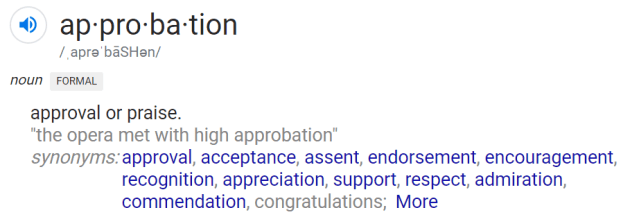
Tell people you appreciate them.  Help them understand how their work helps achieve a greater goal.  We’re nearing the end of the book, and that leads to denser writing and the selection of three quotes.  The first applies to the primary lesson – but the second two are higher level and reflect how to make the most out of reading the book.  They hearken back to the preamble where Carnegie paced the reader with ‘9 Suggestions on how to get more out of this book.

Approbation

He also makes a very bold statement that we only achieve a portion of what we are capable of doing – he is appealing to nobler motives and also throwing down a challenge.

Best Quote(s)

“He pointed out exactly why it was superior and how important the young man’s contribution was to the company.” Pg 264

“Let me repeat: The principles taught in this book will work only when they come from the heart.” Pg 265

“Compared with what we ought to be, we are only half awake.” Pg 266

Page by Page

261

“I noticed that the moment a dog showed the slightest improvement, Pete patted and praised him and gave him meat and made a great to-do about it.”

262

“He was so thrilled that he wandered aimlessly around the streets with tears rolling down his cheeks.”

Carnegie describes, “B. F. Skinner’s teachings. This great contemporary psychologist has shown by experiments with animals and with humans that when criticism is minimized and praise emphasized, the good things people do will be reinforced and the poorer things will atrophy for lack of attention.”

264

“He pointed out exactly why it was superior and how important the young man’s contribution was to the company.”

265

“Everybody likes to be praised, but when praise is specific, it comes across as sincere—not something the other person may be saying just to make one feel good.”

“Let me repeat: The principles taught in this book will work only when they come from the heart.”

266

“Compared with what we ought to be, we are only half awake.”

PRINCIPLE 6 Praise the slightest improvement and praise every improvement. Be “hearty in your approbation and lavish in your praise.”

Posted in Books, Carnegie | 1 Comment

Carnegie 26.4.5: How to Win Friends and Influence People – PRINCIPLE 5 Let the other person save face

Carnegie 26.4.5: How to Win Friends and Influence People – PRINCIPLE 5 Let the other person save face.- Let the Other Person Save Face.

Pages 257 – 259

Carnegie borrows directly from Sun Tzu’s “The Art of War” in Chapter 7, where Tzu says, “36 When you surround an army, leave an outlet free. Do not press a desperate foe too hard.”  Does that extra amount of emphasis really need to be used?  If your point is made sufficiently, do you improve your team’s performance by berating someone who has already admitted a mistake?

Carnegie is giving counsel on how to avoid creating enemies, and how to avoid creating scenarios where those watching your behavior would be disappointed in your actions.  Leadership is as much about creating positive scenarios (growth, challenge, development) as it is about avoiding negative ones (petty behaviors, resentment, distraction).  Don’t let personal behaviors create distraction.

Make your point and move on.  Avoid the perception of cruelty.

Best Quote(s)

“Whereas a few minutes’ thought, a considerate word or two, a genuine understanding of the other person’s attitude, would go so far toward alleviating the sting!” Page 257

Page by Page

257

“Whereas a few minutes’ thought, a considerate word or two, a genuine understanding of the other person’s attitude, would go so far toward alleviating the sting!”

258

“Effect? The people go away feeling a lot better about being fired.”

259

“I left that meeting with my head up in the air and with the determination that I would never let that boss of mine down again.”

PRINCIPLE 5 Let the other person save face.

Posted in Books, Carnegie, Methods | 1 Comment

Carnegie 25.4.4: How to Win Friends and Influence People – PRINCIPLE 4 Ask questions instead of giving direct orders.- No One Likes to Take Orders

Carnegie 25.4.4: How to Win Friends and Influence People – PRINCIPLE 4 Ask questions instead of giving direct orders. “No One Likes to Take Orders”

Pages 254 – 256

When a decision is required and urgency rules the day – generals give orders.  How should leaders act when there isn’t a clear field of battle?  Groups make the best decisions when there is a broad range of input from a diverse team.  They make the best decisions because such a group fields a broader range of ideas, and then with that diversity, there is better dialog leading to the best decisions.  Often time those best decisions are combinations or derivatives of ideas where many people are the owner.

Carnegie is laying the ground for this style of participatory group leadership.  As with all of the other examples, his focus is on 1-on-1 examples.  Teams do the best when everyone is excited to share their opinion.

Shouting out orders without the input of those around you is a great way to create resentment and prevent good feedback.  Barking orders is not ‘beginning in a friendly way‘, and it is certainly not encouraging the other person to talk about themselves!

Best Quote(s)

“Asking questions not only makes an order more palatable; it often stimulates the creativity of the persons whom you ask. People are more likely to accept an order if they have had a part in the decision that caused the order to be issued.” Page 255

Page by Page

254

“He always gave people the opportunity to do things themselves; he never told his assistants to do things; he let them do them, let them learn from their mistakes.”

“A technique like that makes it easy for a person to correct errors. A technique like that saves a person’s pride and gives him or her a feeling of importance. It encourages cooperation instead of rebellion.”

255

“Asking questions not only makes an order more palatable; it often stimulates the creativity of the persons whom you ask. People are more likely to accept an order if they have had a part in the decision that caused the order to be issued.”

256

“Is there anything we can do to handle this order?” “Can anyone think of different ways to process it through the shop that will make it possible to take the order?” “Is there any way to adjust our hours or personnel assignments that would help?”

PRINCIPLE 4 Ask questions instead of giving direct orders.

Posted in Carnegie, Methods | Comments Off on Carnegie 25.4.4: How to Win Friends and Influence People – PRINCIPLE 4 Ask questions instead of giving direct orders.- No One Likes to Take Orders

Carnegie 24.4.3: How to Win Friends and Influence People – Talk About Your Own Mistakes First – PRINCIPLE 3 Talk about your own mistakes before criticizing the other person

Carnegie 24.4.3: How to Win Friends and Influence People

Talk About Your Own Mistakes First – PRINCIPLE 3 Talk about your own mistakes before criticizing the other person.

Pages 249 – 253.

Carnegie builds again off of earlier points – he has already said, “If you’re wrong admit it” and the principle of the previous chapter was “call attention to mistakes indirectly.”  This chapter really combines both of these – admit your own mistakes and then use them to indirectly call attention to the mistakes of others.

If ‘mistakes’ were a concept – this is the third clear time they are a topic in the book.

  • If the mistake was yours – admit it.
  • If the mistake was that of another person – don’t call it out directly.
  • Here again we combine these bullets – admit your mistakes as a bridge to calling out the mistakes of others.

As with the previous ‘compliment sandwich’ this method is no longer as pristine as it once was.  If we position ourselves as the only one with ‘experience’ having committed mistakes, we run the risk of alienating those around us and coming across as pompous.

Avoid this risk by being sincere and humble – if you’ve made mistakes it gives you the right to help others avoid them.

Best Quote(s)

“Admitting one’s own mistakes—even when one hasn’t corrected them—can help convince somebody to change his behavior.” Page 253

Page by Page

249

“You are twice as old as Josephine. You have had ten thousand times as much business experience. How can you possibly expect her to have your viewpoint, your judgment, your initiative—mediocre though they may be?”

Carnegie has been using his own failures as anecdotes throughout the book. Here he gives it as a formal rule.

“But don’t you think it would have been wiser if you had done so and so?”

250

“It’s one of the words I always have had trouble with.”

251

“You consider me a donkey,” he shouted, “capable of blunders you yourself could never have committed!”

252

“If a few sentences humbling oneself and praising the other party can turn a haughty, insulted Kaiser into a staunch friend, imagine what humility and praise can do for you and me in our daily contacts.”

253

“Admitting one’s own mistakes—even when one hasn’t corrected them—can help convince somebody to change his behavior.”

PRINCIPLE 3 Talk about your own mistakes before criticizing the other person.

Posted in Books, Carnegie, Methods | 1 Comment

Carnegie 23.4.2: How to Win Friends and Influence People – How to Criticize—and Not Be Hated for It – PRINCIPLE 2 Call attention to people’s mistakes indirectly.

Pages 244 – 248

Carnegie has already covered mistakes very thoroughly earlier – “If you’re wrong, admit it.” Now he’s giving guidance on how to correct someone else’s mistakes – and he’s saying to be indirect.

Since 2015 the phrase ‘compliment sandwich‘ has caught on for people who follow Carnegie’s first two leadership methods:

  •  Begin with honest praise
  • Give indirect compliments

Indirect correction of mistakes is okay, if the other person is capable of grasping the indirectness.  What if they are not capable?  If they don’t grasp the technical foundation of their mistake, can they grasp the nature of their error?  What if language or cultural gaps are making the mistake worse?

Be indirect – but be prepared to be direct if needed. Carnegie is telling the reader to not be a jerk.  Don’t make them feel stupid.  But do be clear if need be.

Best Quote(s)

“Gentlemen,” he started, “you are leaders. You will be most effective when you lead by example.” Page 246

Page by Page

Page 244

“Quietly slipping behind the counter, he waited on the woman himself and then handed the purchase to the salespeople to be wrapped as he went on his way.”

Page 245

“This could be easily overcome by changing the word “but” to “and.””

Page 246

““Gentlemen,” he started, “you are leaders. You will be most effective when you lead by example.”

247

Lyman’s sermon is not good. How should his wife coach him?

“Lyman, that is terrible. That’ll never do. You’ll put people to sleep. It reads like an encyclopedia. You ought to know better than that after all the years you have been preaching. For heaven’s sake, why don’t you talk like a human being? Why don’t you act natural? You’ll disgrace yourself if you ever read that stuff.”

248

PRINCIPLE 2 Call attention to people’s mistakes indirectly.

Posted in Carnegie, Methods | 2 Comments

Carnegie 22.4.1: How to Win Friends and Influence People – PRINCIPLE 1 Begin with praise and honest appreciation.

Be a Leader: How to Change People Without Giving Offense or Arousing Resentment. If You Must Find Fault, This Is the Way to Begin.

Pages 237 – 242.

Section 4 really pivots towards use cases of all the earlier rules that have been covered, and we begin with Carnegie saying that leadership begins with praise and *sincere* appreciation.

Best Quote(s)

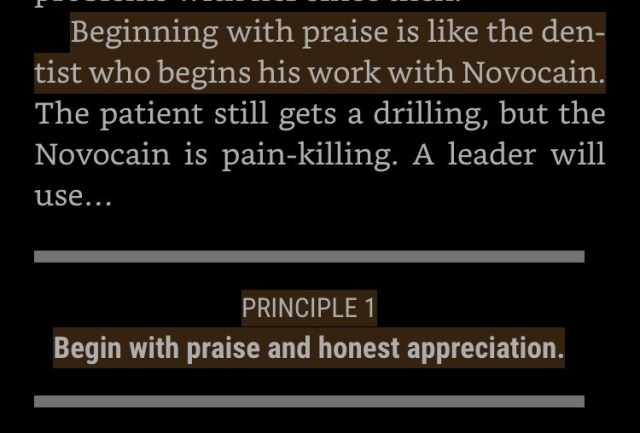
“Beginning with Praise is like the dentist who begins with Novocaine.” Page 242

Page by Page

237

“There are many occasions on which it would be precisely the right thing to say, but is it quite suitable to this particular occasion?”

238

Lincoln to Hooker, with whom he was upset and expected much. “There are some things in regard to which I am not quite satisfied with you.” Talk about tact! And diplomacy!

239

“Beware of rashness, but with energy and sleepless vigilance go forward and give us victories.”

240

[No best or relevant quote.  None!]

241

Brass is running late.

“It is one of the cleanest and neatest bronze factories I ever saw,” said Gaw.

242

“Beginning with Praise is like the dentist who begins with Novocaine.”

PRINCIPLE 1 Begin with praise and honest appreciation.

image

Posted in Books, Carnegie, Methods | Comments Off on Carnegie 22.4.1: How to Win Friends and Influence People – PRINCIPLE 1 Begin with praise and honest appreciation.

How to Replace a Baseboard Heating Cover in an Hour or Less

The number one hit for ‘replacing baseboard heating covers’ is a This Old House Episode that looks pretty daunting.  My son and I just knocked this out in less than an hour.  Here’s what we did:

  1. Measure
    1. We had 3 baseboard heeaters.
    2. 1 was 5 feet
    3. 1 was 10 feet = 2 * 5 feet.
    4. 1 was 12 feet = 2 * 6 feet.
  2. Order from Baseboarders.com.  Our order arrived in less than 2 days.
  3. Remove the ends – some were already done from measuring in Step 1.  Be safe!
  4. Vacuum, clean and de-dust.  Be safe!
  5. Install new covers.  End caps on first.  Connectors on last.
Posted in Uncategorized | Comments Off on How to Replace a Baseboard Heating Cover in an Hour or Less

Carnegie 21.3.12: How to Win Friends and Influence People -PRINCIPLE 12 Throw down a challenge.

Carnegie 21.3.12: How to Win Friends and Influence People -PRINCIPLE 12 Throw down a challenge.

Pages 228 – 231

Appeal to people’s nobler vision (as called out in Principle 10), and then enlist them in the challenge of achieving it.  This great goal is possible.  Can you get there first?  Can you get their faster than their competition?

  1. Appeal to society’s better self.
  2. Ensure that there are metrics and milestones so progress can be tracked.
  3. Then appeal society’s better self to hit the target first.

Best Quote(s)

“That is what every successful person loves: the game. The chance for self-expression. The chance to prove his or her worth, to excel, to win. … The desire to excel. The desire for a feeling of importance.”

Page by Page

Page 228

““He asked us how many heats we made, and we told him six. He chalked it down on the floor.”

229

“Let Charles Schwab say it in his own words: “The way to get things done,” says Schwab, “is to stimulate competition. I do not mean in a sordid, money-getting way, but in the desire to excel.” The desire to excel! The challenge! Throwing down the gauntlet! An infallible way of appealing to people of spirit.”

Another mention of Roosevelt.

230

Carnegie tells of the persuasion of someone to take on the warren role at Sing Sing, a famous American prison. “Young fellow,” he said, “I don’t blame you for being scared. It’s a tough spot. It’ll take a big person to go up there and stay.”

“I have never found,” said Harvey S. Firestone, founder of the great Firestone Tire and Rubber Company, “that pay and pay alone would either bring together or hold good people. I think it was the game itself.”

231

“That is what every successful person loves: the game. The chance for self-expression. The chance to prove his or her worth, to excel, to win. That is what makes footraces and hog-calling and pie-eating contests. The desire to excel. The desire for a feeling of importance.”

From earlier – we are channeling their need to be important into a real outcome.

PRINCIPLE 12 Throw down a challenge.

Posted in Books, Carnegie, Theory, Trust | 3 Comments