The Goal – Chapter 07 – A Short, Worthless Chapter

[The MBA’s best guide to Goldratt’s The Goal][Video Guide to Chapter 7]

There are a few short, practically throw away chapters in The Goal that help us transition the narrator or pull in emotional cues.  This is such a chapter.

P053 – “Why should I be different?”  The narrator talks about committing to his current job.  Without commitment, it is hard to do the daily work needed to make real change.

P054 – “More of the same is not going to do any good.”  If everything else has failed, changing tactics provides a shot at success.

Posted in Uncategorized | 2 Comments

The Goal – Chapter 06 – Improving Metrics Create Visibility

[Click for a chapter-by-chapter summary of the whole book.] [Video summary of Chapter 6.]

Chapter 6 takes us back to the plant, where our narrator meets with his controller to re-evaluate financial numbers.  Then he returns late to home where he misses his daughter and finds a disappointed wife.  The chapter closes back at the plant.

Rogo knows his plant isn’t healthy – but his numbers don’t tell him that.  If the numbers don’t help, then the numbers are part of the constraint and deserve focus.  Poor financials and reporting – just like the Vanity Metrics of Ries in The Lean Startup – are a constraint in creating real improvement.  Call out the constraint and address it.

Operations Highlight

This chapter has three that are very compelling:

  1. “How can I possibly control what goes on?”

  2. “Producing products is just a means to achieve the goal.”

  3. “The first thing I’m trying to do is get a clear picture of what we have to do to stay in business,” I say.

It requires a great deal of energy to fully control a situation – leaders should create situations where teams can be trusted to execute. If a company can maintain profits without production, it should do so.  Before acting know what you want to accomplish.

Writing Highlight

“She waited by the front window for you all evening until I made her go to bed.”

Plenty of readers of Goldratt deride the family component as a side story – but every time I’ve re-read the book, these are the parts that grow in resonance.

Page by Page

P042 – “You use your people, or lose ’em—you got it?””  Rogo is pushing his people to ‘look busy’ – but activity away from the constraint is not productive.  Often times, such ‘look busy’ activity creates a feedback loop that is tough to get out of – especially if it involves customers.

P043 – “How can I possibly control what goes on?”  Rogo hits on a fundamental truth – it is very hard to force someone to do something.  Instead, we must educate and coach.  Force is rarely effective in creating an outcome.

P044 – “Is there a simplified way to know if we’re making money?”  Keep the business simple. I once had a customer tell me that I was fortunate that my business was simple – they didn’t understand that simplicity had been hard won with difficult decisions and discipline.  Simplicity is earned, but is highly valuable.

P045 – “Producing products is just a means to achieve the goal.”  If a business can generate the same profits without manufacturing – shouldn’t it do so?  This question is at the heart of many outsourcing / in-sourcing initiatives globally.

P046 – “Bad cash flow is what kills most of the businesses that go under.”  Businesses fail when high growth products change the flow of cash and they aren’t prepared for the change.

P047 – ““The first thing I’m trying to do is get a clear picture of what we have to do to stay in business,” I say.”  If you don’t know what to do, spend some time figuring out what the right thing to do is.  In military terms, this is the OODA loop – Observe, Orient, Decide, Act.

Frustration is energy without focus.  Prevent future frustration by focusing your energy now by deciding your strategy.

P048 – “On the paper, I write down the three measurements which Lou and I agreed are central to knowing if the company is making money: net profit, ROI and cash flow.”  Simple, basic financial measures paint a compelling picture when applied consistently over time.

P049 – “To make money by increasing net profit, while simultaneously increasing return on investment, and simultaneously increasing cash flow.”  The Goal!

P050 – “She waited by the front window for you all evening until I made her go to bed.”  But here, Rogo has uncovered the goal for his plant at the cost of time with his family.

P051 – “It’s just that those concerns are not part of his world.”  As with the observation of P043 – Rogo can’t control what his people do, but his people can win if he educates them on what matters to the business.  An educated and motivated team is a powerful tool in growing a business.

Posted in Books, Business, Uncategorized | Tagged , , , , | Comments Off on The Goal – Chapter 06 – Improving Metrics Create Visibility

The Goal – Chapter 05 – The Worst Corporate Meeting

Our author, Goldratt, begins the education process for the Theory of Constraints:

  • Strawmen are introduced.
  • We sit with our narrator, Rogo, as he endures a corporate meeting to understand why goals are being missed.
  • Rogo comes to us fresh off of a 2 week flashback, where his Sherpa, Jonah, presented him with uncomfortable questions.
  • Rogo flees the meeting and literally sits on a vantage point looking down at his plant to get a ‘high level view.’

Operations Highlight

“They’re out there renting warehouses to store all the crap they’re buying so cost-effectively.”  Creating accounting inventory without knowing how it will be monetized is a symptom of corporate hoarding.  R&D teams that don’t deliver are collected like zoo animals – put on display, but not expected to make real contributions.  The tools, personnel and inventory a plant builds must enable the goal of profitability – otherwise they turn into time traps justifying their own existence.

Writing Highlight

“Our tribe is dying and we’re dancing in our ceremonial smoke to exorcise the devil that’s ailing us.”  Rogo’s visions of witch doctors, cargo cults and pre-science cultures unaware of the laws of nature is cutting.  Poor performing operations functions can wear the robes of a cult – shedding their vestments only with clarity and candor.

Page by Page

P034 – There are a lot of highlights in the opening page of this chapter.

“You’re just playing a lot of games with numbers and words.”

“Because as I glance from face to face, I get this gut hunch that none of us here has anything more than a witch doctor’s understanding of the medicine we’re practicing.”

“Our tribe is dying and we’re dancing in our ceremonial smoke to exorcise the devil that’s ailing us.”

“What is the real goal? Nobody here has even asked anything that basic.”

“What the hell am I doing here? I’m wondering what good it is for me—or any of us—to be sitting here in this room. Is this meeting (which is scheduled to last for most of the day) going to make my plant competitive, save my job, or help anybody do anything of benefit to anyone? I can’t handle it. I don’t even know what productivity is. So how can this be anything except a total waste?”

P035 – “For a second, I consider ignoring the question.”  From a management standpoint – ignoring the question, even if it feels snarky from the asker, is rarely the right move. Don’t ignore the question.

P036 – “Some distance below, down across the highway, is my plant.” Rogo flees the meeting, fuels up on pizza, then literally gets a high level view of his plant.  Goldratt is not shy about metaphors as he shows us how to think about operations challenges.

P037 – “They’re out there renting warehouses to store all the crap they’re buying so cost-effectively.”  Creating inventory – either intermediate or final – is rarely the right move for a business unless demand is known!  Once a business starts exterior warehousing, it is like activating a hoarder – it is a difficult addiction to get rid of.

P038 – “It’s not enough to turn out a quality product on an efficient basis.”  Plenty of businesses went bankrupt efficiently building a quality product.  Someone else got more efficient, or better at quality – and with that they used their profits to create and extend a lead.

P039 – “So technology is important, but it isn’t the goal.”  Technology is often an enabler of sales, but if a customer can buy a product without technology – do not take the risk.

P040 – “The goal of a manufacturing organization is to make money.”  Here we have a clear goal for the organization.  Now, we’ll need a plan to measure this and share it to the organization.  (This comes in Chapter 09.)

P041 – “If the goal is to make money, then (putting it in terms Jonah might have used), an action that moves us toward making money is productive. And an action that takes away from making money is non-productive.”

Often times in an organization it can be hard to determine what actions move the business towards making money.  However, it can often be very clear what actions take you further from making money.  Activity that promotes the good, or stops the bad is good activity.  Stopping unproductive actions is valuable! Explain the rationale, be patient with the team, and the goal will emerge.

Posted in Books, Business, Uncategorized | Tagged , , , | Comments Off on The Goal – Chapter 05 – The Worst Corporate Meeting

The Goal – Chapter 04 – Introducing Jonah in an Airport Flashback

(Full Chapter by Chapter Review) (Video Review of Chapter 4)

With Chapter 04, the reader is 10% in to Goldratt’s classic and the pattern and story structure are getting clearer.

  • This is a two-week flashback to an encounter with a former professor.
  • Rogo is on his way to a presentation about robotics improving productivity.
  • His professor takes on the Yoda / mentor role and asks about his plant, robotics productivity and company goals.
  • This causes Rogo embarrassment and inner conflict as he realize that he cannot answer simple questions which tie together corporate-speak with his goals.

Operations Highlight

“It is very unlikely your people are lying to you. But your measurements definitely are.”

People want to do right, teams want to win.  Sometimes they are caught in the wrong structure and the wrong scorekeeping so they cannot see the right actions to pursue.

Writing Highlight

I’m beginning to feel somewhat insulted by this.

If you’re a manager not performing to your own goals and objectives – it is embarrassing.  It feels insulting to be questioned when so much effort is being laid to support a company, especially when it creates sacrifice for family.  Goldratt nails this emotion, further pulling in the reader.

Page by Page

P026 – “I got a grant to go and study some of the mathematical models you were working on.”  Rogo needs help and he needs perspective – but simply focusing on the problem hasn’t created a solution.  From Ch01, we know he works hard.  We know he is committed – he’s got to take a different tact to solving his problems to find the answer.

P027 – “See, it was just in one department that we had a thirty-six percent improvement.” Rogo boasts to Jonah. “Then you didn’t really increase productivity,” he [Jonah] says.  Rather than sputtering corporate speak, Jonah asks questions and points out the absurdity of some of Rogo’s situation.  Clarity and perspective will often help resolve situations.

P028 –  “But if your inventories haven’t gone down . . . and your employee expense was not reduced . . . and if your company isn’t selling more products—which obviously it can’t, if you’re not shipping more of them—then you can’t tell me these robots increased your plant’s productivity.” From The Lean Startup – all of these numbers would be considered Vanity Metrics.

P029 – Jonah to Alex, ““Besides, I see those symptoms in a lot of the manufacturing plants.”  If the solution was easy, everyone would be doing it.  Jonah, with his perspective helps Alex recognize that if everyone could fix their problems the way he had been working, then the problems would not be there.

P030 – “Yes, well, if you could start to think about what we’ve been discussing, you probably could get your plant out of the trouble it’s in.” [Teach a man to fish…]

“I’m curious,” I tell Jonah, “what made you suspect something might be wrong with my plant?” “You told me yourself,” Jonah says. “No, I didn’t.” “Alex,” he says, “it was clear to me from your own words that you’re not running as efficient a plant as you think you are. You are running exactly the opposite. You are running a very in-efficient plant.”

“No,” he says. “It is very unlikely your people are lying to you. But your measurements definitely are.” [Vanity metrics!]

“You think you’re running an efficient plant . . . but your thinking is wrong.”

“What’s wrong with my thinking?”

P031 –  It’s no different from the thinking of most other managers.” “Yes, exactly,” says Jonah. “What’s that supposed to mean?” I ask; I’m beginning to feel somewhat insulted by this. “Alex, if you’re like nearly everybody else in this world, you’ve accepted so many things without question that you’re not really thinking at all,” says Jonah.

[Rogo’s fringe feeling of being insulted is not Jonah’s issue.  If Rogo wants answers, he is going to be uncomfortable.  Jonah cannot simultaneously expect Jonah to provide him with useful feedback, and demand that it be spoonfed to him.]

“When you are productive you are accomplishing something in terms of your goal, right?”

P032 –  And he’s saying, “Alex, I have come to the conclusion that productivity is the act of bringing a company closer to its goal. Every action that brings a company closer to its goal is productive. Every action that does not bring a company closer to its goal is not productive.”

Here, 4 chapters in we have a clear Theory of Constraint definition of productivity.  1/ Activities towards the goal are productive.  2/ Activities not towards the goal are not productive.

P033 – “Alex, you cannot understand the meaning of productivity unless you know what the goal is. Until then, you’re just playing a lot of games with numbers and words.”

in Lean Startup terms – this game playing is called, “playing house.” It looks good, but it is a cargo cult, not meant to seriously create growth.  Companies can rarely indulge themselves with such detours and game playing.

Posted in Books, Uncategorized | Tagged , , , | Comments Off on The Goal – Chapter 04 – Introducing Jonah in an Airport Flashback

The Goal – Chapter 03 – Awful Corporate Meeting

[Visit the full Chapter by Chapter Summary!]

In the first two chapters, Goldratt has set the stage with a troubled plant combined with the demands of family life.

  • Chapter 3 is short.
  • Our narrator, Rogo, faces a dreaded event – attending a short noticed, bad news corporate meeting.
  • As is common, the corporate meeting offers few solutions – merely more complex information delivered via powerpoint.
  • From a writing standpoint, Goldratt introduces himself (via Jonah) with a flashback sequence that leads into Chapter 4.

Operations Highlight

“He wasn’t afraid to delegate responsibility.”

If there isn’t enough trust in your organization to delegate, then there are broader issues that need to be addressed.  Are you training correctly?  Are you developing your team?  Are position descriptions written clearly and used to create accountability?

Writing Highlight

“For a few seconds I’m wondering where the hell this cigar came from.”

Like Bilbo Bagins clutching the One Ring in his pocket, Rogo finds the cigar and is summoned to a flashback which will lead him on a path to resolution.

Page by Page

Page 021 / 360 ~ 7% – “The irony is that in order to be there at such an early hour, half the people attending will have had to fly in the night before.”  If Rogo’s employer has a long term goal of saving money, then why are they losing money to create this meeting?  If they are losing money, shouldn’t they make sure it is a good use of everyone’s time?

P022 – “He wasn’t afraid to delegate responsibility.”  Rogo has a good relationship with his boss when he felt trusted and had clear delegation.

P023 – “He’s got till the end of the year to improve performance, or the whole division goes up for sale.” While this assignment may be tough, a clear goal with a timeline creates amazing clarity.

P024 – “The first quarter has just ended, and it’s been a terrible one everywhere.” If the whole company has had a terrible quarter, this presents real opportunity for Rogo.  His plant’s challenges are not unique.  He has the chance to show real improvement and differentiate from the pack.

P025 –  “For a few seconds I’m wondering where the hell this cigar came from.”  This line provides the segue to Chapter 4, where Jonah – Rogo’s sherpa – is introduced.

Posted in Books, Uncategorized | Tagged , , , | Comments Off on The Goal – Chapter 03 – Awful Corporate Meeting

The Goal – Chapter 02 – Defining Process

[Click for a chapter-by-chapter summary of the whole book.]

Chapter 2 picks up with the same style that we found in Chapter 1.

  • The reader meets Rogo’s spouse, Julie, and learns more about their situation.
  • The backdrop of Rogo’s plant, its location in his home town, and how he came to work there are developed.
  • The setting moves from Rogo’s home, back to the plant, and then a diner.
  • Order 41427 ships – but the context is laid for Alex’s concerns about the big picture problems he faces.

Operations Highlight

“Why can’t we consistently get a quality product out the door on time at the cost that can beat the competition?”

There are steps to teach a team how to finish a process:

  1. Write out the process.
  2. Execute process, once, slowly. No other activities are allowed.
  3. Repeat the process for speed.
  • The same methods are used in drilling athletic motions.

Writing Highlight:

“It was the silence that really got to me.”

Silence at a production site is usually a bad sign – for an active site, most money producing operations create noise. A silent, shut down site calls back history and the overconfidence of others.

Page by page highlights:

P010 – “That’s your idea of a night on the town?” Says Julie to Alex. If you’ve got a commitment – honor the full commitment. If you don’t have the resources to make the commitment – don’t make it in the first place. A 1 hour allocation of time doesn’t meet his wife’s needs, so Alex’s partial attempt to meet it leaves them both unhappy. Goldratt takes personal application of the Theory of Constraints and puts them in the middle of the story.

P011 – “There’s nobody except you to talk to, and you’re not home most of the time.” Julie’s personal goal, which enables her happiness, is to have someone she can relate to.

P012 – “The neighborhood where we live looks like any other American suburb.” The author has written in a way to appeal to anyone who has dealt with a North American production site.

P013 – “It was the silence that really got to me.” Rogo is describing his trip to an abandoned plant also in his home town. The shuttered site is silent – and his comment resonates with anyone who has heard the echoes ripple through a similar location.

Rogo’s concerns and ambition pull in the reader – Rogo wants to keep that plant open and is afraid of what happens if he fails. “I hate to think that the next time my name is in the paper, the story might be about the plant closing. I’m starting to feel like a traitor to everybody.”

P014 – “Donovan has stolen every body he could grab and put them all to work on this order.” Peach’s demands for 41427 will be met, but at the cost of every other order in the plant. No other work will get done.

P015 – “Thanks, but don’t ask me how we did it,” he says. Is Donovan telling Rogo that he can’t explain how it was done, or that the costs were so high it wasn’t worth it?

P016 – “I’m all for shipping orders, Bob, but not the way we did it tonight,” I tell him. Rogo knows that the 41427 shipped in a way that isn’t sustainable and with high opportunity cost.

P017 – “Every six months it seems like some group from corporate is coming out with some new program that’s the latest panacea to all our problems.” Rogo is looking for a high level system to address his issues. It took the plant a long time to get into this current situation – and it will take the plant a long time to get out. Changing approach every six months won’t let any process get done. These six month changes are similar to Peach’s reorganization of plant priorities to 41427. To measure the output of a process, the process must be allowed to complete.

P018 – “Why can’t we consistently get a quality product out the door on time at the cost that can beat the competition?” Rogo is starting out with good, simple questions. If this were continued in a “5 Whys?” Type approach, the team could start to untangle their situation. It takes a mature team to have this kind of discussion.

There are steps to teach a team how to finish a process quickly:

  1. Write out the process.
  2. Execute process, once, slowly. No other activities are allowed.
  3. Repeat the process for speed.

The same methods are used in drilling athletic motions.

P019 – “If we could just get our backlog out the door.” Rogo’s plant has a backlog – and every item of backlog can be converted into $s. Helping an organization convert backlog into cash is one of the quickest ways to improve profitability.

Posted in Books, Business, Uncategorized | Tagged , , , , | Comments Off on The Goal – Chapter 02 – Defining Process

The Goal – Chapter 01 – Alex’s Production Site Fails

[This is #1 in a series covering all 40 Chapters – Visit the summary. Video summary is here, and a <60s summary of the chapter is here.]

Chapter 1 of The Goal pulls the reader right in:

  • Goldratt, the author – and creator of Theory of Constraints – sets the book in the first person, positioning the reader as Alex Rogo.
  • The setting is a manufacturing environment.
  • The settings are simple – in Chapter 1 we move from the parking lot, into the plant, and into our narrator, Alex Rogo’s office.
  • Alex’s emotions are part of how the author tells the story and teaches about the Theory of Constraints.
  • The author pulls in components of the Theory of Constraints early on – using goals as motives and hinting at how constraints impact production.
  • There is a diversity of character backgrounds and education levels – just like any work setting.

Operations Highlight

“Peach doesn’t give a damn about the other do-it-now job.”

If there was a hippocratic oath of production management, it would read – “don’t make the situation worse.” Rogo’s boss Peach wants an order shipped – and his efforts to do so cause chaos and likely throw every order for the week further behind. This will cause him to be back at the plant next week, and the problems will just grow and delays increase. There is a corollary to this hippocratic operations oath – if you don’t understand if your action will make the situation worse, be patient.

Writing Highlight

“Going into the plant is like entering a place where satans and angels have married to make kind of a gray magic.”

To tame the satans, angels and the complexity of their gray magic we must bring the simplicity of a clear goal to the plant floor.

Page by page highlights of Chapter 1; Pages 1 – 10.

Page 1 – “Too bad that I may never get the chance now.” The reader learns that our narrator also has a goal, even though it is weakly stated. He wants a shot at being CEO. In these early chapters, before ToC is introduced, Goldratt is still following the rules and laying out principals – he then pulls these concepts back in later in the book.

Page 2 – “Peach doesn’t give a damn about the other do-it-now job.” Peach, who frustrated our narrator by taking his parking space, is now causing chaos in the plant. Order 41427 is late, so change over and set up costs be damned, Rogo’s boss, Peach, is going to get that order shipped. Anyone who has worked to a deadline is familiar with the chaos caused by this behavior.

Page 3 – “Sure, uh, but what should we be working on?” Rogo is ready for action – and his team highlights two constraints to effective action – communication and prioritization. Rogo is about to hop out and get 41427 shipped, but his team doesn’t know that yet and they aren’t sure where to start.

Page 4 – “So where was I last night, he asks, when he tried to call me at home?” Goldratt pulls in a myriad of personal and life lessons in this book. Many first time readers quote these components as being cheesy, boring or not worth their time – but they are relevant. Co-workers bring these emotions to the plant floor. Work life boundaries are important to team morale.

Page 5 – “And if you still can’t do it, then I’ve got no use for you or this plant.” In my first reading of the Goal in 2001, this line struck me as to blunt and cruel. But it brings wonderful clarity to the situation for Rogo. Clear deadlines are wonderful when they exist and are known.

P006 – “From the shelf by the door, I get my hard hat and safety glasses and head out.” Rogo knows that he cannot meet Peach’s challenge in his office – it requires work out in the plant with his colleagues.

P007 – “Going into the plant is like entering a place where satans and angels have married to make kind of a gray magic.” The prose may be simple, but Goldratt has a keen ability to summon the smells, sound and sites of a production site.

P008 – “And he doesn’t talk real fancy; I suspect it’s a point of pride with him.” As the reader is introduced to the characters around Rogo, Goldratt continues to highlight the variety of communication styles and educational backgrounds. The reader senses the author’s desire to make a broad reaching book.

P009 – “But, see, the problem is that the machine itself is down and it may stay down for some time.” The reader is introduced now to the NCX-10 and first hints of the Theory of Constraints. If all work flows through this tool, and if the tool will be down for a while, how can product can be completed? How can money be made?

Posted in Books, Uncategorized | Tagged , , , , | Comments Off on The Goal – Chapter 01 – Alex’s Production Site Fails

Apple’s Watch – Offense or Defense?

Amazon is loaded with hundreds of inexpensive fitness trackers.

Apple’s watch is the future of the company.  The watch will shrink in size, radio quality will improve, capabilities will grow and eventually watch revenues will pass the iPhone.

No, no, no.

Apple’s watch is a defensive play. Look for fitness trackers on Amazon. There are a slew of well built Asian knock-offs following designs that have challenged FitBit, but bring 80% of the Apple Watch functionality for $30. Selling the Watch keeps the most loyal iOS users from defecting – this is a defensive play.

Zone to Win is the latest book from Geoffrey Moore, author of Crossing the Chasm.  Crossing the Chasm is a landmark in product development, laying out the Product Lifecycle Model and showing how different customer populations change the role of product development.  ZtW outlines how product development can work outside of a pure startup in the walls of an established business.  A simple 2 x 2 grid lays out the four zones and establishes how companies can prioritize, set boundaries, and use product development to win new markets while defending existing ones.

More established business strategy analysts view the Apple Watch as an offensive play – I disagree. Moore discusses in the book that very rarely do companies cannibalize their own best products.  Apple would love to watch the Watch win – but it is too big of a commitment to say goodbye to the iPhone.  As Apple missed the Alexa trend with Siri, and like Microsoft’s miss of the shift to mobile, Apple won’t win against a host of low cost watch competitors, all of whom don’t pay Android licensing fees and build devices that can pair with the iPhone at a fraction of the cost.

The iPhone is defense – so we would expect that it eventually loses to the low cost, disruptive competitors.

Posted in Books, Business, Disruption, Invention, Theory | Tagged , , , , , , | Comments Off on Apple’s Watch – Offense or Defense?

$TSLA’s Race Against Constraints

Bo knows $TSLA.

GP’s with a name portfolio company are coy with their humblebrag as they pitch new limited partners.  This isn’t the kid down the street who puts his Bo Jackson rookie card at the front of his card collection.  This is the clever neighbor who would only lead with Bo if there was a host of treasures to find deeper in the collection.  If that name portfolio company was $TSLA, then the story was simple, “The batteries are impossible to develop.  Once you have the battery, electric motors are much easier – which will allow the winner to dominate other lines of transportation. Existing auto makers can’t catch up to Tesla.”

The investment thesis was that $TSLA would solve the battery constraint before auto makers could make the cultural change to a new energy system.  That was it – there was no secondary thesis around automated vehicles.  Everyone assumed $TSLA would then win the “learn-to-make-automobiles” constraint.

The constraint in a system is the rate limiter.  In a hydraulic system it is the narrowest pipe.  In a chemical reaction the constraint is the lowest available catalyst.  In Goldratt’s classic The Goal, his son’s scout troop is constrained by Herbie.  Herbie is the slowest on a hike.  The troop doesn’t finish until Herbie finishes.  No one goes faster than the constraint.

$TSLA looks to be losing the constraint race against traditional auto makers.  Model 3s aren’t shipping.  $TSLA’s constraint is becoming a legitimate manufacturer, which now appears to be harder for a new entrant than it is for an automotive maker to develop EV capabilities.

Posted in Uncategorized | Tagged , , , , , | Comments Off on $TSLA’s Race Against Constraints

Five criteria for picking winning industrial / manufacturing technologies

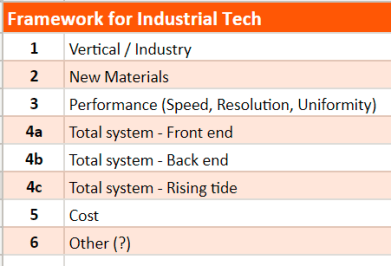
Framework_IndustrialInnovation and technology development in manufacturing and industrial businesses can occur on many dimensions – because of the long development times one of the most important criteria to pursue is the ability to iterate quickly and create feedback loops with customers.  Jenny Lawton, COO of Techstars and previously with Makerbot, highlighted this development cycle risk on her November 28, 2016 appearance on Jenny Fielding’s IoT Podcast.

Businesses, products and technologies that help customers go faster will win compared to slower moving peers.

Creating speed and customer interest requires a new business to score high in some combination of the following areas:

1/ Vertical

It’s hard to ignore a new technology that has specific customer pull or that addresses a large known need within society. Product market fit is long sought after, and sometimes with industrial technologies it can be clear that there are only so many possible solutions, and that one method / process / technology is going to win out if the cards are played right. Moore’s Crossing the Chasm is all about creating as many winning scenarios as possible by getting to large market adoption.

Innovation in advanced manufacturing requires an end customer that exists in a vertical. Knowing how to deploy a new production technology to the benefit of a specific vertical is extremely valuable. This knowledge must be confirmed by an existing supply chain partner, or by team members recently just out of industry.  This is not a problem to validate in .xls or with some $5,000 market report – it must be spoken directly from the mouth of customers willing to spend money.

Many problems of this nature in heavy industry are addressed within large organizations and are not trusted to external providers.

2/ New Materials

New materials change how things get done.  DuPont rebuilt itself on Nylon, Gore was created on PTFE – many modern industrial giants exist on the back of finding new niches for their core material. This trend exists in additive manufacturing – Carbon has charged into footwear with the use of new polymers. Desktop Metal, Form Alloy, Trio Labs and many others show the interest in use of metals, ceramics and other inorganic materials. In industry many decisions are made starting with a known good material, and then accepting the form factor in which it is available. Taking a material and making it workable with a new technology so it can be used in new areas can open new, large markets.  As a corollary – expecting a customer base to change materials is often a trap.  Material qualification can be costly, many enabling characteristics aren’t fully documented, and the time to complete these activities is very long.

Enabling materials to be produced in new ways, while conserving their bulk properties in the new form is a tried and true method of creating new markets and growth.

3/ Performance (Resolution, Speed, Uniformity, etc.)

With electrospinning Elmarco changed fiber production by making sub micron fibers easily produce-able.  The speed of the fundamental process was notoriously slow, but we changed customers perception of that speed by dramatically improving uptime – thereby leading to an overall increase in speed.  Other processes had long produced tiny fibers, but they did so by occasionally producing large fibers.  That single large fiber ruined the uniformity of a web (or membrane) – thus creating a premium value for uniformity.  As we continued to scale up the process, this uniformity and precision allowed customers to use even less of the process (bad for us), and use more of cheaper processes (good for them) to produce high value materials.

Additive manufacturing sees parallels in voxel resolution, speed of part assembly and uniformity of build quality.

4a/ Total Systems – Front end

Very few things exist in isolation.  At Unitive, our chip scale packaging required customer education, new thought processes and a great deal of supply chain integration. With Elmarco, the lab tools were (and continue to be) a crucial tool in educating the work force in how to use the process.  Front end processing and preparation of a process matters a lot. In additive manufacturing this can take many forms – analysis of a piece to be replicated, scanning of materials, computer modeling and simulation and such simple things as design rules and educational courses.

4b/ Total Systems – Back end

Beth Macy’s Factory Man dedicates multiple segments to the value of the finishing rooms in defending the US furniture industry from Asian competition.  Additive manufacturing can currently require several finishing steps depending on the part’s end use and base material.

4c/ Total Systems – Rising tide

In some markets, the best way to monetize a new technology is to internalize it for self use (see SaaS for Tow Trucks). Sometimes it is better to sell the tools to others. Many universities and government consortia aided the boom in nanofiber interest by selling courses and analytical services to new market entrants. Low cost sensors enabled better production tools.

A method, tool, system or technology that accelerated the adoption of additive manufacturing / 3d printing accelerate would prove a major benefit to the industry.  It could be packaged and sold, or it could be used to create an internal advantage.

This type of innovation can take many forms – it could be a web-based image assessment of a customer’s inventory seeing how many items could benefit from new production methods.

5/ Cost

Cost can be a valid reason to innovate and help customers adopt a new technology, but most often it is a trap.  Costs best use is often to rule out an approach, rather than to rule it in. Many things can look cheaper in a .xls spreadsheet or google doc – but when exploring the political decision making within a large customer, the difficult in creating the change makes it hard to capture all of the costs.

Costs should be evaluated at the individual operation / production step – but also at the system level.  It is important to understand system level decision criteria and finances in manufacturing – as most target customers have sophisticated accounting methods and substantial corporate overhead (which can erase potential savings).

Making something easy to do, and thereby making it faster, is usually a better area of technology disruption than making it cheaper.

Cost, like materials above, create a corollary – if your costs are way out of line with current methods, then you face an uphill battle.  If your per unit costs will be cheaper, but it requires a multi-million dollar completely speculative investment to create a proof of concept – then that will be more challenging than the status quo (do nothing), or a similar method that only costs a few thousand dollars to qualify.


6/ Other

There’s always some other dimension in which new teams, technologies and people can provide value. Keeping an empty space on the paper to reflect on those surprises is important.

Warning sign: Supply chain ‘turns’

One ‘Other’ that often pops up in manufacturing technologies is where supply chains ‘take a turn’.  This may be when a product leaves a multi-billion dollar plant to go to a low cost finishing operation, or when a product’s supply chain goes from few, to many competitors.  These changes in market dynamics are a signal to pay attention and vet the lay of the land with customers very thoroughly.

Posted in Business, Disruption, Innovation, Theory | Tagged , , , , , , , , , | Comments Off on Five criteria for picking winning industrial / manufacturing technologies