New or Better?

When new technologies arise there is a real desire to create a Disruptive Product(TM), to focus on the new and to avoid simply making a better version of the current market leader. Don’t fall into that trap. It is almost always the right approach to first create something ‘better’, before advancing on something new.

  • Customers buy Better faster than New (unless New is very disruptive).
  • Better has more opportunities for insertion.
  • Customers spend less money to evaluate Better than New – New requires time to think and create methods.
  • Better has a line item in your customer’s budget.
  • Better has metrics that can be measured and proven.
  • Customers know their ROI for the current product – this is the start of knowing ROI on your better product.
  • ‘New and improved’ can sell in retail, where buyers can easily replace an item. In industrial technologies, where long qualifications are common – new comes with risk. Risk is bad.
  • Better, if positioned correctly, can transition to New.
  • New creates lofty visions in the minds of customers and investors. This creates fractures, fractures shorten the life of a business.
  • Better can be benchmarked. If the product is x% better here, y% faster there, and enables z% savings – then you can know exactly if the customer is wiling to pay x*y*z*(discount)*(life).
  • New is a Swiss Army knife – adding a can opener to an uncomfortable cork screw. The product strategy is to win with an avalanche of average.
  • Better often has an owner in your current buyer. New often requires coordination within your customer, increasing the cost of evaluation.

The timeline between Better and New may be very short – but skipping Better is almost always a mistake.

If New is so easy, why not just do Better first?

Most businesses that pursue New, without doing Better first (or at least having Better in their back pocket) are scaring their potential customers. There is often a desire for a grandiose supply chain maneuver. Sometimes these things happen – but they are rare. New conveys greed. It demeans the efforts of the current performance leading product – whereas Better is a salute that builds off what came before.

Posted in Disruption, Innovation, Marketing, Uncategorized | Tagged , , , , , , , , , , , | Comments Off on New or Better?

Startups or Big Co?

Born between May 20 and June 20 – the astrological sign of Gemini, defined by the duality of the twins Castor and Pollux, lurks around every corner. While at UVA for undergraduate studies – this was captured in two different majors – biology and economics.

After moving on from an advanced industrial process company where I ultimately served as CEO for two years, interviews prompted another duality;

“Are you a startup guy or a big company guy?”

Questions like this are reasons to always be interviewing.  I didn’t have a clear answer. With some reflection:

The Entrepreneur’s Journey (out of Techstars) is a great framework.

  • I’m a 60/40 startup guy vs BigCo guy.
  • What matters most to me is being effective and getting things done. The best way to predict this is knowledge and appreciation of the needs of a vertical / end industry.
  • I’m a data driven industrial guy.
  • Different settings ask for different skills.  Sometimes the way of the startup is right, sometimes the resources of the big company are right.
  • Some customer problems in the world of data driven industry are best solved by startups, but the constraints occur in the asset base of a large customer.  The major reason startups have failed in heavy industry is the constraints in the customer base.
  • There are lots of people who are drawn to entrepreneurship because they are sold on the fast paced environment and ability to have a big impact.  Industrial customers tend to chew up those living for this part of the Entrepreneur’s Journey.

Being a “startup person” or a “big company person” is as much about your personal commitment to what you are doing.  Sometimes a startup mentality is essential, and sometimes new technologies can only win in a startup.  In industrial technologies, the  constraint is the asset base and it sits in a big company. To win in industry, you’ve got to have an entrepreneurial mindset balanced with political patience.

Posted in Disruption, History, Industry, Methods, Theory | Tagged , , , , | Comments Off on Startups or Big Co?

Industrial Business Models – Customer ROI

Your technology is great.  It makes the world a better place.  Benchtop results were good – but yields actually went up as you’ve scaled results.  You’ve also made your first big decision and you’re going to sell the technology to others to help them sell into their end markets.  Your customers will learn the end markets, the minutiae of what drives value and how to apply your latest / greatest technology.

All you have to do is sit back and sell to them.

Have a model of customer ROI in at least one market.

This is a trap.

Even with all of the great startup guidance, literature, mentors and coaches available – a startling number of new businesses continue to believe that they can leave the heavy lifting to their future customers.  The technology is so good, they don’t even attempt to understand customer ROI.  Many established companies make this case too – but the pain of failure is much worse when you only have one product.

Visionary customers are explained in Moore’s classic on tech marketing.

There are always a few visionary customers who will do the work to find out ROI for you. Most customers will not. To get feedback, a new product must be surrounded by a body of work that supports its value to new customers. Customers don’t expect you to be an expert in their field, but they will get frustrated and share less with you if you waste their time. The effort to develop ROI and to understand your customer’s end business always pays back.

[Sometimes the payback is finding out sooner that it doesn’t work and that you should stop / pivot / change.  That’s okay too.]

Posted in Industry, Innovation, Marketing, Materials Science | Tagged , , , , , , , , , | 1 Comment

Industrial Business Models – Choice #1

Hardware is dead. Hardware is booming. Hardware is hard and no one should do it. Hardware is different. Hardware is the same.

Industrial businesses manufacture and sell to supply chains, as opposed to individual consumers.

IoT, IIoT and additive manufacturing attract attention to heavy industry – where a thing is being produced and is being sold into a supply chain, rather than to an end consumer. [1] If you’ve got a new technology and are trying to figure out the right business model, then there is one major decision to make early on in regards to the business model.

  • Option 1: Use your advantage (the new technology) to make a thing and sell it.
  • Option 2: Sell others the ability to make use of your technology.  Enable others.

I would choose between the two based on; (i) ease of access, and (ii) the ability to create cadence, speed and iteration.

Option 1 is the route if you know a target vertical and if the technology gives a big advantage in a vertical.  It’s also a good option if the technology is hard.  You aren’t forcing people to digest the technology – you’re instead using it to sell a ‘new and improved’ version of something they already buy.

Option 2 requires distribution.  It also requires that the technology be a big enough improvement over what the market currently uses that everyone is drawn to it, but that the technology be easy enough (or similar enough to current processes) for customers to be easily educated.

Pick a business model.

There are plenty of other things to consider between these two options – but most of the flavors are really minor variations in how a business aligns with customers, finances the customer’s purchase decision and constructs the right channel.  Supply chain structure matters a great deal and can easily push the decision one way or another.

[1] – I reserve the right to modify this definition.

Posted in Disruption, Industry, Innovation, Materials Science, Theory | Tagged , , , , , , | Comments Off on Industrial Business Models – Choice #1

Trust: “We’re not following rules, but expect you to.”

image

Catton’s Civil War History lays out many social and ethical concerns

There are many great political and social points in Catton’s histories of the American Civil War.  In his 1961 book The Coming Fury, he discusses how Southern plantation authors were going to Union generals and asking to have their slaves returned. Their pretense was that the Fugitive Slave Act of 1850 required the Northern states to do so.

There was at least one problem with relying on this law.

The Southern states proclaimed to no longer be a part of the Union, nor were they governed by the Constitution. Following the Fugitive Slave Act assumed that both parties were following the Constitution as the primary set of rules. Despite having done away with that primary set of rules – the Constitution of the US – the Confederates assumed that the Northerners would still be bound to the secondary rules.  This was not the case.

In modern contracts, this issue can be dealt with under a severability clause.  For example if a document includes an NDA, were a party to fail one point of the document, the other party can’t go make use of the information.

Violating trust is a red flag in contracting.

In complex transactions it becomes extremely difficult to document everything that must transpire for both parties to be satisfied.  The time required to fully document and contract what is to occur may be longer than the life of the product! When things get tricky, as they often can, it is important to remember that if one side is walking away from part of an agreement, they can’t expect the other side to stick to everything as well.

Trust is the bridge that allows parties to come to agreement.  When one party is flagrantly violating an accepted rule and expecting their counterpart to continue to abide by that rule then trust is broken.

Posted in Business, Disruption, History, Industry, Methods, Policy, Trust | Tagged , , , , , , , , | Comments Off on Trust: “We’re not following rules, but expect you to.”

“What does it take to be CEO?” Reflections a year after leaving.

President Lincoln had a nice business card.

The question caught me off guard. My interviews after resigning in October ‘16 were split between pure startups (IoT, Industrial, Fiber and Filtration related mostly), where having had the CEO title was enough, and bigger companies / past customers (mostly in engineered fabrics and manufacturing) stayed away from ‘personal’ questions because of our past relationship.

“What does it take to be CEO?”  This should be an easy question – it surprised me I didn’t have an answer ready to go.

The past year has been a whirlwind. Career shifts aren’t predictable. We’d planned on hanging out in RTP and having a long job search – but given the opportunities that arose, it became quickly apparent that the plan was changing.

I love working in manufacturing. Commercializing new technologies and processes requires many different skills, working with bright people, and fostering trust across diverse cultures. The right sectors can be lucrative. It fulfills a social need around employment that is important to me. Bringing entrepreneurial and lean thinking to industry enables new products and materials to be built and societal problems to be solved more quickly.

The colleague who asked is a total rockstar with great runway. They’ve got a deep education background, solid understanding of operations, a balanced personal life and are fun to hang out with. Even though we were shutting down for Christmas, the question required consideration – to do so it was split in two:

  1. What skills were required to become CEO?
  2. What does it take to be a good CEO?
Posted in Business, Methods | Tagged , , , , , , , , , , , | Comments Off on “What does it take to be CEO?” Reflections a year after leaving.

“What does [did] it take to be[come] CEO?” Answer: Goals / Failure / Reality

StrengthsFinder is a great way to talk about personal motivations (Learner, Activator, Strategic, Context and Input). DiSC profiles (Persuader / Inspirational) are also helpful – but this tool still feels more tailored to corporate HR. StrengthsFinder is an amazing framework for leaders to understand what tools to use in becoming CEO.

1/ A goal.

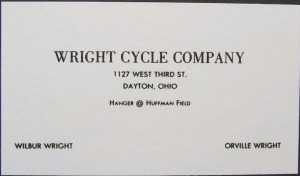
wright-business-card

The goal was to fly.

Sometimes it is really clear what **not** to do, but not really clear what should be done. It can be obvious how to not lose, but still be hazy in understanding what ‘winning’ would look like.

Through my time in manufacturing as an operator and investor – it became clear to me what winning would look like for our technology. It was also clear that we weren’t working towards that goal – in fact we were still doing a lot of ‘obvious losing’ type activities.

Articulating a clear vision can be hard. Communicating strategy clearly in an organization can be difficult (it even says so in both of my possible DiSC profiles). Alignment is not easy to build. However, it is better for someone to have that vision, and have the constraint be communication and alignment, than for the organization to not have a clear target or definition of success.  We were the leader in our space – our goal was to grow that space and create sustainable long term business.

“Accomplishments are measured against realistic expectations.” – Jalen and Jacoby Podcast

Strategic – There was a vision of success. The business was adrift in an ocean of complexity – but it was clear that the constraint was in developing end market solutions. Without that, everything was luck.

Context – The success was defined within the reality of the market and technology we were in.

3/ Comfort with failure.

Three of us were sharing the CEO role when I was asked to take over. The previous Group CEO (I was #10 to have ‘CEO’) in my title, had left us in that spot for a year after his resignation. Any of my other colleagues could have done it. The board could have done a search, or a chairman could have stepped in. I hate losing and I was tired of it.

“I hate losing and I was tired of it.”

Better to fail at a new role, pursuing a winnable end game, rather than watch another person have to come up to speed on the needs of our customers and capabilities of our technology. As a senior in highschool I’d avoided voting for myself to be captain of the volleyball team – only to lose by one. My friend, who voted for himself, became captain with the help of my vote. Not again – any egalitarian view of leadership had been lost.

Strategic – It was clear that the time that it would take to bring someone else up to speed was too great. Either I could do it, or we would fail in leadership purgatory before someone else came on.

Activator – It was better to step into a difficult position rather than simply ‘hope’ that would everything would be okay.

3/ Willingness to talk about reality.

Our plans to achieve our goals were not robust. The financial plans did not build off of the operating plans and neither interacted with the technology plans. When this became clear it was clear our duty as management was to have this conversation, rather than hide from it. Everywhere our observations about reality were doubted – but we were the only ones doing the work.

image

Pirie’s book is a classic on how to frame, and deal with, problem resolution.

If a team had done no planning – they lost the right to complain about a mediocre plan that needed work (the fallacy of damning the alternative). If the sales plans failed, then I expected my colleagues to hold me accountable and identify the gaps. If the board asked for a plan – we needed to either admit problems and ask for time or be prepared to share some painful updates.

To achieve a goal, leaders need to create a map. Without defining reality, we don’t know where we are on the map.

Input – Input is all about taking the right piece of information and delivering it where it is needed. It’s like a person with an API that serves up connections / tidbits as needed. Input collects data and feeds it to the model that defines reality.

Learner – Modern education espouses multi-disciplinary learning – but this is definitely true in electrospinning and in any application of fiber science. Too often new market entrants would try to over simplify a problem – only to have it be a fundamental constraint to achieving their goal.

[The business card images came from here.]

Posted in Business, Industry | Tagged , , , , , , , | 1 Comment

“What does it take to be (a good) CEO?” Answer: People

All of the successes were from bringing in good people, helping them frame problems and getting them the tools they needed to be successful. The failures? They were mine – mostly due to not properly resourcing a problem with the right people, or having the right people but without the right tools for them to win.

Leadership requires aligning the right people around an activity. I was fortunate to have good mentors, good colleagues and good customers.  Big leaps happened with the right people in place with the right tools.  Stagnant periods without progress (the real killer of startups) happened in the absence of the right people, or when the team didn’t have essential tools.

1/ Mentors

A mentor recruited me into the company – but then left. I filled his role, and then took on the group CEO role. His advice was extremely valuable. Dave Neal was a long time mentor and his partner Chris Heivly became a trusted advisor. Advising other startups earlier in their entrepreneurial journey can be cathartic and clarifying. Hap Klopp changed my whole view of working with apparel and commercializing industrial technologies. An under achieving startup can acquire a lot of emotional debt and tension as it struggles to find product-market fit. Combine this with culture gaps between production (Eastern Europe), sales and technology (US and Western Europe), and a global customer set (US, S. America, China, India, Russia – all over) and it can be hard to get a feel for what is really happening.

Mentors let you have an audience to talk about and try on ideas. They can provide the, “that’s dumb” feedback that is needed sometimes – and keep you focused on what delivers for your customers.  The mentor also can be sure that your corporate role is in line with your personal goals.

2/ Colleagues

textile_industry_drawing_photo-001

Six years later, the supply chain diagram holds up.

Complex problems can require broad teams to get the needed skill sets around the issue. Electrospinning is complex.  Manufacturing is complex.  The end industries are complex. Combined – it can be overwhelming. We were fortunate to have exceptionally bright minds with top academic pedigrees. The team was young, but it was committed and creative. Having the right colleagues and creating the right dialog is crucial to success.

Taking on a leadership role can quickly change team dynamics. An open dialog helps create success, but this can be hard to maintain. Fostering positive feedback loops that help customers win is important. Ego, arrogance and pride can stop the kinds of change that startups must embrace.

3/ Customers

Steve Blank’s definition of a startup as a business in search of a customer is dead right. Good customers are invaluable. Finding profitable learning scenarios accelerates commercialization. Creating open, positive feedback loops is essential.  Elmarco has some amazing customers – and the diversity and skillsets of the team made it possible to forge deep and lasting relationships that created fast learning for Buyer and Seller.

As the tenth person to have ‘CEO’ in my title – I treated the investor group as a customer. As a hired (as opposed to founding CEO) I had an obligation to present reality as the management team understood it, to them – even if it was at odds with their beliefs, or what they had been told in the past.

4/ Recruiting

If good people are a key to leadership – then the ability to recruit is essential. Knowing how to frame the problem, the role needed to solve it, and to use that to attract people is essential. Frame the problem poorly and no one will join – or you will get the wrong people on board.

The right person, the right conversation and the right insight can change perspective dramatically. A big network leads to broad recruiting. Good recruits can create success out of very difficult situations.


Posted in Business, Disruption, Filtration, Innovation, Invention, Marketing, Materials Science, Methods, Textile, Theory, Uncategorized | Tagged , , | 1 Comment

Biology vs the Over-Simplification of Economics

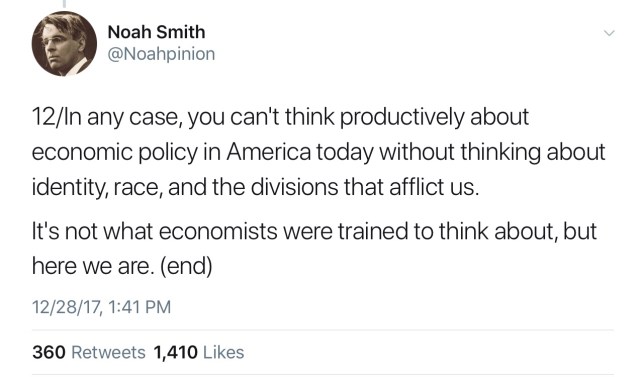
A changing US tax code and shifting geopolitical activity puts more focus on the opinions of economists. Bloomberg economist and Michigan economics PhD, Noah Smith (his blog is Noahpinion) highlighted many of the issues in modern economic analysis in a recent twitter thread. At the core of most modern economics is an over simplification that leads to theoretical results that differ from reality. Biology as a field avoids this by embracing complexity and data.

Smith’s point highlights a common concern with economics – it solves problems through simplification. As an undergraduate double majoring in biology and economics the two fields are polar opposites. Biology encounters complexity and tries to make sense of the systems and data that the world presents. Economics does the opposite. An economist sees the complexity in an area without data – and proceeds to create simple, imaginary characters called ‘rational consumers’ and build up models based on equations and assumptions.

Simplification was an essential tool in a time of limited computing power and little data – but these items are no longer a constraint in how we can look at the world. Moore’s law gives computational power. Data is abundant – and if the specific data is not, then there are many ways to test or create it.

The economist sees a world that behaves irrationally because people aren’t rational consumers. People are more than consumers, and they place importance on items that aren’t in simple models. The moral simplification of people into actors with few unchanging needs feels ethically shallow.

The biologist starts with data, embraces complexity, and interprets facts to create a model as the pattern becomes clear. In the modern world, there are times when complexity needs to be embraced, and times when it needs to be simplified.  Pivoting between the two extremes is an important skill.

Posted in Business, Methods, Theory | Tagged , , , , , , , , , , | Comments Off on Biology vs the Over-Simplification of Economics

Supporting a Technology Team

Technologies build the future. Teams deeper in a technology than ourselves are all around us – providing support at a vendor, evaluating you as a customer, reporting to you, supporting you indirectly, or in some other format.

0/ People first.

As with any group – a team, regardless of their nature – is a collection of individuals who have their own needs, wants and lives. Treat them as individuals, treat them with respect and establish trust. Be sincere. Insincerity is more obvious in demanding situations – trust takes time.

1/ Set goals.

“Tell them the goal, not how to do it – then let them surprise you.” Phil Knight, Shoe Dog

Set clear goals. Create alignment around those goals by getting input and feedback.

A team with a goal that is incorrect will outperform one with no goal. Goals make it possible to budget time and confirm you’ve got the right resources. In the absence of a clear strategic goal, start with basic SMART goals.

Energy is required to create change. Spend energy wisely. Team members who can create success flourish when allowed to show their creativity. Crafting goals and building alignment brings out the most in team members.

A great deal of turmoil, morale issues and other team challenges can be addressed by stating the goal and framing how it can be achieved.

2/ Trust, but verify.

“Make it as simple as possible, but no simpler.”

Start from a position of trust. You need this team because they have capabilities and expertise that you do not have. This team has been chosen over other options (other teams, other methods, or even the option of no team). What is the point in choosing a team that you do not trust?

Ask questions to help the team educate you. Be prepared. Do not flaunt your preparation. Do not, do not, do not reference worthless credentials from years ago. If the team cares about your credentials, or if the team wants your background – they will ask. You are in their world and you need their help. Your effort to understand and your ability to keep your mouth shut is your passport that allows you entry.

Questions may uncover a Trust Issue (TM), or an Obvious Unstated Issue (TM). Individual questions can yield better results than group dialog in these scenarios. Allowing avoidance of embarrassment can accelerate dialog. Crafting scenarios which allow reversal of past beliefs permits open dialog. Creating social permission for change is a valuable skill that benefits from facts and transparency.

3/ Teams outperform individuals.

Modern technology problems are most efficiently solved with teamwork. Open debate and collaboration will beat a brilliant individual functioning as a top-down, command-and-control leader. A good team will beat a brilliant individual. A good team of brilliant individuals is unstoppable.

4/ Methods beat goals.

Teams should craft their own plans to achieve the goal [1]. Drafting a plan for a team may work – but over time this is less effective. A team that drafts a plan owns the plan. Teams that draft their own plan show more creativity, more resilience and are more likely to succeed than teams that simply follow instructions. Using well known methods allows the team to deliberately move ahead and provides insurance if it turns out that the original goal [1] turns out to be incorrect.

Goal modification is a fact of life – robust methods are insurance against such changes.

A plan, once drafted, is put up for debate. The dialog should be open and collaborative. Debate and input from all is important. Identifying as many of the needed steps and dependencies is essential. (In a perfect world, we should follow Goldratt’s Theory of Constraints and Critical Chain Project Management methods. That can take time to implement.)

With steps identified, time and resources can be identified. Milestones are often needed to anticipate approval steps and future sign offs.

5/ Share context.

Resistance can come in many formats.

“We don’t want to set a goal, as we haven’t hit one in this industry yet.”

“We don’t want to set a plan, as we know it will change.”

Team’s come with their own history and their own context. Things that worked for you may have just failed for them. We know from [1] that ordering people about is a short term tactic that eventually plays out.

Resistance needs to be met with context and patience. Commercial perspective is often important in helping a technology team understand the goal and develop suitable solutions.

Teams will often want context from someone other than you. This is normal and if possible can be a great way to encourage a broader perspective.

6/ Create transparency.

There are many ways to create transparency – especially as the Goal is published and reinforced. Good plans allow for simple metrics to track progress – often referred to as Key Performance Indicators (“KPIs”). Picking the right KPIs is part of the debate.

Finding the right KPIs is also part of the debate. Great KPIs allow quick benchmarking across teams. KPIs track progress across time if peer projects are not available.

“Same book, different chapters.”

Transparency can slide into information overload. Big projects have many facets. Every team member can’t possibly know every part – in the same way that a leader cannot know every activity of the team. All parts of the plan must be internally consistent. Different parts of the team may read different chapters, but each chapter is from the same book.

7/ Small teams are good.

“Figure out the right number of people and remove one.” – Bill Gates

Teams require budgets. Leaders who measure life accomplishments by headcount are unlikely to beat those who focus on profitability. Large teams require coordination that cost time and effort. Technology has many components and requires integration of many fields – excess team members cost more in coordination than they pay back in productivity. Teams should be as small as possible. And then get rid of one person.

The small team that has been built should have as many possible skills that help achieve the goal given the number of people on that team. Diversity is good. Diversity comes in many flavors; functional role, geography, education level, gender, race and more.

Broad perspective accelerates the debate required of good planning. Leaders of culturally narrow teams must be active in creating feedback loops.

8/ Remove constraints.

Constraints stand between the team and the goal. Constraints may arise even earlier – preventing the setting of a goal or the creation of a plan. Remove and address constraints as they arise. If there are no constraints – evaluate and reframe goals to uncover constraints.

A system that has no constraints is not operating at capacity and resources can be deployed elsewhere. If constraints are not clear, simulating a repetition of the goal can be useful in identifying other considerations.

“What if we hit the goal, but then the company / customer / market needs us to do it all again, but in 1/2 the time?”

Leaders set goals, facilitate planning and remove constraints. Constraints come in many forms. Leaders can often create more constraints than they remove when working with new teams!

Christensen’s “Resources / Systems / Priorities” framework is effective in highlighting possible constraints. Large companies often find constraints in too many ineffective systems and too few useful systems. Small companies find constraints in resources – most often in personnel or assets. Both large and small companies can be constrained with poor use of priorities.

Sidenote: Firing a Colleague

Any ethics violation or insurmountable Trust Issue(TM) merits a firing. Fraud, gross negligence, safety and health issues are not tolerable. In these scenarios, firing should be assumed, with the onus of explanation being on the individual. Thorough investigation is required to determine the scope of the problem.

In general, development is the preferred course to termination for an employee with a bad fit to their current role. Institutional memory and respect is important. Firing as a motivational tool for those that remain can be effective only a few times before it causes a major shift in the company’s reputation among potential recruits.

A underperforming individual should be fired when:

• Coaching is not effective.

• Any possible new position interferes with the project where they were previously staffed. If they can’t let go after having been moved on – then they will slow the progress the company needs.

• It has been shown that they do not have the skill set needed for the position they are in, and it isn’t possible to coach them up.

• If an employee has been put through a notice and improvement process, but not shown effort to improve.

• The individual has shown continual, repeated failure over a long time horizon and not shown enough initiative to improve the company’s position.

• Failure without learning is costly.


Posted in Uncategorized | Comments Off on Supporting a Technology Team