Goldratt’s Rules of Flow: Chapter 5 – “What is Triage?”

[If you haven’t read the original version of The Goal – it’s a better book. Here’s a chapter-by-chapter video summary, and a <60 second summary too.]

[Click here for a 60 second video summary of the first 8 chapters of Goldratt’s rules of flow.]

Summary

Marc works on homework from his executive MBA course over the weekend while reviewing projects at his office.

Best Writing (Pages 21 – 24)

“The homework for the Rules of Flow course is due today, which means he has three more hours before he has to post it.” – Page 21

“Triage is not only about prioritizing but also about deciding what is the right course of treatment.” – Page 22

“Marc makes sure that the experienced project managers work on the more complicated projects and when there is a need he gets them more people to help out.” – Page 23

“Both of them are rather small, they have little to no value, but they will take up some man hours to complete.” – Page 24

Posted in Goldratt's Rules of Flow | Tagged , , , | Comments Off on Goldratt’s Rules of Flow: Chapter 5 – “What is Triage?”

Definitions: Hypernormalization & Hypernormal

Neither hypernoramlization, nor its British spelling of hypernormalisation are found in the Oxford English Dictionary or Merriam Webster as of February 2023. Wikipedia sources the phrase to Adam Curtis‘s documentary of the same name, which pulls the term from Alexei Yurchak, a Russian anthropologist who used the term in his 2005 book Everything was Forever, Until it was No More: The Last Soviet Generation.

Watching the Adam Curtis documentary is the best way to catch the mood of the term, however, his style is an acquired taste and the film is nearly three hours long.

There are many ways to deconstruct the word to make it usable in other situations:

Noramlize: to make (something) conform to or reduce (something) to a norm or standard

Merriam-Webster.com

Normalization, is the act of normalizing something; the making or reducing of something to a norm or standard. Hypernormalization gets interesting in its interpretation, because it could imply that the prefix ‘hyper-‘ applies to ‘normal’, or to the act of ‘normal-ization’. Is Yurchak making hypernormals or is he normalizing in a hyper faction?

‘Hyper-‘ as a prefix means “super, excessively, excessive, that is or exists in space of more than three dimensions” when defined by Merriam-Webster.com.

When Curtis’s work is referenced it often includes the popular Solzhenitsyn quote:

“We know they are lying, they know they are lying, they know we know they are lying, we know they know we know they are lying, but they are still lying.”

Attributed to Aleksandr Isayevich Solzhenitsyn (1918 – 2008)

Building on this quote and the documentary, a hypernormal would be a normal that is super, excessive, or even exists in space of extra dimensions. From the Curtis film and Yurchak’s work, the hypernormal results from the manipulation of reality – through media, propaganda, social conventions, and society to create an unsustainable perception of reality that defers from the underlying physical surroundings.

For Yurchak, the collapsing USSR was a giant hypernormal in which he lived, worked, and studied. Part of life in the hypernormal is that everyone can see the problems, but the situation prevents them from defining another way to live. In a hypernormal there is acknowledgment that things are wrong, however, there is an inability to conceive of a method to fix the situation. A need for change is acknowledged, what to ‘change to’ is unknown.

If we take an undefined noun – the hypernormal – as the original part of the term, then hypernormalization is the act of creating such a scenario. Hypernormalization is the creation of scenarios where the population recognizes they are in a hopeless scenario, however they cannot perceive a way out of the scenario.

Normalize is itself a loaded term, and perhaps should be the focus. If we normalize something and codify an activity that was previously novel, we run the risk of accepting something that should not become acceptable. In this scenario, hypernormalizing would be normalizing things at a great rate – an activity which could inadvertently create a ‘hypernormal’. By normalizing too fast, a society may recognize it is broken but be incapable of creating solutions.

Neologism: Are you in a hypernormal?

In a normal period of time – removing the modifiers that create a hyper normal – everyone may note something is wrong, but they can correct course. In a normal period, perhaps they don’t know things are off, but in that case, they don’t know that they need to change. Also in a normal period, things can be okay, in which scenario there is no need for change.

A 2×2 breakdown of hypernormal shows that it exists under two conditions:

  • A need for change is known.
  • Change is not possible.

One could exist inside of many hypernormals;

  • A work situation hypernormal.
  • A regional situation of hypernormal – for example failures in local utilities requiring upgrades.
  • National situations of hypernormal – for example tension between nations causing local supply chain failures, and no one is capable of resolving the issues.
  • Global hypernormal – there is a need for collaboration on certain crops or fisheries, yet no resolution is possible.

In fact, it is easy to see a situation where someone exists in multiple local hypernormals where problems can be easily addressed, but are never resolved. From my perspective, this was the warning of Curtis’s documentary – that the act of creating hypernormals is now easily done and is proliferating. The scenarios described in Martin Gurri‘s Revolt of the Public could be hypernormals – the situation is bleak, neither the protesters nor those in power no how to change course.

The world is ‘normal’ when we first wake up in the morning, when we pursue the same tasks we’ve lived with our entire lives – but minute by minute we encounter more hypernormals where we see inherently broken systems that are under no system of repair, maintenance or rejuvenation.

Hypernormal (noun)

An accelerated version of reality where the outlook is bleak, and yet there is no ability to change course.

“We thought it was difficult in normal times, but then the hypernormal came and not only were things difficult, we could see that there was no end to the difficulty and no ability for us to change our lot.”

Posted in Policy, Theory, Trust | Comments Off on Definitions: Hypernormalization & Hypernormal

Goldratt’s Rules of Flow: Chapter 4 – “Undesirable Effects in Multi-Project Environments”

[If you haven’t read the original version of The Goal – it’s a better book. Here’s a chapter-by-chapter video summary, and a <60 second summary too.]

[Click here for a 60 second video summary of the first 8 chapters of Goldratt’s rules of flow.]

Summary

It is now September and Marc attends his first eMBA course on project work taught by Richard Silver; his first rule is to “avoid wasting resources.”

Best Quotes (Pages 13 – 20)

“The Rules of Flow course in the Executive MBA program is his favorite.” Introduction to Professor Richard Silver, Page 13

“Are you involved in more than one project that share[s] common resources?” Prof. Silver clarifies the definition of multi-project environment, Page 14

“But she said they don’t have time to help us.” Page 15

“We actually don’t mind when the customers ask for changes. That means we get to charge them more.” Rick, talking about project challenges, Page 16

‘Too much time is spent on status reports.” Shonda on Page 17 [another example of typos, poor editing

But the project management course is at eight o’clock in teh morning and he doesn’t want to miss his Saturday workout at the gym. – Marc doesn’t like Silver’s approach, but even with his family business on the line he can’t be bothered – Page 18

“The first obstacle to flow I’d like to cover is wasting resources.” – Page 19

“Do your projects bring value to your company’s customers?” – Page 20

Posted in Books, Goldratt's Rules of Flow | Tagged , , , | Comments Off on Goldratt’s Rules of Flow: Chapter 4 – “Undesirable Effects in Multi-Project Environments”

The Third Definition of “Violence”: Changing the Definition of Words

Most can define violence nearly exactly in line with the Oxford English Dictionary‘s first listed definition;

Violence: “The exercise of physical force so as to inflict injury on, or cause damage to, persons or property”

Oxford English Dictionary

This is the ‘1.a.’ definition. The 1.c. definition, first noted in 1596 is more intellectual,

Violence: “Improper treatment or use of a word; wresting or perversion of meaning or application; unauthorized alteration of wording.”

Oxford English Dictionary

The definitions of words are of such importance that they are considered on par with, and derived from acts of physical violence. Corruption of words has such an impact on society that the description of the act uses the same word that causes physical pain to our fellow man.

Commit no violence. Violence destroys society. Violence is the last resort.

Posted in Trust | Tagged , , , , | Comments Off on The Third Definition of “Violence”: Changing the Definition of Words

Goldratt’s Rules of Flow: Chapter 3 – “Re-evaluating”

[If you haven’t read the original version of The Goal – it’s a better book. Here’s a chapter-by-chapter video summary, and a <60 second summary too.]

[Click here for a 60 second video summary of the first 8 chapters of Goldratt’s rules of flow.]

Summary

Marc goes to a bar, he is single and never pursued the MBA he wanted to get. He turns to alcohol rather than dealing with the real problems in his life.

Best Quotes (Pages 11, 12)

“He never thought he’d end up alone.” Marc reflects alone at a bar, Page 11

“That means he’ll sign up for the Executive MBA program. He likes the sound of that.” Page 12

“I’m treating myself to something nice.” Marc says to bartender, Page 12

Posted in Books, Goldratt's Rules of Flow | Tagged , , , | Comments Off on Goldratt’s Rules of Flow: Chapter 3 – “Re-evaluating”

Goldratt’s Rules of Flow: Chapter 2 – “Can’t Miss the Due Dates”

[If you haven’t read the original version of The Goal – it’s a better book. Here’s a chapter-by-chapter video summary, and a <60 second summary too.]

[Click here for a 60 second video summary of the first 8 chapters of Goldratt’s rules of flow.]

Summary:

Marc meets with his top two project leaders to talk about changes they can make – the whole activity feels repetitive to him. One of the engineers, Kyle, resigns at the end of the meeting.

Best Quotes by Page (Pages 7 – 10)

“If he wants a chance to start the discussion with his father again, he can’t miss the due date with these tow large customers.” Page 7

“You know it’s not all our fault. They changed the requirements when we were halfway through.” Kyle to Marc, page 8

“We increased our staff by ten percent and… and it didn’t seem to make any difference.” Page 9 Marc to Kyle

“The thing is I’ve got another offer. One that is too good to pass up.” Kyle resigns to Marc, Page 10

Posted in Books, Goldratt's Rules of Flow | Tagged , , | Comments Off on Goldratt’s Rules of Flow: Chapter 2 – “Can’t Miss the Due Dates”

Goldratt’s Rules of Flow: Chapter 1 – “The Big Picture”

[If you haven’t read the original version of The Goal – it’s a better book. Here’s a chapter-by-chapter video summary, and a <60 second summary too.]

[Click here for a 60 second video summary of the first 8 chapters of Goldratt’s rules of flow.]

Summary

Isaac Wilson’s company has just lost its biggest customer because their projects are always behind schedule and late. He tells his son, Marc, an MBA who runs the engineering and project management team, and also mentions that he may find a buyer for the business.

Page by Page Commentary and Highlights (Pages 1 – 5)

Page 1

There are two incomplete sentences on the very first page, which is disappointing. One of the great aspects of The Goal is the form factor that Goldratt chose and that the writing still holds up over time.

The 2nd sentence: “Some legal jargon about poor service and breaching agreed-upon terms, with the last line: “We will no longer be using your services.”

The 5th sentence: “A large company that has been doing business with them for over fifteen years.”

Page 2

“Damn. We missed the final due date only by a month or so.” – Marc Wilson to his father, Isaac.

Page 3

“Rushing to finish projects at the very last minute has become the norm and they are missing more and more due dates.” – Page 3

“Deep inside, Isaac had been hoping that Marc would also figure out some kind of miracle to manage engineering more efficiently, but that doesn’t seem to be the case.” – Page 3 – It’s a red flag when you’re looking for miracles.

Page 4

Type setting error – lack of indentation or mistaken carriage return in a paragraph.

“I’m afraid you don’t,” Isaac replies. “We need to look at the big picture here.”

Page 5

“That’s why I’m going to start looking for a buyer.”

Posted in Books | Tagged , | Comments Off on Goldratt’s Rules of Flow: Chapter 1 – “The Big Picture”

Peloton Costs At 1,000 Rides: $1.43 per Class

Prior to my wife’s interest in a Peloton, I’d never even done a spin class. I like riding and had done some mountain bike biathlons when we were first married. Including our purchase of the original hardware, we’ve paid $5,140 to Peloton – and as a family we’ve completed 3,511 classes – giving us a cost per class $1.46.

We tend to assume that an hour of an organized activity will cost at least $20 – although drop in BJJ sessions can easily run $40. That makes $1.46 a real bargain.

Other benefits:

  • The ab classes are good, and maintaining a goal of ‘inbox zero’ is a good challenge.
  • It’s a great way to maintain health and recover from injury – personally it’s been great for avoiding a hip surgery.
  • The kids go in and out of phases of liking the bike, but it’s good to see them mix it in with their other training for volleyball and football.
  • It’s been a good bridge to other online training – I love the Yoga4Bjj team, and we got comfortable getting a Tonal (instead of a smith press and/or cable machine) because of our positive experience with the Peloton.
  • The Peloton is easy to customize and easy to repair. Yes, it costs a premium, but with that you get common parts and a large user base that is helpful in keeping everything working.
Posted in Uncategorized | Comments Off on Peloton Costs At 1,000 Rides: $1.43 per Class

Congressional Award: Top Youth Award for Service – A Parent, Adviser and Validator’s Perspective

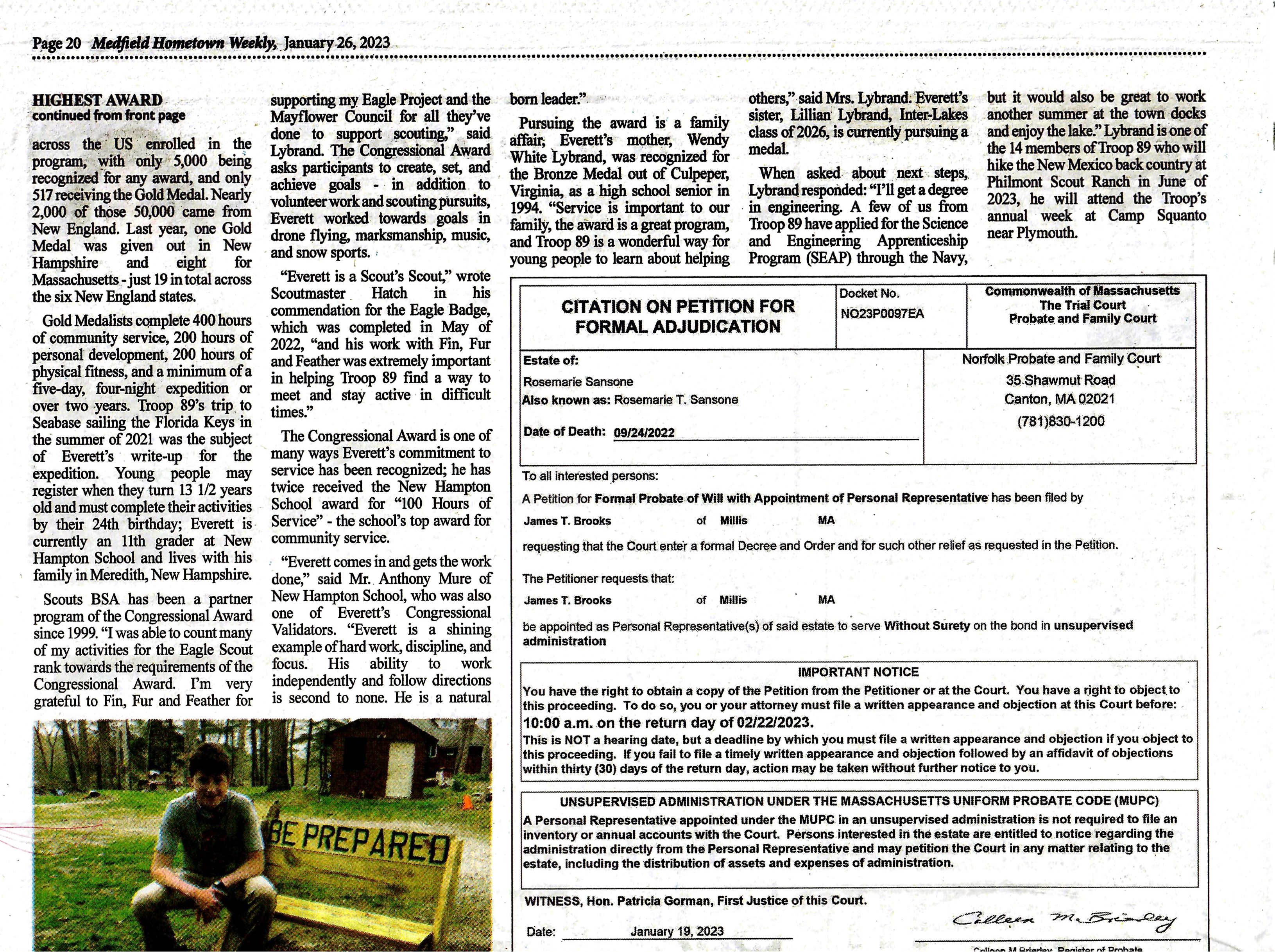
In 1993 my wife earned the bronze medal for the congressional award (“CA”). In February of 2020 my son, Everett Lybrand, began his pursuit of the award and he received the gold medal in November of 2022, he will attend the ceremonies in June of 2023 in Washington DC. Finding consistent numbers for the award can be tricky – from what we can tell there are 50,000 students enrolled in the program at any given time, typically 5,000 are recognized each year (across all certificates and medals), and about 500 receive the top award – the gold medal – in a given year. For the state of New Hampshire, where we live – only one student received the gold medal in the most recent year, only 20 or so received it across the six New England states.

The Congressional Award is the United States Congress’ award for young Americans. It is non-partisan, voluntary, and non-competitive.

CongressionalAward.org

With my wife’s background with the award, and with our son active in Scouts, BSA – the longest running partner organization of the CA – pursuing the award was pretty straight forward for us as a family. Over this time period new resources for the award have emerged.

Why do the award?

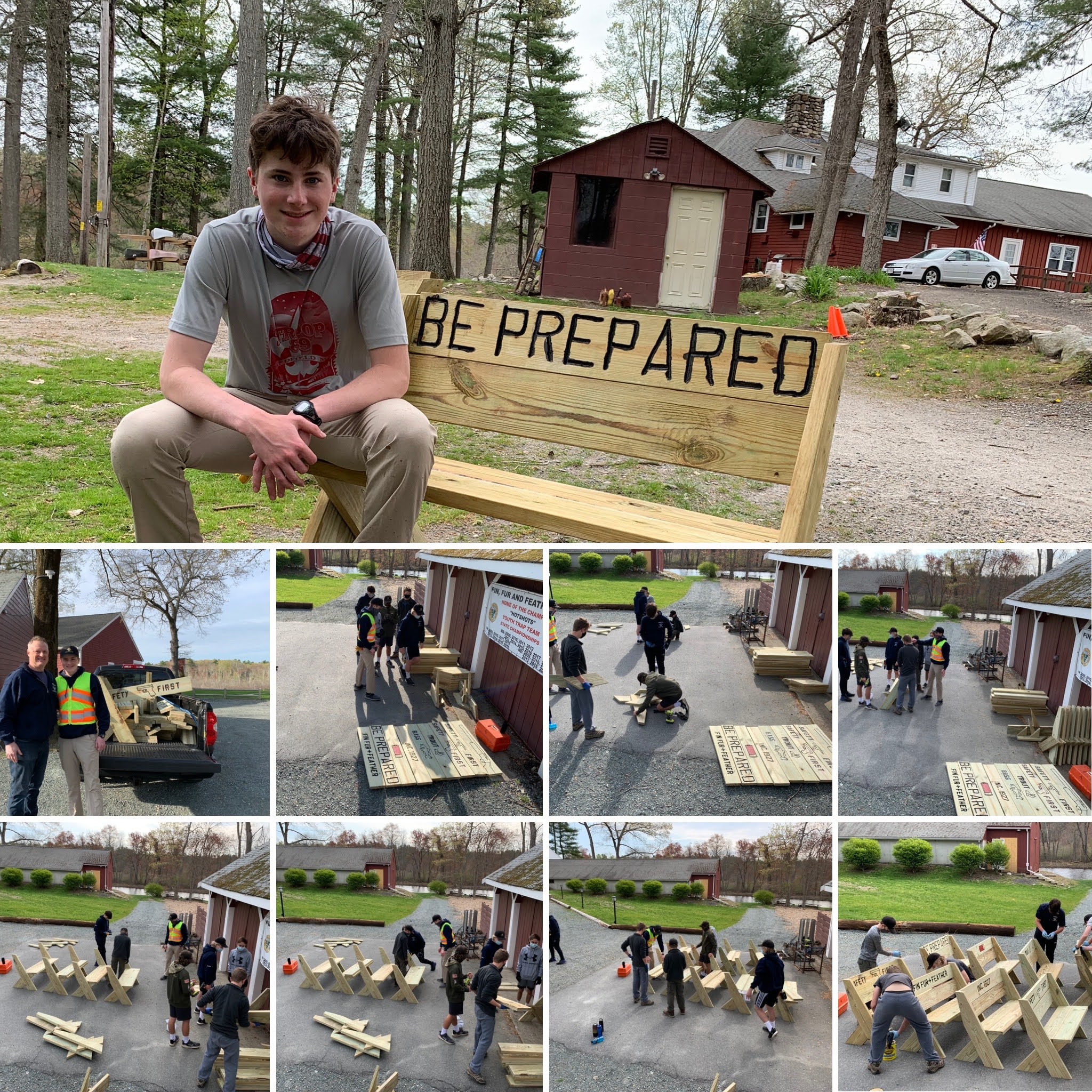
For our son, he was going to do most of the qualifying activities anyway as he had committed to completing the eagle rank with his scout troop. We’re fortunate that he was part of a large, well-organized, well run, New England troop – Troop 89 out of Medfield, Massachusetts. Basically by tracking his activities in the CA’s format, he completed the award with the addition of a write-up for the excursion – which itself was a trip to a Scout High Adventure Camp.

Our daughter is now working towards the award, and for her it provides a nice way to tie together many activities. It’s taking her more time to find the right excursion because she’s not been involved in scouting. The award is a structured way for a student to achieve something, to maintain a relationship with adults, to set goals, and to work towards those goals.

What helped him in pursuit of the award?

Sign up as early as possible. Register here!

Students can begin pursuit of the award at the age of 13 1/2. Sign up as close to that as possible. The gold award requires that the student complete at least one hour towards each of the three categories each month – for the gold medal the time period is 24 months. Registering as soon as possible is the best way to get the ward done in time for college applications, and the cost is only $25.

Do 1 hour each month.

Write goals such that your student can complete at least one hour per month. Our son completed his gold medal over a period of 28 months because he missed opportunities to do an hour a few times early on in his process.

Find experienced advisers & validators.

Just like the board of review process in scouting, the adviser relationship is designed to create consistent interaction for your student with a trusted adult. Our son worked with an experienced trained adult from Scouts BSA. Our daughter is working with a family friend who has served as a director of a private school. All of our son’s validators came from his scout troop or his school.

Meet the Standards.

A big part of scouting is helping the scouts understand that they need to meet the standard, and also that there is no bonus for exceeding the standard. There is no ‘+’ version of a merit badge.

Find help.

There’s a great Facebook page – Congressional Award Support – for people looking for help with the award. Many there are parents or validators who can help answer questions.

Inspire the student.

My guidance to my son for how to write-up his expedition would have been totally wrong. Instead, he sought out others who had done write-ups online. He was able to follow their guidance in constructing his report which was accepted when first submitted.

Track your progress.

We tracked our son’s progress in Google Sheets; I would advise logging in to the digital form that the award uses – Submittable – once at first to see the format. However, I wouldn’t use it to track your progress over time. Enter the information on your own in a format that you control.

Regular reviews.

Our son reviewed his progress with his validator quarterly, our daughter does it monthly.

Pick Reliable Validators and Advisers

A common question on the Facebook group is how to deal with validators and/or advisers that are taking a long time to reply. This can be very frustrating for a student who has had a regular habit of volunteering, only to struggle with a submission that requires a sign-off at the very end, and the adult is nowhere to be found. Pick people that are reliable. Pick an advisor that can also sign off as validator – they should be in the know about the status of the effort.

Posted in Uncategorized | 1 Comment

Untangling: What’s Happening in Chicago? How Much Is Violence an Issue?

Hypothesis:

The nicest parts of Chicago (top 10%) are now much nicer, the safer parts much safer. The skills required by media to explain what’s going on are now much greater than what would be needed in the past. These issues combine to make it difficult to decipher what’s happening in the city from afar. Both patterns – the actual events, and the observation of the events, are fracturing – experiencing a fractal as a result of wealth concentration brought on over the past two years.

Background:

“What’s happening in Chicago?” asks a friend over the phone, “I can’t tell.”

On cable news, on television, Chicago is violent. 44 are shot in one weekend. 8 die. (Link to August 2022 news) My friend lives in Los Angeles, his wife is from South America, they travel the world. “The news can’t be trusted to be accurate,” he says, “what did you see when you were there?”

I visited Chicago to see customers in the suburbs in June, at that time nearly 1,000 people had already been shot in 2022 (Link). My hotel was downtown, in The Loop. Violence occurs nearby (2 killed in Downtown violence, Michigan Avenue Crisis Worsens, Gunfire Near ‘Bean’), but I saw none. Chicago is full of tourists. The violence I see on cable news, on television is similar to that seen by my Angelino friend. Cable and television news does not stop tourists. My personal experience and that of the media does not agree.

The violence is real and does not stop tourism. What’s going on?

“I have a theory,” I say, and attempt to overlay how Mandelbrot’s fractals explain the impact of lockdowns and the past three years. He listens and helps formulate this hypothesis.

  1. The nicest 10% of Chicago is much nicer than the bottom 90%. With the concentration of wealth that has occurred, the nicest 10% of that 10% – the 1% – is now even that much nicer than the 10% – 2% of niceness from which it has emerged.
  2. Likewise, safety has stratified. The safest 10% has now been stratified, such that within it, the safest 10%, the overall top 1%, is now much safer – perhaps truly safe. This area includes the wealthiest neighborhoods and tourist areas most of the time.
  3. The nicest neighborhoods in Chicago are the same (link); near North Side, Gold Coast, Lincoln Park, Old Town, The Loop, Streeterville, Lake View, Wicker Park, River North, Marina City, etc. When the stratification happened, it didn’t knock a neighborhood out wholesale – it created stratification within the neighborhood.
  4. 10% of Gold Coast is even safer than the 90% it as now left behind – the same for Lincoln Park, and all the neighborhoods above, etc. Maybe one building is now much safer than the next. Maybe one floor is safer than another. A fracture has occurred.
  5. How do you know if you’re in the safest part post-fracture? If you have to ask, you are not in it.

Within the nicest and safest parts of Chicago, parts become even nicer, even safer.

Watching cable news, watching television in South America with his wife, my friend sees the same confusing coverage I see in New England because the same stratification has happened to news coverage. The changes from the new stratification to the neighborhoods are too fresh. Media coverage is also stratified, making it less likely for a proper understanding to occur.

In the past, the best 10% of media coverage caught the stratification. Now only the best 10% of the 10% – the 1% – detects the change.

Beforehand, it took the top 10% of media to articulate what was the safest 10% of Chicago:

.10 * .10 = .01

Post fracture, we require the top 10% of the 10% to describe the safest 10% of the 10%:

.10 * .10 * .10 * .10 = .0001

The region of safety decreases from 10% to 1%, making detection more difficult. Because my Angelino friend and I depend on a fallible news media to digest what’s happening, because we’re not locals, the lens used is also lower in quality.

What Would Prove this Wrong?

Crime statistics could show that Chicago is less dangerous, making this whole topic moot.

We could learn that past reporting on crime was no more accurate, making the compounding effect of reporting irrelevant.

If there is a source of information reporting on this accurately – it could be that my Angelino friend and I are the only two people who seem to think violence in Chicago is an issue.

What Would Prove this Right?

If over time, certain areas continued to show less crime – and if those areas were subsets within the previous ‘nice’ areas of no crime. A map would emerge like the illustrations of WW2 airplanes with bullet holes showing what hasn’t been hit.

This could only be proven correct with multiple studies over a long period of time. Socioeconomic and crime data is not quickly gathered.

Posted in Goldratt's The Goal, Policy | Tagged , , , , , , , | Comments Off on Untangling: What’s Happening in Chicago? How Much Is Violence an Issue?