Carnegie 11.3.02: How to Win Friends and Influence People – PRINCIPLE 2 Show respect for the other person’s opinions. Never say, “You’re wrong.” – A Sure Way of Making Enemies—and How to Avoid It

Pages 151 – 163

Carnegie 11.3.2, Pt 3 – PRINCIPLE 2 Show respect for the other person’s opinions. Never say, “You’re wrong.” – A Sure Way of Making Enemies—and How to Avoid It

Best Quote

An adult to young Ben Franklin:

Ben, you are impossible. Your opinions have a slap in them for everyone who differs with you. They have become so offensive that nobody cares for them. Your friends find they enjoy themselves better when you are not around. You know so much that no man can tell you anything. Indeed, no man is going to try, for the effort would lead only to discomfort and hard work. So you are not likely ever to know any more than you do now, which is very little.”

Page by Page

151

“You can tell people they are wrong by a look or an intonation or a gesture just as eloquently as you can in words—and if you tell them they are wrong, do you make them want to agree with you? Never!”

152

Over three hundred years ago Galileo said: You cannot teach a man anything; you can only help him to find it within himself.

As Lord Chesterfield said to his son: Be wiser than other people if you can; but do not tell them so.

153

There’s magic, positive magic, in such phrases as: “I may be wrong. I frequently am. Let’s examine the facts.”

Harold, ‘Our dealership has made so many mistakes that I am frequently ashamed. We may have erred in your case. Tell me about it.’

“You will never get into trouble by admitting that you may be wrong.”

154

Mr S and the Justice, “I made the enormous blunder of telling a very learned and famous man that he was wrong.”

155

Carl Rogers, the eminent psychologist, wrote in his book On Becoming a Person:

“Our first reaction to most of the statements (which we hear from other people) is an evaluation or judgment, rather than an understanding of it.”

156

Drapes – friend lags a compliment (call back to ___)

“Well, to tell the truth,” I said, “I can’t afford them myself. I paid too much. I’m sorry I ordered them.”

157

To Franklin

“Ben, you are impossible. Your opinions have a slap in them for everyone who differs with you. They have become so offensive that nobody cares for them. Your friends find they enjoy themselves better when you are not around. You know so much that no man can tell you anything. Indeed, no man is going to try, for the effort would lead only to discomfort and hard work. So you are not likely ever to know any more than you do now, which is very little.”

158

Franklin “And this mode, which I at first put on with some violence to natural inclination, became at length so easy, and so habitual to me, that perhaps for these fifty years past no one has ever heard a dogmatical expression escape me.

159

“I am convinced now that nothing good is accomplished and a lot of damage can be done if you tell a person straight out that he or she is wrong.”

160

Lumber sales, “Mr. Crowley saw that his firm was losing thousands of dollars through the arguments he won.”

If winning costs you money, then you aren’t really winning.

161

“And at last he saw that the mistake was on their part for not having specified as good a grade as they needed.” All made possible by gentle questions, without objection.

162

Dr. King replied, “I judge people by their own principles—not by my own.”

“General,” he said, “do you not know that the man of whom you speak so highly is one of your bitterest enemies who misses no opportunity to malign you?” “Yes,” replied General Lee, “but the president asked my opinion of him; he did not ask for his opinion of me.”

PRINCIPLE 2 Show respect for the other person’s opinions. Never say, “You’re wrong.”

 

Posted in Uncategorized | Comments Off on Carnegie 11.3.02: How to Win Friends and Influence People – PRINCIPLE 2 Show respect for the other person’s opinions. Never say, “You’re wrong.” – A Sure Way of Making Enemies—and How to Avoid It

Carnegie 10.3.01: How to Win Friends and Influence People: Part 3, Chapter 10 – You can’t win an Argument

Pages 143 – 150.

Carnegie teaches the reader in steps.  Here he is removing a negative tendency – if you disagree with someone, don’t wind up in an argument.  Later in other sections, he builds back up the positive things to do in order to change someone’s mind.  However, here in Chapter 10 he is simply working with the reader to make sure they avoid making a situation worse.

Best Quote

“As wise old Ben Franklin used to say: If you argue and rankle and contradict, you may achieve a victory sometimes; but it will be an empty victory because you will never get your opponent’s good will.”

Page by Page

143

“The raconteur mentioned that the quotation was from the Bible. He was wrong. I knew that. I knew it positively.”

144

Mr. Gammond, “Why prove to a man he is wrong? Is that going to make him like you? Why not let him save his face?”

145

“He is speechless then. There is no room for an argument.”

146

“As wise old Ben Franklin used to say: If you argue and rankle and contradict, you may achieve a victory sometimes; but it will be an empty victory because you will never get your opponent’s good will.”

147

“But as soon as his importance was admitted and the argument stopped and he was permitted to expand his ego, he became a sympathetic and kindly human being.”

148

Buddha said: “Hatred is never ended by hatred but by love,”

Lincoln returns – “No man who is resolved to make the most of himself,” said Lincoln, “can spare time for personal contention.”

149

Keep a disagreement from becoming an argument:

• Welcome the disagreement.

• Distrust your first response.

• Control your temper

• Listen first

• Look for areas to agree

• Be honest

• Promise to think through the other new points

• Thank them for interest

• Postpone action to think

150

PRINCIPLE 1 The only way to get the best of an argument is to avoid it.

Posted in Books, Carnegie | 1 Comment

Carnegie 09.2.6: How to Win Friends and Influence People: Pt 2, Ch 9 – PRINCIPLE 6 Make the other person feel important—and do it sincerely. – How to Make People Like You Instantly

Pages 126 – 138.

Carnegie hits with a simple directive – be interested in people.  He also highlights not to go to far – do not pander.

Best Quote

“What was I trying to get out of him!!! What was I trying to get out of him!!!”

Carnegie’s point here is that he is not pandering, and that he had sincere interest.  He didn’t want to know the other person in order to gain – he just wanted to know them.  Why not?  Life is short.  Say hello to the person next to you.

Page by Page

126

Dale stars again in the opening anecdote.  Carnegie wants to make the clerk like him, so he looks for an honest, sincere compliment to open the dialog.

“So while he was weighing my envelope, I remarked with enthusiasm: “I certainly wish I had your head of hair.””

127

“What was I trying to get out of him!!! What was I trying to get out of him!!!”

“I got the feeling that I had done something for him without his being able to do anything whatever in return for me.“

The law states, “Always make the other person feel important.”

William James said: “The deepest principle in human nature is the craving to be appreciated.”

128

“Do unto others as you would have others do unto you.”

129

“Apparently each thought that she was in charge of this project.”

The subject of the story is in a familiar position – managing a poorly organized non profit activity.

130

“The life of many a person could probably be changed if only someone would make him feel important.”

This is a real truth of Carnegie’s made even more important in a modern world where it can be very hard to connect with others.  Take interest in those who are around you.

131

“To help me never forget this rule, I made a sign which reads “YOU ARE IMPORTANT.”

Carnegie repeats the Emerson quote from earlier:

“Remember what Emerson said: “Every man I meet is my superior in some way. In that, I learn of him.””

132

“This house was built with love.“

Mr. R is acting on the guidance from the earlier chapter – he is being sincere in his listening skills and talking about what his aunt loves – her home.

133

“You appreciate beautiful things.” The Aunt appreciates his interest and rewards him with a car.  The stars of Carnegie’s anecdotes are always quickly rewarded.

134

“Yet in spite of all these tremendous accomplishments, he craved little recognitions even as you and I.”

135

“You remind me of something I had almost forgotten. It is beautiful, isn’t it?”

Even with great wealth, George Eastman appreciates the compliment.

136

“Finally, George Eastman turned to Adamson and said, “The last time I was in Japan I bought some chairs, brought them home, and put them in my sun porch. But the sun peeled the paint, so I went downtown the other day and bought some paint…”

137

“You mean a great deal to me and to this company, and you are as important to the success of this restaurant as I am.’”

138

“Talk to people about themselves,” said Disraeli, one of the shrewdest men who ever ruled the British Empire, and they will listen for hours.”

PRINCIPLE 6 Make the other person feel important—and do it sincerely.

Posted in Books, Carnegie, Methods | 1 Comment

Carnegie 08.2.5: How to Win Friends and Influence People: Pt 2, Chapter 8 – PRINCIPLE 5 Talk in terms of the other person’s interests.- How to Interest People

There is no better way to learn about someone than to prod them into telling you about their favorite things.  Vacations, hobbies, pets, loved ones and fears – one of the best ways to help someone speak is to make it possible for them to speak about themselves.

Best Quote

‘Mr. Funkhouser, I believe I can make money for you.’

As of 2010, there were fewer than 4,000 American Funkhousers according to the US Census.  It was one of their progenitors that most likely spoke this wonderful line in the pursuit of a lucrative new job.  It is memorable, clear and to the point.  It also spoke to Mr. Funkhouser’s primary interest – making money.

funkhouser

Page by Page

121

“For Roosevelt knew, as all leaders know, that the royal road to a person’s heart is to talk about the things he or she treasures most.”

122

“He talked in terms of what interested the other man.”

123

Hotelier, “I decided to find out what interested this man—what caught his enthusiasm.”

124

‘Mr. Funkhouser, I believe I can make money for you.’

125

PRINCIPLE 5 Talk in terms of the other person’s interests.

Posted in Uncategorized | Comments Off on Carnegie 08.2.5: How to Win Friends and Influence People: Pt 2, Chapter 8 – PRINCIPLE 5 Talk in terms of the other person’s interests.- How to Interest People

Carnegie 07.2.4: How to Win Friends and Influence People – PRINCIPLE 4 Be a good listener. Encourage others to talk about themselves.- An Easy Way to Become a Good Conversationalist

One of the first true ‘self-discovery’ books I read was Rebecca Zhafir’s, The Zen of Listening.  Like Carnegie, her soft cadence helped the reader feel under solid control when listening to another’s story.

Best Quote

“And so I had him thinking of me as a good conversationalist when, in reality, I had been merely a good listener and had encouraged him to talk.”

The stories where Carnegie uses himself in the persuasion lessons are always interesting – in this seventh chapter we open with him describing a socialite who opens politely, but really wants to tell her own stories.

Page by Page

110

Dale Carnegie doesn’t play bridge? He does not play bridge!?! Sad.

“Oh, Mr. Carnegie, I do want you to tell me about all the wonderful places you have visited and the sights you have seen.”

“I was this and I was that, and he ended by saying I was a “most interesting conversationalist.” An interesting conversationalist? Why, I had said hardly anything at all.”

“All she wanted was an interested listener, so she could expand her ego and tell about where she had been.“

111

“And so I had him thinking of me as a good conversationalist when, in reality, I had been merely a good listener and had encouraged him to talk.”

“Harvard president Charles W. Eliot, “There is no mystery about successful business intercourse. … Exclusive attention to the person who is speaking to you…””

112

“… He listened with his mind and attentively considered what you had to say while you said it. … At the end of an interview the person who had talked to him felt that he had had his say.”

113

Carnegie’s persuasive writing has a pattern.  Parenting is a common topic and point of view.

“Robert responded: “No, but I really know you love me because whenever I want to talk to you about something you stop whatever you are doing and listen to me.””

114

One of Carnegie’s vignettes calls back to a common topic – the modern telephone. 

“He got this feeling of importance at first by kicking and complaining.“

115

“I listened patiently to all he had to say.“

116

“Later, when his wife presented him with a baby boy, he gave his son the middle name of Detmer, and he remained a friend and customer of the house until his death twenty-two years afterwards.”

Carnegie is so convincing in his persuasiveness, it is almost as if he went a step to far just to get the reader to say, “there is now this happened.”  Whoever has heard of an angry customer pivoting hard and naming their child after a vendor?

117

“He wrote General Grant asking about a certain battle, and Grant drew a map for him and invited this fourteen-year-old boy to dinner and spent the evening talking to him.”

Lincoln drapes the $5 bill, Grant adorns the $50.

118

As the Reader’s Digest once said: “Many persons call a doctor when all they want is an audience.”

119

Even Lincoln needed a listener.

“Lincoln had done all the talking himself. That seemed to clarify his mind. “He seemed to feel easier after that talk,” the old friend said.”

“In describing Freud, “You’ve no idea what it meant to be listened to like that.””

“A person’s toothache means more to that person than a famine in China which kills a million people.”

120

PRINCIPLE 4 Be a good listener. Encourage others to talk about themselves.

Posted in Carnegie | Comments Off on Carnegie 07.2.4: How to Win Friends and Influence People – PRINCIPLE 4 Be a good listener. Encourage others to talk about themselves.- An Easy Way to Become a Good Conversationalist

Carnegie 06.2.3: How to Win Friends and Influence People: Pt 2, Chapter 6 – PRINCIPLE 3 Remember that a person’s name is to that person the sweetest and most important sound in any language. – “If You Don’t Do This, You Are Headed for Trouble”

In the Lord of the Rings series, Tolkien introduces the famous character Smeagol with his declaration:

“I am not going to tell you my name, not yet at any rate.”

Names have power.  Carnegie teaches about their power.

Tolkien_Quote

Best Quote

“We should be aware of the magic contained in a name and realize that this single item is wholly and completely owned by the person with whom we are dealing … and nobody else.“

Page by Page

100

He said, “Hard work,” and I said, “Don’t be funny.”

101

“No. You are wrong,” he said. “I can call fifty thousand people by their first names.”

“The final list contained thousands and thousands of names; yet each person on that list was paid the subtle flattery of getting a personal letter from James Farley.”

102

“Remember that name and call it easily, and you have paid a subtle and very effective compliment.”

103

“He told the boys and girls in the neighborhood that if they would go out and pull enough clover and dandelions to feed the rabbits, he would name the bunnies in their honor.”

104

“People are so proud of their names that they strive to perpetuate them at any cost.”

105

“Libraries and museums owe their richest collections to people who cannot bear to think that their names might perish from the memory of the race.”

As we walk further down Carnegie’s path of persuasion, another of his methods appears – he will often identify an objection, validate it – and then remove it.

“Most people don’t remember names, for the simple reason that they don’t take the time and energy necessary to concentrate and repeat and fix names indelibly in their minds.”

… “But they were probably no busier than Franklin D. Roosevelt,”

106

“When the driving lesson was finished, the President turned to me and said: ‘Well, Mr. Chamberlain, I have been keeping the Federal Reserve Board waiting thirty minutes.“

Callback to other points of the book – and a look ahead!

107

“One of the first lessons a politician learns is this: “To recall a voter’s name is statesmanship. To forget it is oblivion.””

108

“We should be aware of the magic contained in a name and realize that this single item is wholly and completely owned by the person with whom we are dealing … and nobody else.“

PRINCIPLE 3 Remember that a person’s name is to that person the sweetest and most important sound in any language.

Posted in Carnegie, Trust | Comments Off on Carnegie 06.2.3: How to Win Friends and Influence People: Pt 2, Chapter 6 – PRINCIPLE 3 Remember that a person’s name is to that person the sweetest and most important sound in any language. – “If You Don’t Do This, You Are Headed for Trouble”

Carnegie 05.2.2: How to Win Friends and Influence People: Pt 2, Chapter 5 – Smile – “A Simple Way to Make a Good First Impression”

5.2 Carnegie, How to Win Friends and Influence People – Part 2, Chapter 2 – Smile – “A Simple Way to Make a Good First Impression”

Watch Instead: (Carnegie Video Shorts – Smile)

In these early chapters, Carnegie is just laying out basic ground rules on how to work with other people.  It is a lot easier to work with others when you smile.

Best Quote

Professor James V. McConnell, a psychologist at the University of Michigan, expressed his feelings about a smile. “People who smile,” he said, “tend to manage, teach and sell more effectively, and to raise happier children.”

Page by Page

091

“Actions speak louder than words, and a smile says, “I like you. You make me happy. I am glad to see you.””

092

“Professor James V. McConnell, a psychologist at the University of Michigan, expressed his feelings about a smile. “People who smile,” he said, “tend to manage, teach and sell more effectively, and to raise happier children.””

093

“You must have a good time meeting people if you expect them to have a good time meeting you.”

094

“I find that smiles are bringing me dollars, many dollars every day.”

095

“Act as if you were already happy, and that will tend to make you happy.”

096

“Abe Lincoln once remarked that “most folks are about as happy as they make up their minds to be.””

097

“Essayist Elbert Hubbard, “Do not fear being misunderstood and do not waste a minute thinking about your enemies. Try to fix firmly in your mind what you would like to do; and then, without veering off direction, you will move straight to the goal.””

098

“Chinese proverb “A man without a smiling face must not open a shop.””

099

Vignette – the value of a smile at Christmas.

Smile!

Smile

Posted in Carnegie, Filtration, Methods | Comments Off on Carnegie 05.2.2: How to Win Friends and Influence People: Pt 2, Chapter 5 – Smile – “A Simple Way to Make a Good First Impression”

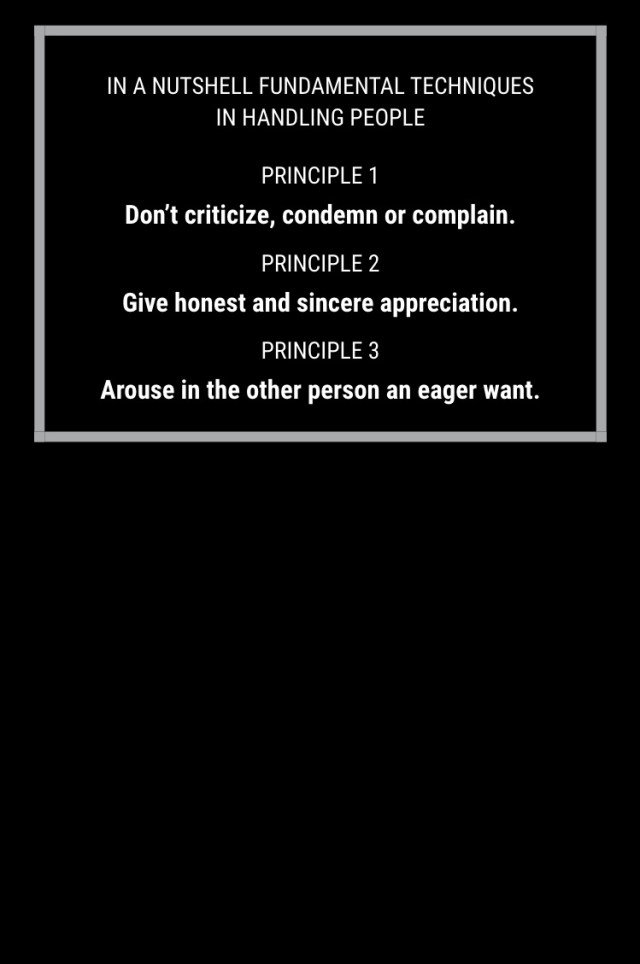
How to Win Friends and Influence People: Carnegie’s 3 “In a Nutshell Fundamental Techniques in Handling People”

Carnegie’s book begins with three fundamental techniques for handling people – 1/ don’t critize, 2/ give sincere appreciative, 3/ arouse an eager want.

Part One: Fundamental Techniques in Handling People

1. If You Want to Gather Honey, Don’t Kick Over the Behive

2. The Big Secret of Dealing with People

3. He Who Can do This Has the Whole World with Him, He who Cannot Walks a Lonely Way

Posted in Books, Carnegie, Uncategorized | Comments Off on How to Win Friends and Influence People: Carnegie’s 3 “In a Nutshell Fundamental Techniques in Handling People”

Carnegie 04.2.1: How to Win Friends and Influence People – PRINCIPLE 1 Become genuinely interested in other people – “Do This and You’ll Be Welcome Anywhere”

The chapter title is, “Do This and You’ll Be Welcome Anywhere”, which Carnegie answers with – PRINCIPLE 1 Become genuinely interested in other people.

Best Quote(s)

“I love my audience. I love my audience.”

“I love being here,” is a great internal mantra, regardless of where you find yourself.

Page by Page

077

But a dog makes his living by giving you nothing but love.

You can make more friends in two months by becoming interested in other people than you can in two years by trying to get other people interested in you.

078

The New York Telephone Company made a detailed study of telephone conversations to find out which word is the most frequently used. You have guessed it: it is the personal pronoun “I.” “I.” “I.” It was used 3,900 times in 500 telephone conversations.

079

Alfred Adler, ““It is the individual who is not interested in his fellow men who has the greatest difficulties in life and provides the greatest injury to others. It is from among such individuals that all human failures spring.”

“If the author doesn’t like people,” he said, “people won’t like his or her stories.”

080

“I love my audience. I love my audience.”

081

By having a sustained interest in other people, he created a new life for himself at a time when most people consider their productive years over.

082

Personal story – I left with my tail between my legs and drove around the town for several hours.

083

I have discovered from personal experience that one can win the attention and time and cooperation of even the most sought-after people by becoming genuinely interested in them.

084

If we want to make friends, let’s put ourselves out to do things for other people—things that require time, energy, unselfishness and thoughtfulness.

085

If we want to make friends, let’s greet people with animation and enthusiasm.

086

“The next afternoon I called on this man and sent in word that I had some stamps for his boy.

087

“I’m anxious to win this debate, and I’ll deeply appreciate whatever help you can give me.”

088

“I had made more headway in two hours by becoming genuinely interested in him and his problems than I could have made in ten years trying to get him interested in me and my product.”

“Publilius Syrus, remarked: “We are interested in others when they are interested in us.””

089

“My father was dead; my mother and I lived alone in a small apartment and we were on welfare.”

A great deal of Carnegie’s anecdote structure is based on personal success.  The focus of the story has risen from poverty and great challenge to overcome the odds and control their fate.

090

PRINCIPLE 1 Become genuinely interested in other people.

Posted in Books, Carnegie, Methods, Theory, Trust, Uncategorized | Tagged , , | Comments Off on Carnegie 04.2.1: How to Win Friends and Influence People – PRINCIPLE 1 Become genuinely interested in other people – “Do This and You’ll Be Welcome Anywhere”

How to Win Friends and Influence People: Pt 1, Ch 3 – PRINCIPLE 3 Arouse in the other person an eager want – “He Who Can Do This Has the Whole World with Him. He Who Cannot Walks a Lonely Way”

How to Win Friends and Influence People – Chapter 3 – PRINCIPLE 3 Arouse in the other person an eager want. – “He Who Can Do This Has the Whole World with Him. He Who Cannot Walks a Lonely Way”.  Carnegie’s point in this chapter is that action occurs when we know what the other party wants.  Only by focusing on their wants, creating alignment and ultimately a shared vision – can we help create movement.

Best Quote

“So the only way on earth to influence other people is to talk about what they want and show them how to get it.” Page 55

Carnegie uses a poorly written mailer as an example of how companies fail when they focus on what they want, rather than what the customer wants.  He reproduces the mailer – along with his humorous feedback.  His point below has stuck with me:

“[Who cares what your company desires?]” Page 61

Page by Page

055

“Why not use the same common sense when fishing for people?”

“So the only way on earth to influence other people is to talk about what they want and show them how to get it.”

056

“Every act you have ever performed since the day you were born was performed because you wanted something.”

“First, arouse in the other person an eager want.” Overstreet

057

“Then Carnegie offered to wager a hundred dollars that he could get an answer by return mail, without even asking for it.”

Note the very subtle call back to Abraham Lincoln whose image graces the $5 bill that Carnegie pledged to his nephews to prompt their reply. Dale Carnegie is **that** good.

058

“Tomorrow you may want to persuade somebody to do something. Before you speak, pause and ask yourself: “How can I make this person want to do it?””

059

Carnegie uses a first person anecdote, where the cost of a conference room for a training session is discovered to be 3x that which he was told.  He does not get angry, rather he searches to find out what the owner wants.

“I was a bit shocked when I got your letter,” I said, “but I don’t blame you at all.”

060

“Mind you, I got this reduction without saying a word about what I wanted. I talked all the time about what the other person wanted and how he could get it.”

061

Carnegie analyzes a mailer from a business that doesn’t follow the guidance of Chapter 3.  It is bad.  Carnegie’s blunt responses are funny.

“[Who cares what your company desires?]”

062

“[…If you had as much sense as a half-witted hummingbird, you would realize that I am interested in how big I am—not how big you are. All this talk about your enormous success makes me feel small and unimportant.]”

“We desire to service our accounts with the last word on radio station information.”

“A prompt acknowledgment of this letter, giving us your latest “doings,” will be mutually helpful.”

Every little line from the self-absorbed mailer is painful to read.  Carnegie’s comments are funny.  The point of corporate narcissism being a bad way to win customers is well made.

063

“[Finally, down here in the postscript, you mention something that may help me solve one of my problems.]”

This might have been a toss-away comment from Carnegie – but the small part that is useful to him is but a trifle.  It is amazing how small efforts to make things easier for a customer can be well received.

064

“Let’s not waste any time talking about our problems.”

065

“However, we regret to say that it isn’t possible for us to do that when your trucks bring us a large shipment late in the afternoon, as they did on November 10.”

Carnegie’s anecdote here focuses on a customer who wants to get customers to better organize shipments, and they are effective by following the method.

066

“Thousands of salespeople are pounding the pavements today, tired, discouraged and underpaid. Why? Because they are always thinking only of what they want.”

067

“He told me again that I could get it by telephoning, and then asked me to let him handle my insurance.”

068

“The world is full of people who are grabbing and self-seeking. So the rare individual who unselfishly tries to serve others has an enormous advantage. He has little competition.”

069

“Looking at the other person’s point of view and arousing in him an eager want for something is not to be construed as manipulating that person so that he will do something that is only for your benefit and his detriment. Each party should gain from the negotiation.”

070

“I want to play basketball.”

“First, arouse in the other person an eager want.”

071

“What were his wants?”

072

“The father, looking at the bed, obeyed Charles Schwab’s injunction: he was “hearty in his approbation and lavish in his praise.””

073

“PRINCIPLE 3 Arouse in the other person an eager want.”

Posted in Books, Carnegie, Methods | Tagged , | 1 Comment