Biography: Harry S Truman

Audible.com is one of my favorite websites.

The accomplishments of the 33rd US President, Harry S Truman, and the methods he used to achieve them are a great guide for the increasing complexity of the modern world.  Truman spoke clearly and did what he thought was right.

I just finished the 54 hour David McCullough biography of President Harry S Truman.  Having been on a biography kick lately, my interest in Truman grew out of some exposure to the surveillance challenges faced by Eisenhower and the technology Eisenhower deployed to address those challenges.  Having preceded Eisenhower in the White House, it was fascinating how different the two administrations used technology to face challenges.

Still, Truman’s role in shaping the current modern world was impressive:

Official Presidential Portrait, via Wikimedia.

  • Served in the artillery in World War I.
  • As a senator his “Truman Committee”, formed in 1941, would make sure that US Industry focused on winning the war, not maximizing their profits.
  • Chosen to serve as Vice President to an ailing Franklin D. Roosevelt over the encumbent Vice President, Henry Wallace.
  • Took over as President 82 days after the inauguration.
  • The surrender of Germany on May 8, 1945.
  • Attended the July Potsdam conference with Stalin and Churchill, which would establish the geopolitical framework for the rebuilding of Europe.
  • Decided to drop the Atomic bomb on Japan in August 1945.
  • Oversaw the de-militarization of the US economy including an awkwardly handled national railroad strike in 1946.
  • The creation of the United Nations, including persuading Stalin to include the USSR.
  • The Truman Doctrine, which called for the containment of Russian expansion.
  • The creation of the Marshall Plan, which called for the re-industrialization of Western Europe.
  • The consolidation of the Navy and Army under the Secretary of Defense, the creation of the US Air Force and the CIA.
  • The Berlin airlift, which avoided confrontation with Russia.
  • Recognition of Israel as a state.
  • Won his own election in 1948 with an audacious ‘Whistle-Stop’ tour that covered over 20,000 miles – directly appealing to the people.  This was one of the greatest failures of modern poll-making, as his Republican opposition, Dewey, was heavily favored.
  • He ordered the integration of the armed forces.
  • He mobilized and stopped the N. Korean invasion of S. Korea – entering the US into the Korean War.
  • He encouraged MacArthur’s early bold actions in the Korean War, and then stepped in to ensure that the military was fully subordinate to the civilian government by firing MacArthur for insubordination.
  • He saw the creation of the Atomic Energy Commission, ensuring civilian oversight of nuclear energy and nuclear weapons.
  • After appointing Marshall Secretary of State, he watched as the Chinese communists won out over their corrupt Nationalistic opposition, which was eventually vanquished to Taiwan.
  • He oversaw and did what he could to oppose the rise of Joseph McCarthy.
  • He oversaw the rebuilding of the White House, which had fallen into disrepair.
  • He survived an assassination attempt, appearing on schedule for a speech later that same day.
  • Truman oversaw a clean-up of the IRS, which had begun the habit of taking bribes.
  • He commissioned a sweeping survey of Civil Rights, which was to establish the legal framework for integration.
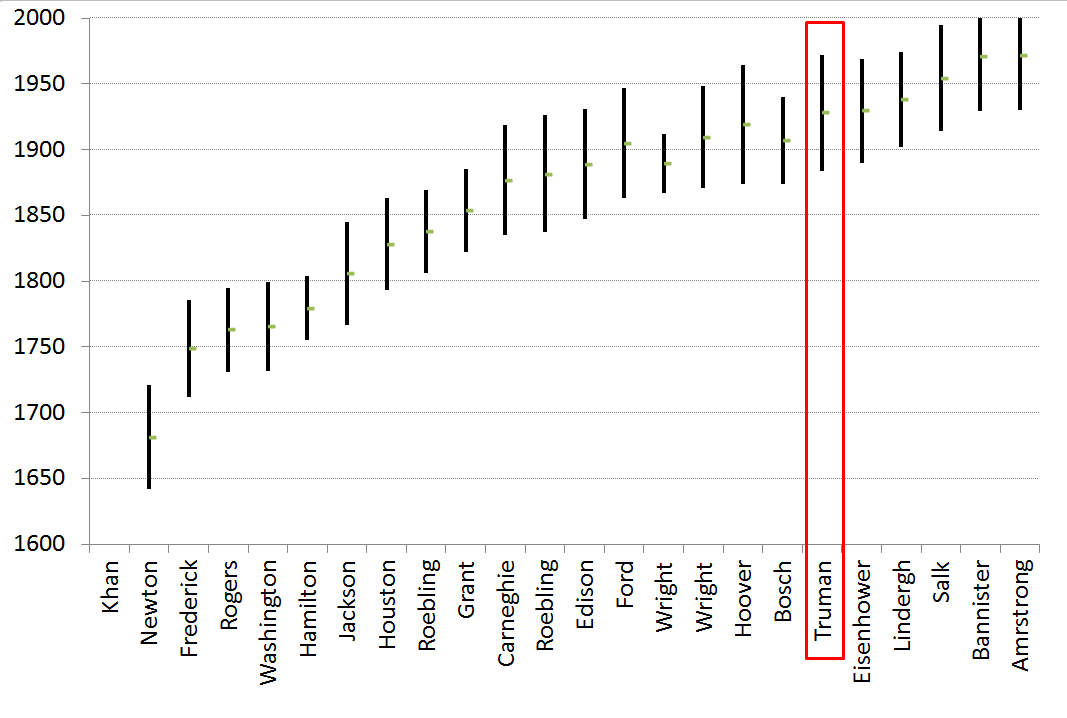
Truman (his lifespan highlighted in red) has a significant number of accomplishments, even when compared to an illustrious set of peers.

Truman was a plain spoken man from Independence, Missouri – he fully believed that when presented with the true options, the American people would always make the right decision.  It is refreshing to read about how his clear, direct communication was able to enable so many institutions and changes that continue to serve as institutions core to the modern world.

Posted in History, Uncategorized | Tagged , , , , , , , | 1 Comment

An Apology to my European IT Team

In 2008 I dismissed my Czech colleagues concerns about email oversight, only to see their concerns be validated in 2013.

In 2008 when we were opening the US office for a European maker of membrane production equipment, we had all of the early IT choices someone has to make when first opening a business.

  • How should we access email?
  • What CRM tool should we use?

From our standpoint, that was easy.  We should use a Google/Apps account and Salesforce.com, both of which we’d worked with quite a bit.

You could feel the head of our Czech IT team recoil in horror over the phone.  “No, we will put a server in your office and here are the applications we’ll use.”  We pushed back, talking about how while hosted solutions were then rare in Europe, they were commonly used here in the US.  He sent us an email with highlights of the Google Terms and Conditions that would preclude us from working with them.

We sell heavy industrial equipment to entities all over the world, including some foreign governments.  Any possibility that our emails could be remotely read in one jurisdiction would make it hard to work with governments in another.

My colleague went on to make another point, “As written, someone could go into our account and take confidential information, and we would never know.  This way, they would at least have to come get our server – we would know that the information was out there and decide what to do next.”

I then argued that things don’t work that way in the US, that there is judicial oversight, extensive use of warrants and that the activities such email tracking programs pursue don’t pertain to our business.  My colleague, who grew up under Communism and had lived through the Velvet Revolution in 1989 replied,

“On one hand I’m glad you have grown up in an environment where you’re able to trust your government so much, and on the other I’m sorry to tell you that governments can change.”

As more information comes out on Prism, two criteria consistently show up that we would have consistently triggered oversight:

  • Almost all of our emails, phone calls or other digital correspondence have a participant outside of the US.
  • Because of the sensitive nature of machine design, much of our work is sent encrypted.

Their concerns were sadly correct – they were right, I was wrong.

Edit: The Hacker News discussion thread covers most of these points in a better way than I can.

Posted in Business | Tagged , , , , , | 17 Comments

Filtration in the Popular Media: Singapore Smoke

From the Economist Article, “Hazed and Confused.”

This June 21st article from the Economist, “Hazed and Confused; Smog over Singapore” covers the recent pollution challenges in Singapore.  The pollution is caused from fires used to clear lands in neighboring Indonesia – the smoke crosses the sea, making life miserable for the people of Singapore.

The Pollutant Standards Index (“PSI”) topped 401, with previous readings of 371 and 321.  A 1997 score of 226 created concern.  Over 200 is considered, “Very Unhealthy.”

The original US EPA classifications for the PSI and AQI.

As with any metric, the standards vary dramatically.  Singapore still uses the PSI, which counts the micro-grams of material per cubic meter of air per day.  The US has now moved on to the Air Quality Index (“AQI”) – which focuses on the size of the particulate in addition to their concentration levels.  Respirable Suspended Particles (“RSP”) have diameters of 10 um or less.  AQI focuses on Particulate Matter of 2.5 um (“PM2.5”) or smaller.

In the US filtration industry – PM2.5 would be picked up in a conventional filter depending on its MERV rating.  The E3 channel covers particles from 3 – 10 um; the E2 channel from 1 – 3, and the E1 from 0.3 – 1 um.  A MERV 16 filter would pick up at least 95% of the PM2.5 (> 95% E2 and E3 capture).

Filtration media could be used to make the facemasks more comfortable and to improve the indoor air quality for the people of Singapore looking to get out of the smoky outdoors.  Providing that same efficiency of particulate remover with a lower pressure drop would reduce energy costs and likely allow for longer filter life.

Posted in Disruption, Industry, Textile | Tagged , , , , , , , | 1 Comment

Autonomous Vehicles: The Future of the Car

A Google Driverless Vehicle going through the paces on a test course. Photo from Wikimedia.

There’s a coming inflection in how data and computational power are used in how we interact with vehicles.  Google is focused on self-driving vehicles, Ford is betting big on connected vehicles and finding business models that improve the safety and efficiency of vehicles is increasingly important.

Freakonomics Radio’s recent podcast, “Baby You Can Program My Car” outlines some of the statistics that will drive adoption.  Steven Dubner, author of “The Hidden Side of Everything” interviewed Dr. Raj Rajkumar of Carnegie Mellon University, where he works on autonomous vehicles.  The high level statistics are impressive.

  • 93% of auto accidents are due to human error.
  • 34,000 traffic deaths per year in the US alone.
  • 2,000,000 adults go the emergency room per year in the US.
  • 1,000,000 traffic deaths per year globally.
  • 80% of drivers rate themselves ‘Above Average’ – people like to drive.
  • Industries effected: Auto, Insurance, Healthcare, Logistics, Entertainment (drink all you want, the robot will drive you home)

“Do not let humans drive” appears to be an effective rule in reducing vehicle accidents in cities, low speeds, high speeds and almost every possible situation.  CMU is working with General Motors on a vehicle that doesn’t have all of the extraneous components so frequently seen on the Google vehicles and is lower in cost.  My alma mater, The University of Virginia, had also spent time creating autonomous vehicles, one of which, Tommy Jr. (named after Thomas Jefferson) participated in an early DARPA challenge.

Update: June 2013

The Free University of Berlin is pursuing self-driving cars, positioning Germany as a leader in the field.  Their Volkswagen Passat is a testbed for what Germany hopes will be a fleet of autonomous taxis.  The latest German-made Mercedes S-Class has both a camera to focus on the road and multiple radar sensors.  A Director at Mercedes expressed his belief that vehicles will be functioning on their own, “in a couple of years.”

Posted in Uncategorized, Vehicle | Tagged , , , , | Comments Off on Autonomous Vehicles: The Future of the Car

X is a Historical Accident

This article from paidContent explores the question, “What if the ‘mass media’ era was just an accident of history?”  Matthew Ingram, the author, talks about how there is “pervasive nostalgia” within the media business for the good old days.  The article touches on many of the same comments made by Peter Chernin related to Peak DVD, and is the same trend I’d observed in regards to Peak Television.

‘X is a Historical Accident’ is a scenario where an X is in decline, it has past Peak X, and whatever will be replacing X is different and likely found to be surprising.  Ingram’s points on the decline of traditional media (the existence of Peak DVD and Peak Television) are in line with the Peak X conversation – what he adds is the observation that whatever is coming next may be very different.

Ingram outlines a Peak X, where Y is very different than X.  In this case, he argues that this age of traditional media, where advertising and content flow through centralized entities, is a historical accident, and that the growing move to individuals broadcasting their experiences is a reversion to the historical mean.

Posted in Innovation, Theory | Tagged , , | Comments Off on X is a Historical Accident

Materials Science Reporting: Stronger, Lighter Elevator Cables

This German elevator illustration is from 1405; mass commercialization began in 1852 with Otis’s invention of the ‘Safety Elevator’ which included a counter-weight to the cab.

Reporting on innovations in the materials science field tends to follow the Gartner Hype Cycle – most early reports are vague, full of promises, and ultimately a few years later, nothing has been delivered.  The Economist’s recent article on innovations in elevator cables is a great example to the contrary – it is a real innovation, near to commercialization, overseen by a group that understands technology scale up that has a practical impact on society.

Using the materials science framework of: Process => Structure => Properties => Performance, provides an easy way to appreciate the clarity provided in this article.

Process

We’re not provided with any detail on the rope production process – but we are provided with the most important detail in that the maker is Kone, a Finnish elevator maker.  Unlike other materials science innovations where the primary source is an academic or research laboratory, the source here is an entity that is well familiar with their target industry and understands what it takes to produce material at scale and at a cost that is attractive to their target market.

Structure

The structure of the cable is also slim on details – but we’re told that it is swappable with current elevator cable technology.  Reverse compatibility is more important in materials science product adoption than in many other industries.  As a new material flows out into the supply chain, the users just want it to work.  Further, many times a full list of all the characteristics needed for the material to work isn’t available.  The only way a user can find out that it doesn’t work in a certain scenario is when it fails – a scenario not acceptable with an elevator cable.  In the article, The Economist leads with the fact that Kone has a 333 meter deep test shaft to exercise new materials – test rigs that replicate operating scenarios are crucial in the commercialization of new materials.

Properties

The article notes that a 400 meter tall lift would require a steel cable that weights 18,650 Kg, while a carbon fiber lift would only weight 1,170 Kg – a 94% reduction in the weight of the cable.  The author states that in combination with the cab, the reduction in weight of the entire assembly is 45% – perhaps that 20,000 Kg cab should also be made of carbon fiber.  Weight is the primary novel property of this new cable.

Performance

Many times in materials science, performance is achieved at a needed grade – here the strength of the cable is fixed.  It must be strong enough to support the cab, which means having the appropriate tensile strength and other properties.  There is a fixed performance grade, the major impact is reducing the weight of the cable while maintaining strength.  A stronger cable with no reduction in weight, would not have any benefit.

Connection

Tall buildings create a connection with why we care about lighter elevator cables – this connection is crucial in successful commercialization.

Lastly, the reason that this story resonates is because the lighter weight of the cable enables performance of taller buildings.  This human interest component – the thought of buildings rising a kilometer or more, unconstrained by the limits of modern elevator systems, is what gets an institution of The Economist’s caliber involved.  Often times it is the final element of pull – the ability to connect how a new material will enable societal goals, that is the real determinant in how successful a new material can be.

Lighter, high strength cables, could be useful in many industries – the article even touches on the Space Elevator concept.  Cables may not find their way into the main stream via usage in elevators – it could be maritime, construction, automotive or any of a dozen other applications, but buildings may serve as the beachhead market which provide cash flow for their makers until product market fit is found.

Posted in Business, Disruption, Industry, Innovation, Invention, Materials Science | Comments Off on Materials Science Reporting: Stronger, Lighter Elevator Cables

Email is the New Telegraph

India currently sends about 5,000 telegrams a day.  The same telegram that was pioneered in 1837 by Samuel Morse.  Telegram service is scheduled to end ‘next month’ according to the article and India’s system is the last of its type – this will be the last telegram sent.  Peak telegram for India was 60 million telegrams per year with a distribution network of 45,000 offices – and that occurred in 1985, a dozen years after Motorola first developed the cell phone.

Posted in Business, Disruption, Industry, Innovation | Tagged , , | Comments Off on Email is the New Telegraph

X is the New Y!: Product Succession

“Cycling is the new golf” proclaimed The Economist in an April 2013 article, which caused me to go dig up an older series of articles that began in 2006 stating, “Is World of Warcraft the New Golf?”  Maybe we should just state that video games are the new golf, since this 2010 article stated, “Halo – It’s the New Golf” and outlined how the BBC had a team that was issuing open challenges.

Edgerton's text covers how mature, established products show persistence and resilience in the face of innovation.

Edgerton’s text covers how mature, established products show persistence and resilience in the face of innovation.

I’m skeptical of any article where the lede is “X is the New Y”, but they are fascinating because it stimulates discussion about product and material succession.  As Prof. David Edgerton explains in his book, “The Shock of the Old,” Y tends to be more resilient than we expect.  Rifles remain more lethal than bombs and bicycles rack up more transport miles than airplanes and cars.

The US housing boom financed a huge growth in the number of golf courses in the US – over 3,000 new courses were built between 1990 and 2005, representing over 20% of the golf course inventory in 2005.

“Golf was so dramatically overbuilt in the 1970s, 1980s and 1990s that I believe we’ll continue to see a conversion of older public courses to residential,” Boud [an Irvine based real estate consultant] says.

Peak Golf

Somewhere in the late 1990’s and early 2000’s that combination of low interest rates fueled a housing and golf course building boom.  Good times and high household earnings made spending a 5 hour round using brand new carbon fiber golf clubs an easy thing to do.  Since that time, every golf metric has moved the other way – there are 4 million fewer people who consider themselves golfers (14% decline since ’05), fewer than 16,000 courses (2% decline since ’05) and most importantly fewer than 465 million rounds played per year (7.5% decline since 2005 and 11% decline since 2000).

Golf was at the top – Peak Golf was inevitable.  X is the new Y and X is the new Golf, because Golf had nowhere to go but down.

Golf courses, golf players and rounds per year have been on a steady decline.

Golf courses, golf players and rounds per year have been on a steady decline.

Posted in Business, Disruption, Industry, Innovation, Invention | Comments Off on X is the New Y!: Product Succession

Peak X: Applying Hubbert’s Peak Theory Beyond Natural Resources

Peak oil by production basin.

Shell Oil Geologist Dr. M. King Hubbert (1903 – 1989) coined the phrase ‘Peak Oil’ based on his observations about petroleum production rates for a given geographic area.  Hubbert’s “Peak Theory” would be broadly stated as, “for a given geographic region, the rate of petroleum production tends to follow a bell-shaped curve.”  Production begins, production grows, and then production slides.

Dr. Hubbert’s prediction in 1956 that the US would reach peak output in 1970 shocked the industry because of the financial and geopolitical implications.  Since that time Peak Theory has been applied to many other markets, with an established framework for its adoption in natural resources and increasing adoption in other areas.

Peak Dinosaur

Hubbert’s Peak Theory can be applied to society’s rate of discovery of new dinosaur type species.

In this 2009 Slate Article, the author takes Hubbert’s Peak Theory and applies it to the rate of discovery of dinosaurs.  At the time there were about 3,000 full type-species of dinosaur fossils known to man.  Discovery rates were running at 14 per year, up from 6 per year between 1970 and 1990.

Peak DVD

In this 2013 article relating a conversation between author Lynda Obst and Peter Chernin, former head of Fox Studios, Hubbert’s Peak Theory is never mentioned explicitly, but its presence is felt.  As the two media experts attempt to make sense of the recent turmoil in Hollywood and throughout the movie industry – Chernin states clearly that the ‘New Abnormal’ in the industry is due to the collapse of DVD sales.  The removal of DVD revenues, which accounted for 1/2 of the industry profits, has had a huge impact on the industry.

Chernin outlines several components of Peak Theory when applying it to an industry, which is helpful in understanding at how to look at Peak Theory outside of a natural resource setting;

Technology cause.  DVDs have gone away because the industry shifted to digital delivery.  Customers don’t buy DVDs anymore – they download movies.  Even those that pay for movies now pay much less, “$3 or $4 video-on-demand (VOD) rentals instead of $15 DVD purchases.”

Peak recognition causes paralysis.  The entertainment industry now realizes that DVDs aren’t coming back.  This has led to their aggressive pursuit of international markets and changes in what kinds of movies they produce.  However, it has also led to a lot of panic.  Executives, according to Chernin:

“They said to me, ‘We don’t even know how to run a P&L right now.’” The look on his face expressed the sheer madness of that statement. “ ‘We don’t know what our P&L looks like because we don’t know what the DVD number is!’ The DVD number used to be half of the entire P&L!”

The good times are gone.  Chernin discusses how individuals in the industry have to adapt more than just their business practice – their entire concept of self was based on a premise of continued unconstrained growth that was incorrect.  Rather than pine for the ‘good old days’ adjusting to the new normal is crucial for making decisions and operating a business in a setting of persistent uncertainty.

[June 24, 2013 Update: According to this 2010 article, Peak DVD was hit in 2004 with $14 Bn in sales.  Nice to see that Cracked.com referenced the same Chernin aritcle.]

Peak Television and Peak TV Advertising

Peak DVD resonates personally – it was at an entertainment industry event hosted by Shamrock Capital in 2006 that I first saw Peak Theory applied outside of natural resources.  Then the implication was simple – there are only 10,080 minutes in a week during which an individual could watch a screen, and at the time television had nearly 100% of that time.  YouTube was only a year old and it was clear that television, which had held a monopoly on leisure screen time, was going to have new challengers – Peak Television and Peak Advertising had arrived.

Update: June 19, 2014

In The Long Now Foundation‘s May 21 Podcast on reviving extinct animals, Stewart Brand referenced a recent article on Peak Farmland, based on a paper published originally by Jesse Ausubel.  The author discusses in detail growth in farmland in India, China and the US, and how that growth has tapered as mankind has increased yields per acre for a given crop.  Using their projections, the authors forecast that globally 150 – 400 million hectares could be moved away from farm production by 2060.

Reason.com turns out to be a good source on this topic – they also published an April 2010 post titled, “Peak Everything” in which they discuss resource constrains in both Lithium, Neodynium and even Phosphorous.

Posted in Business, Industry, Innovation, Materials Science | Tagged , , , , , , , | 3 Comments

Filtration Challenges: Too Many Circles in my Venn Diagram

With Efficiency on the y-axis and Energy consumption (aka Cost) on the x-axis, our optimum location is the top left.

With Efficiency on the y-axis and Energy consumption (aka Cost) on the x-axis, our optimum location is the top left.

When we are working with a customer to design a new porous material, the first two criteria we often look at are (1) the efficiency (how much of the particulate are we going to capture, usually expressed as a % [1 – penetration%]) and (2) the resistance caused by the material as the filtrate flows through the filter.  (2) is often expressed as pressure drop, air perm or flux, but it is really an expression of the energy, or cost, of filtering the material.

These two measures are combined by most of the large filter, media and membrane manufactures into some kind of quality factor – often referred to as Alpha.  It really boils down to two big questions:

  • Make Efficiency and Energy as our first two criteria - Capacity (or life) is usually the next one on the board.

    Make Efficiency and Energy as our first two criteria – Capacity (or life) is usually the next one on the board.

    How much of the material am I going to catch?
    [Correct Answer = as much as possible.]

  • How much am I going to spend to catch it?
    [Correct Answer = as little as possible.]

Most of the time this performance can be detected with a flat sheet – in some filtration applications you can do it with a very small 2 cm circle.  As you begin to scale the application to move to prototyping the element and eventually into field trials, all sorts of other constraints begin to emerge, some are known and can be anticipated, but many are not.  Let’s ignore commercial constraints for now.

If I’m making a new filter media, many technical and materials constraints arise:

  • Environmental durability is often a crucial component in media selection - but our Venn diagram is getting ugly.

    Environmental durability is often a crucial component in media selection – but our Venn diagram is getting ugly.

    What is the capacity of the media?  How many grams per square meter of the filtrate can it hold? 

  • Does the material maintain its properties when converted into a filter?  Can it survive the thermal and mechanical stresses of a pleating process?
  • Are there unique environmental challenges?  Is the environment highly acidic, humid, or do we even know what kinds of particles we will encounter?
  • How does the material handle through the conversion process?
  • Lastly, we need to know if the flat sheet porous material behaves the same way in that end product that it did when we began.  Changing the macro structure of some materials will change their end performance.
There are very few spaces where our criteria overlap - none where we hit all of the needs.

There are very few spaces where our criteria overlap – none where we hit all of the needs.

We’ve slowly moved from a nice, classic Venn Diagram where we hope to find an overlapping space to one in which there are many materials constraints.   This gets even more complex when we stop ignoring the commercial side of the equation and begin to layer in market concerns, such as annual volume, cost and other market needs.

Posted in Industry, Innovation, Materials Science, Textile | Comments Off on Filtration Challenges: Too Many Circles in my Venn Diagram