Favorite Podcasts

This may have been my first mp3 player.

My first digital music player was a Rio, and I first signed up for the iTunes store in 2005. But for a music phase in high school, Bob Dylan is the only artist for which I’ve regularly kept a music collection.  My favorite things to listen to are podcasts and audiobooks.

TWiT: This Week in Tech, was the initial podcast that got me hooked.  At that time I was working with several early stage funds and by simply downloading the weekly podcast I could listen to a different perspective on many of the goings-on in the tech industry.

One of the things that I most appreciated about TWiT was the context.  The founder had worked in radio, had worked at startups that had failed in the space by going too big too early and was clearly dog-fooding.  They were trying out new things.  They were users of the same technologies they were covering and those same companies were advertising regularly on the show.  While this was clearly going to create some conflicts, it makes for a lot of positive feedback loops in the coverage the team provides.  It has been impressive to see how the platform has grown and the direction they want to take it.

CNET‘s family of podcasts was the second group that I started listening to on a regular basis.  I don’t subscribe to any now, as most of those early show hosts moved on to other things.  Many of them wound up at TWiT – and even now many of them have left TWiT.

In many ways the acquisition of CNET by CBS in 2008 followed the same problems called out by the team at TWiT.  With the dramatic reduction in the cost of broadcasting, talent has less need to work with a large network to cover their costs and secure advertisers.  This is the same problem all forms of media are now facing.

Bill Simmons, Freakonomics and SALT: Seminars About Long Term Thinking, made up the next cohort.  Podcasts have an odd way of referring you to other podcasts.  TWiT’s Triangulation podcast and their uses of guest hosts on the TNT:Tech News Today show did a great job of exposing other podcast hosts to new audiences.  These three shows also do the same.

Hardcore History is a great podcast with a great logo.

The most recent cohort was initiated with the Joe Rogan Experience, which can be very hit or miss depending on the guests.  Like many of the others, his videos are available online at Youtube and elsehwere.  This was followed by Barbell Shrugged, the amazing Dan Carlin’s Hardcore History and most recently the launch of a podcast by the team at Cracked.

Those are the podcasts that are set to automatically download on a regular basis, which when combined with audio books, make up the background noise I’m most often listening to.

Posted in Disruption, Industry, Marketing | Tagged , , , , , , , , | 2 Comments

Recruiting is Fun 2: Date Before You Marry

A very smart friend who runs his own management assessment firm is in the process of figuring out his next steps after a well earned sabbatical.  He’s trying to address challenges that businesses have in recruiting and matching their needs with the available candidate pool.

Date before you marry.

Recruiting is a never ending process.  Everyone you meet could potentially be a colleague at some point.

Early on, when we were building the international presence for Elmarco we posted several position descriptions and interviewed many candidates.  We were overwhelmed with the response – we could have built a team of 50 where we only had spots for 2 – 3 at the time.  Many of those interviews led to great relationships, both suppliers, vendors and customers.

When we do have a position open, it pays to take your time.

Finding ways to engage with people that is respectful of their current position but allows everyone to talk further about what the position entails is really important.  I’ve read many times of other companies with emerging technologies doing ‘stealth recruiting’ of high value prospects that show up out of the blue.  I would struggle with that.

It’s absolutely essential to respect any legal, NDA, or other constraints that might exist between you and a recruit.  However, it is also important to figure out ways to work together to confirm that there is a fit.

This is a strategy I’ve followed not just bringing people on, but in working with potential partners / employers.  This has been fortunate.  It is through those casual interactions over a long time that you can really understand the ethics and potential of the new relationship.

Posted in Business, Marketing | Tagged , , , , , | Comments Off on Recruiting is Fun 2: Date Before You Marry

Recruiting is Fun: Finding the Right People

One of my favorite parts of life is recruiting.  I loved it undergrad when organizations were bringing in new members (for me that was club volleyball and fraternity life).  It is even more pleasant in a professional setting.

When we’re looking for the right people, we’ve got a few steps we like to follow:

Strengthsfinder2-0

This is a great recruiting tool – as you build up the results the history helps you get better.

  1. Have a clear problem.
  2. Figure out how they can win early in the job.
  3. Write a position description.
  4. See how they do on StrenghtsFinder.com.
  5. Have them interview with the people they will work with.

Hiring before you have a clear problem doesn’t work for anyone.  If you haven’t worked the problem yourself, it is tough to understand the tools a new hire will need to be successful.  This goes hand in hand with figuring out an easy early victory your new hire can experience.  Providing someone with a task or project they can do well with in those first few months as they are learning an organization puts everyone on the right path.

Position descriptions are a mess, but it helps to understand what the ‘Perfect’ candidate would look like.  Ideally your hire could be that person at some point, perhaps 5 – 10 years into the job.

Nobody is good at this job until they’ve been doing it for 7 – 10 years.

When I worked in the investment management business, one of the founders of the firm I was with advocated that it took 7 – 10 years to get good at the job.  That isn’t unique to investment management.  That position description will have way too many requirements, but it will give you a template for what you hope that person could grow into over the next decade.

Strengthsfinder is a book and online test that is part of a methodology that assesses an individuals skills.  It’s like doing Myers Briggs (I’m ENTP), but with some additional context.  Having worked with this method since 2000, I’ve got a great .xls sheet that lets me look at everyone whose ever shared their results with me (and yes, that includes my wife).  The test doesn’t have ‘right or wrong’ but it provides a great framework for talking about strengths that makes it easier to talk about personnel issues over time.

Interviewing, like the job itself, is a team sport.  Recruits should speak to the key people that they’ll be working with.  If there are objections, it is better to surface them prior to bringing someone on than afterwards.  If several candidates are coming in, getting the different perspectives will clarify who is the best fit and the short and long term needs of the business.

Then, get them on board and see what happens.

Posted in Business, Marketing | Tagged , , , , , | Comments Off on Recruiting is Fun: Finding the Right People

Automobile Mileage Forecasting

In losing my father-in-law, I was fortunate enough to receive his 2009 3-Series BMW.  My first car was a 1957 Chevy 4-door 210, the second was a Chevy Blazer that I drove until President Obama gave me a deal on it, and most recently I was driving a base model 2010 Camry.  As a frugal guy, the E90 is a wonderful vehicle and driving it is fantastic.

The vehicle wasn’t new for me – it had been borrowed in the past for a few road trips.  I’d never paid attention to the mileage.

I’m now five full tanks in of having monitored the gas consumption in combination with its ‘Mileage to Empty’ calculation.  I’d thought I’d noticed in the past that there was a sharp drop-off in expected mileage over time.

Mileage_10293_image001

Mileage on the y-axis and observation on the x-axis.  Four tanks in an E90 of odometer and ‘Mileage to Empty’ to show forecast fuel efficiency.

The trend started to show here, but I wanted to try and see things more clearly.  I took all four tanks of gas and normalized them, such that the thank was filled up at ‘Mile 0’ and then followed it through the rest of the data points.  I took an initial observation of ‘Total Expected Miles’ which was the odometer reading at Mile 0 + the estimated MTE reading.  At each further point in time (which on the x-axis is the distance traveled since Mile 0), I took the updated ‘Total Expected Miles’ and divided it by the initial Total Expected Miles.

The results are consistent and a bit disappointing.  At the end of the tank, the values dip below 85% of the initial TEM.  For drivers and owners this makes a big dip given it comes late in the life of a gas tank.

Mileage_20011_image001

% of Total Expected Mileage on the Y-Axis as a function of miles driven for four tanks of gas. After 210 miles the tanks total expectation start to drop to 80% of the initial expectation.

Posted in Industry | Tagged , , , , | Comments Off on Automobile Mileage Forecasting

Superbowl Post: Playing a Different Game

SB-XLVII-Logo-Feat1

Seahawks vs Broncos

In 1906 the rules were modified to allow the forward pass American Football (aka “Gridiron”), defining the schism between football and rugby and enabling those teams that made use of the play to dominate their opponents.  If you had the right talent on your team (a quarterback who could throw, receivers who could catch, linemen who could block) and the right strategy (keep the QB in the pocket, run planned routes, use linemen to blog), then you were effectively unbeatable.

Those teams that adopted the forward pass were playing a different game.  The St. Louis University team of 1906 which was one of the fastest adopters outscored their opponents a total of 407 -11 en route to an undefeated 11-0 season.

Playing the game differently can be more beneficial than playing the game better.

While working in illiquid alternatives we would look for groups that were far beyond their peers in; (i) the space they invested in, (ii) their knowledge of the space, and (iii) the resources they could bring to bear for portfolio companies.  We often had the luxury of looking at 5 – 10 of the top investors in the space and it was surprising how frequently one would stand head and shoulders above the rest.

Elmarco_INDARISE (2013_10_02)d

It all comes back to nanofiber membrane composites.

Materials science is much harder than the illiquid alternatives space.  Heavy industry moves slowly.  Proving performance in a membrane can take years and commercial adoption can take just as long.

The more we play the game, the better we get.  When we interact with others in the space we’re always trying to play the game better – but we’re also always looking for ways to play the game differently and help our customers in doing so.  To do this, you must have the right team and the right strategy, just like was required of the football teams of 1906.

Posted in Business, Disruption, History, Industry, Innovation, Materials Science, Theory | Tagged , , , , , , , | Comments Off on Superbowl Post: Playing a Different Game

The Path to Waze King

Waze Routing

Three routes are compared by length, duration and hazards.

Finding new and interesting apps is a hobby with less payback than one would expect.  Waze is worth it.  I’m always in pursuit of apps that actually make your day better and was surprised at the number of Facebook posts I saw at the close of 2013 asking, “What were your favorite new apps?”

Waze is by no means new, but it really is handy for monitoring traffic.

I started tracking my progress along Waze’s gamification system from peon => Grownup => Warrior => Knight => King.  At the time I achieved the levels, they required 11,792 points, 21,894 points and 44,903 points respectively, according to my ‘points until next level’ and current point totals.

Picking up points is pretty easy – in rural Virginia and the Czech Republic, there will often be Pac-Man like points on roads that are not frequently driven and where Waze wants to confirm their existence.  In the Research Triangle Park area, my home base, people leave cars on the side of the road as if it were a hobby – each of these is an easy +6 / Hazard in the Waze system.

My points accrued as follows, in what looks in hindsight like a pretty linear progression earning ~160 points a day (which means there is some automatic pointing sytem as there was no way I was making that many entries a day).

Waze_4601_image001

Some friends have questioned whether or not it is safe to use Waze while driving, and this is a valid concern.  Don’t use it if you are at all at risk of being a distracted driver.  It is an easy, big-button UI approach to add hazards.  My wife and I have actually made a game of it as we team-enter things on longer road trips where the passenger has made the entries.

Posted in Innovation, Invention | Tagged , , , , , , | Comments Off on The Path to Waze King

Peak Privacy & Peak Televsion

On a recent episode of Tech News Today, host Tom Merritt spoke the words, “Privacy is going nowhere but down over the next few years.”  He is the first person I’ve heard to pull together all of these themes and utter something along the lines of “Peak Privacy.”

This article on cord cutters by Business Insider, “TV is Dying, And here are the Stats that Prove It” reiterate previous points made about Peak TV and Peak Advertising.

Posted in History, Illiquid Alternative, Innovation, Invention, Theory | Tagged , , | Comments Off on Peak Privacy & Peak Televsion

Selling Tacos in Prague

Like most Americans, I consider tamales, tacos and tortas the food of my people – I grew up with all varieties of Tex-mex, Mexican, South American and other foods.  Walking through Prague the other day this sign immediately jumped out at me.

Just South of the Astronomical Clock in Prague.

Just South of the Astronomical Clock in Prague.

Didn’t catch that?  Here is a close up.

"The best Mexican food in Prague" - well, now you have my curiosity.

“The best Mexican food in Prague” – well, now you have my curiosity.

There are some great lessons about what the team at Las Adelitas is doing from a marketing standpoint, and even more so about what they aren’t doing.

Targeted advertisement.  Las Adelitas doesn’t have a billboard, it’s got a 30 cm x 1 meter sign.  If you don’t like Mexican food, you will walk right by it.  They aren’t trying to get the whole world to come to their restaurant, they are catching the eye of those that might already be interested and re-directing them inside.

The restaurant is just off the main square in Prague.

The restaurant is just off the main square in Prague.

Location.  The restaurant isn’t off a remote highway stop – it is in the center of one of the world’s most beautiful cities.  Pedestrian traffic is on the order of a busy midtown Manhattan location.  The restaurant is selling something different, but they paid up on the location to expose what they are doing to a broad audience.

Map the product to the market.  The owners aren’t touting fresh ingredient (including fresh guacamole in the winter), the unique equipment (hot corn tortillas), the unique beverages (good margaritas and Mexican beers), or the other unique menu options (nachos, enchiladas, etc.) – they are simply selling food.  They are selling what people know they want, rather than dressing it up in complexity.

Great product.  The ingredients are fresh and the tacos are delicious.  Las Adelitas persuades customers to come in and then makes sure they get exposure to a great product with good service.

Staged engagement.  It starts with the tiny sign on the street.  From there you enter a long hallway to a courtyard where there is more marketing information including signs with pictures of the meals.  Lastly, there is a full menu for anyone to read before taking the last stairs down into the restaurant.

Appropriate investment.  The restaurant itself is pretty tiny.  It is in a great location.  The plant is big enough to deliver fresh warm tortillas and chips with an ice cold margarita.  They don’t have a huge facility, rather they have one that is the right size that should let them stay open for a long time given the quality of the product.

What they didn’t do:

Over-invest.  There isn’t a five story location with flashing lights and billboards.  They aren’t trying to compete with MacDonald’s, KFC or Burger King – each of which have two units within 300 meters.  The plant is the right size in order to prove out the function of the concept.

Delicious tacos that would go head to head with anything in Texas or Mexico (and beat the Carolinas easily).

Delicious tacos that would go head to head with anything in Texas or Mexico (and beat the Carolinas easily).

Hybridize the product.  Just around the corner are dozens of Czech street food vendors – all selling hotdogs, sausages, hot wine and other local cuisines.  It would be tempting for an exotic cuisine to try and meat the local cuisine halfway.  Why not do a Czech sausage taco?  Or a hot wine margarita?  The owners have avoided that, because while it would increase their reach it would invalidate the authenticity of their product.

Too much detail too early.  The initial hook was simple and to the point – if you like Mexican food it is enough to reel you in.  They aren’t attempting to get everyone to stop through, just the educated buyers who will appreciate the quality of the product.  As you proceed, more detail is unveiled.  There isn’t a dancing taco in the square or a full menu out on the exterior – the right information is revealed at the right time.

The expression, “selling ice to Eskimos” has always made me laugh.  The Eskimos likely don’t need the ice and are highly unlikely to become a repeat customer.  Selling tacos to in Prague, however, is an interesting exercise.

Posted in Business, Marketing | Tagged , , , , , , | Comments Off on Selling Tacos in Prague

Our Gladwellian Future

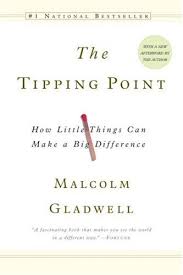
thetippingpoint

This is a great book.

Gladwellian stories are those that take a common assumption and then overturn it with data. As the cost of generating data decreases, and as inaccurate data grows, the genre finds itself in an arms race.  Determining what is enough data and who is really right will now matter as much in publishing as it does in commerce. My first edition hardback copy of The Tipping Point has many dog-eared pages and plenty of water stains from reading it at the beach during our honeymoon in 2000.  It is a great book.  Gladwell, and similar-TED-esque methods of story-telling, have recently received some negative attention.  I’m no publishing expert, but the formula it seems he, and many other authors that I really enjoy, have followed is:

Gladwell(Story) = Common Assumption (X) + Data Driven Reality (Y)

In both Raeburn’s critique of Gladwell and Thomas Frank’s “TED Talks are Lying to You” we’ve now found that Gladwell’s story telling method has itself been subject to Gladwell’s own formula.

Gladwell(Gladwell(Story)) = Common Assumption(Gladwell(Story) + Data Driven Reality(Y)) + Data Driven Reality (Y)

This results in the following conundrum:

  • A Gladwellian story overturns a Common Assumption with data, creating a new prevailing Common Assumption 2.
  • Further data overturns the Gladwellian story and Common Assumption 2.

Common Assumptions are exactly that – Common.  There is no shortage of them.  At the time of Gladwell’s initial writings, creating ‘Data Driven’ realities to contradict those assumptions was a costly endeavor, but the cost to do has dropped significantly. Ten years after reading The Tipping Point, my ability to create data to corroborate a claim or get a paper published is greater than it has ever been.  I can hop on Odesk and contract with people globally to create data or simply parse existing data sets.  And that’s assuming that we base our Gladwellian story on newly commissioned data – as this Economist article points out, science itself is turning out results that are harder and harder to corroborate.

  • 1/2 of published research can’t be replicated per VC rule of thumb.
  • 6/53 landmark cancer studies were repeatable by Amgen efforets.
  • Negative results now account for 14% of papers, down from 30% in 1990.

There is no shortage of Common Assumptions waiting to be over-turned by the application of data, but who is to say that the data that we are using is correct?  It becomes a battle of data sets and the author’s integrity.  We’ve encountered a Red Queen Race, where a better data set is compelled to introduce the next generation of a story.  One author’s story, supported by data, can stay as the dominant narrative until it is overturned by a larger or better data set, which itself may have a competing or supporting narrative.

Posted in Business, Disruption, Innovation, Theory | Tagged , , , , , , , , , | Comments Off on Our Gladwellian Future

Interesting Article Themes

Certain quantitative market and population concepts pop up frequently.

Peak X

2013, June – Initial blog post

2013, July – Peak Printer blog post

2013, October – Peak cable & car blog post

2013, October – Article on how we have passed Peak Antibiotic

2013, November – New Yorker article on the closing of Blockbuster that states that peak Blockbuster VCR-rental store count in the US occurred in 2002 with over 8,000 units.

Y is the new X

2013, June – Initial blog post

2013, June – Product succession

2013, June – Email is the new telegraph

X is a Historical Accident

2013, June – Initial blog post covering, “what if mass media was a historical accident?”

2013, July – Peak Printer blog post, the previously mentioned ‘Peak Printer’ post also hit on the same questions about mass media.

Power Law Found in X

Power laws are fascinating – the implications are still not fully incorporated into much of what is taught as modern statistics.  My first and still favorite book on the topic was Critical Mass by the popular science author Philip Ball.  Nassim Taleb, a student of Benoit Mandelbrot, whose work in fractals is often included in writings in this area, did much to popular Cauchy-type distributions with his book The Black Swan.


Posted in Business, Industry, Innovation, Invention, Theory | Tagged , , , , , , | 1 Comment