Google’s “Create a Filter” – Pure Torture If You Make Real Filters

Specialized software programs are unusual in the filtration industry – Excel and Minitab are used for data analysis, there are lots of .pdfs circulated with marketing materials and those are often originally crafted in PowerPoint, Word or other commonly used programs.  Apple hardware and software are rarely seen in the aging industrial facilities where most of us work.  Google, however is widely used, with engineers and marketing teams alike checking unit conversions from one region to another and often referencing the technical performance specs which drive our industry.

And there it hangs, anytime you use gmail, “Create A Filter.”  Click on the button.  Bang.  It does just that.

My heart breaks every time I see this phrase.

My heart breaks every time I see this phrase.

It is heartbreaking.

Try making a real filter.  There is no click.  No bang.  Just months of work which you hope will corroborate your initial suspicions and solve your customers’ problems.

Please, please don't trash those rolls during slitting!

Please, please don’t trash those rolls during slitting!

First, you make the filter media, a development process that can take years in its own right.  Most filter media is nonwoven or paper based, with an increased dependence on membranes and now composites which combine multiple layers.  Once you’ve got your media in place, we’ll have to head to another type of facility and get those converted into a filter element.

It isn’t unusual for a pleating line to require 300 linear meters or more of material to get configured.   So, if you proto-typed your filter media as an A4 or 8.5 x 11 inch sheet, you’ll have to scale up pretty significantly.  Pleaters can run fast and errors might not get caught until late in the process.  You can watch 300 linear meters of precious, one of a kind media that took months to create get chewed up in seconds – good thing you made a dozen rolls.

Now that you’ve got your final filters built and ready to go, testing is next.  Depending on the specifications you’re going after it can take a dozen filters to confirm performance, again you can work backwards to see the significance of your scale-up needs.

Or, you can just click, “Create A Filter.”

Posted in Business, Innovation, Materials Science, Theory | Tagged , , , , , , , , , , | Comments Off on Google’s “Create a Filter” – Pure Torture If You Make Real Filters

Industrial Tours

I love walking a plant floor. Unfortunately, most of what I see from working with customers can’t go out on the Internet, and if I do have photos, they are under NDA.  My son loves the show How It’s Made on the Science Channel, which is another great avenue for seeing how different plant operations work – I love finding exhibits to take him to.

Boeing

Located at Boeing headquarters in Everett Washington, this is a must see.  I’ve done the tour twice, once in 1994 and then again in 2008.  Photos were not allowed during either tour.  The tour is well set up, at one point you are above the plant floor on catwalks looking down on assembly areas for at least 3 different kinds of large airplane.  It was amazing to see the slowly progressing planes being assembled slowly march towards the exit doors from the hangar.  From a production standpoint, the 2008 tour which highlighted the giant ovens where they heated the synthetic wing-body module was extremely impressive.  (1994, 2008)

This is a must-see industrial tour.

Bourbons, Breweries & Wine

As part of an annual guys’ baseball trip and tours with my wife, I’ve seen many breweries, both large and smaller.  Anheuser-Busch in St. Louis, MO , Coors in Golden, CO, Red Hook in Woodinville, WA and many craft brewers.  For a wedding in 2003 my wife and I also took the Bourbon trail in Kentucky, which let us see the plant operations at Jim Beam and Makers’ Mark.  We’ve also had the fortune to see wineries around the Barossa, Burgundy, Napa, and Yarra.  The manufacturing component adds to the fun of these visits.

Tom Standage, author of A History of the World in Six Glasses, said it best when he was on the Triangulation Podcast (Episode 126) – “I’m treating both drinks and food as technologies.”  Beverage facility tours are great from a manufacturing and technology standpoint.  (1998 – Present)

Carrie Furnaces

This is my favorite tour on the list – the site is open limited hours, mostly on weekend and a self-guided walk (with tourguides at marked points of interest) can take 30 minutes to a full day.  Located 20 minutes outside of Pittsburgh, this site previously held six blast furnaces, two of which are still standing, but in ruined condition.  The plants were purchased after being originally built in 1892 to become part of Carnegie Steel and held many different advanced technologies over their time until they were closed in 1982.  (2013)

Czech Glass Makers

Glass blowing is similar in many to textile making – these are old industries that can now be both the basis of artwork and industrial scale manufacturing.  Both are global in scope.  I had the good fortune to visit the Ajeto facility in the North of the Czech Republic, where we were able to blow our own beer mugs, see their production methods and see the early work they had done with Dale Chihuly.  (2013)

GE Aircraft Engine Facility

A GE J47; Over 30,000 were built.

As part of getting an MBA at UNC, we toured a number of NC based manufacturing sites – this was one of my favorites.   At the time of our tour in 2005 they were just tooling up to work with engines large enough to drive a car through, and at the same time still making small engines for light planes.  Their quality standards and methods were exceptional, as to be expected.   Seeing the fitted tool cases where every tool and part that came out was slotted back or accounted for, lest a wrench leave in an engine, was really impressive.  (2005)

The Henry Ford

I’ve been on the grounds of, run through and driven past the Henry Ford Museum and Village many times, but have never had enough time to venture inside.  It is in Dearborn, Michigan.  (No visit yet)

Lowell Mills

Working looms.

This site outside of Boston, MA is a close second to the Carrie Furnaces.  The Lowell National Historic Park includes a canal system, multiple classic buildings and working belt-powered looms.  There is even a history of the brief failed efforts to make computers in Lowell in the 1970’s and 1980’s.  You can easily spend a day at this site and there are many great things to photograph and learn. (2012)

National Museum of Industrial History

This museum, which is a partnership with the Smithsonian Institution and housed in Bethlehem, PA, is still in the planning phases.  [It is clearly an industrial museum, as it has one of the worst websites since Geocities folded.]  (No visit yet)

North Carolina Transportation Museum

Located 45 minutes from CLT airport and 2 hours from RDU, this museum does a great job of linking transportation and industrial might.  The site’s dominant architectural element is the largest surviving roundhouse (37 bays) in North America, and it is full of industrial locomotives of all types and eras.  After talking a guide into a lighting 30 minute tour after hours for an international friend who was in town, my guest returned the following weekend for a full day – this is a great site to visit.  (2003 – present)

The Bob Julian roundhouse, then and now.

Pensacola Dam

http://en.wikipedia.org/wiki/Pensacola_Dam

Pensacola Dam

As kids growing up in Oklahoma, Grand Lake was one of our favorite places to visit.  Taking the tour of Pensacola Dam, the largest multiple arch dam in the world, holding back nearly 50,000 surface acres of water, was an annual pilgrimage.  In addition to the massive concrete engineering, we could see the turbines and the power plant which made the project possible.  Having since toured other hydro, coal and alternative energy production sites, Pensacola Dam was a great first exposure. (1980s)

The Smithsonian

The Smithsonian has many industrial exhibits, two of the best permanent exhibits are Power Machinery and Electricity: Lighting a Revolution.  The size of the equipment and depth of the educational materials provided are extremely impressive.  There are pistons over three stories tall and enough material to spend half a day walking the floor.  (2004)

Posted in Aerospace, Business, Disruption, History, Industry, Innovation | Tagged , , , , , , , , , , , , | Comments Off on Industrial Tours

Filtration in the Popular Media: Ultrafine Particles and 3D Printing

An ORDbot Quantum 3D printer. (From WikiMedia)

Dr. Brent Stephens and his co-authors at the Illinois Institute of Technology attracted a good deal of popular press attention (TechCrunch Article) with their recent publication of, “Ultrafine paticle emissions from desktop 3-D Printers” in the journal of Atmospheric Environment.  This is the first legitimate safety objection around 3D printing, which has long been a media and technologist darling (I’m in the dissenting camp), and while it is an initial concern, it coincides with growing awareness of how airborne particulate impacts health, wellness and safety.

Health Impact is Unknown, but Under Question

The EPA defines ultrafine particles as those under 100 nm.  There is significant epidemiological research showing correlation between increased quantities of microparticles (which are bigger than ultrafine particles) and cardiovascular problems.

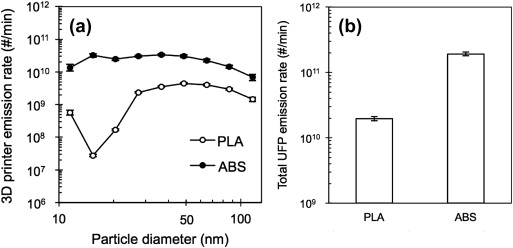
The particle size distribution (from 10 nm - 150 nm) found by Dr. Stephens et al from IIT broken out by PLA vs ABS.

The particle size distribution (from 10 nm – 150 nm) found by Dr. Stephens et al from IIT broken out by PLA vs ABS.

Ultrafine particles are currently being studied by an EPA grant at the University of Rochester.  Particles of this size are covered by the new US standards of the Air Quality Index (“AQI”), which by law requires the measurement of SO2, CO, O3, NO2, Pb and particulate matter.  Currently particulate matter is measured at 10 micron (PM10) and 2.5 micron (PM2.5).  [If we used the same abbreviation, ultrafine particles could be labeled PM0.1.] Even across the US where sensitivity to air pollution is high, at 10 and 2.5 micron, where the standards are defined and well known, it is widely known that measurement methods and their results vary dramatically by geography.  With ultrafine particles we have reason to be concerned about their presence due to known health issues with larger particles at PM10 and PM2.5, however we are a long way away from being to reliably measure and implement any kinds of controls on a national basis.

Fill Rates of UFP in a Cubic Meter: 10 seconds to 8.5 minutes

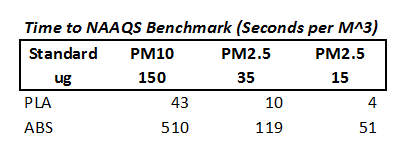
Fill rates (seconds to hit standard in one cubic meter) for PM10 and PM2.5

Fill rates (seconds to hit standard in one cubic meter) for PM10 and PM2.5

Stephens et al. showed that there were approximately 10.5 * 10^10 particles of each bin emitted by the printers working with ABS and a lesser amount for those working with PLA.  If we were to take the current NAAQS standards about micrograms per cubic meter of air and then use an average particle diameter of 70 nm, include typical densities for PLA and ABS, we would expect that an unventilated 3D printer would hit the PM10, and both PM2.5 microgram boundaries between 4 seconds and 8.5 minutes of run time if there was no ventilation and it occupied a cubic meter.  We are naively using the PM10 and PM2.5 numbers even though there is not a standard for PM0.10 – PM1.50, which would cover the results from IIT.

Calculation of Fill Rates using Polymer Densities and Estimates

Calculation of Fill Rates using Polymer Densities and Estimates

Particulate Composition

Many popular press references to Stephens work cite benchmarking efforts in his paper which compares the concentration levels he finds to what has been shown in other studies to be near other conventional activities that have been studied for UFP emissions.  While this may create comfort in the population, the materials being used in a 3D printer may be different than that found in these more established practices – particularly those where food preparation is used.

“For comparison, our estimate of the total UFP emission rate for a single PLA-based 3D printer (1.9e2.0 _ 1010 # min_1) was similar to that reported during cooking with an electric frying pan (1.1e2.7 _ 1010 # min_1).”

I do not know of any recipes which call for PLA, ABS or many of the other materials used in 3D printing / light manufacturing to be added to a meal prepared in a frying pan.

Measurement Methods & Standards

Just as with any other filtration activity, the standards around UFP will be important to understanding the very existence of, in addition to the nature and scope of a potential problem.  The ASHRAE standards around MERV have allowed for widespread adoption of filtration standards and served as the framework for similar standards in Europe.  The DOE standards around HEPA enabled particulate standards which led to precision manufacturing in the nuclear, electronics and life science industries.  Increased usage of AQI allows a better understanding of how particulate matter impacts global health and wellness.  Developing similar standards for both UFP size and UFP composition will allow for better understanding of the problem as well as potential methods of abatement.

Will HEPA work?

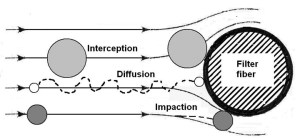
Filtration Capture Mechanisms - Diffusion has the Best Outlook for UFP

Filtration Capture Mechanisms – Diffusion has the Best Outlook for UFP

Creating a filtration regime for any new potential pollutant or hazard is hard.  The DOE and emerging global standards around HEPA focus on 0.3 um (300 nm) particulate – boulders compared to the fall smaller UFP’s studied by Stephens et al.  The paper references that increased UFP concentrations were only seen for particulate smaller than 150 nm, which led the researchers to focus on the smallest 9/12 size bins identified in their initial planning.  The HEPA standard is met when a filter collects 99.97% of 0.3 um particulate according to the ASME AG-1-2003 standard.

There are three filtration mechanisms; interception (where a particle hits the filter media), impaction (where the particle is drawn into the filter media), and the most important for UFP – diffusion (where Brownian motion causes a collision between the particle and the filter media as the particle traverses across the filter media).  These methods form a portfolio of capture mechanisms which combine to create the overall efficiency of the filter media.  At particle sizes below 300 nm (0.3 um) diffusion is the dominant method – and diffusion holds this highest value method down to the lowest particle sizes measured of 10 nm.  As can be seen in the exhibits, collection efficiency for diffusion are at 30% and less for particles in the range outlined for the 3D printer UFP study.

HEPAfigure5

Filtration Capture Mechanisms by Capture Rate for UFP in HEPA Applications

Safety Approaches for 3D Printing

One would expect that over time the safety approaches used for 3D printing would include what is seen as standard in similar applications – first, encapsulate the unit to protect the operator from the UFP flow.  Second, have a steady flow of process air (as would be used with any volatile, flammable or otherwise potentially dangerous material) to keep concentrations low.  Further, prior to releasing process air, be sure that any particulate is captured.  For now, large banks of HEPA filters could potentially be sufficient.  Depending on what materials are being used, activated carbon, scrubbers, or potentially even oxidation could be effective in treating waste air before release to the environment.

Things to Keep in Mind

This is primarily a scrap rate issue for the makers of 3D printers.  A very small percentage of the raw material is not converted into a final good, but instead, converted into a potentially hazardous particulate aerosol.  Further improvements in yield will reduce the issue.  However, if productivity increases without improvements in yield, then the problem will only grow.

For the 3D printer industry it would be valuable to look at the particulate hazards generated by the manufacturing practices which are being replaced.  It would have been very useful to see what Dr. Stephens’ team at IIT could find at an injected molded plastics facility working with similar materials.

This is the first legitimate complaint against 3D printing in what has otherwise been an easy path towards social acceptance.  The technology is widely loved and hyped in the popular media.  Will the industry players react in an organized fashion to address these issues?  It would be a simple act to put together a working group to seek guidance from ASHRAE, DOE, INDA or other filtration bodies that have dealt with similar industry safety issues in the past.

Posted in Business, Disruption, Industry, Innovation, Materials Science | Tagged , , , , | Comments Off on Filtration in the Popular Media: Ultrafine Particles and 3D Printing

Peak Cable & Peak Car?

A September article by Bloomberg coined the term ‘Cord-Never’ in line with those who are ‘Cord-Cutters’ and have surrendered their cable or satellite subscription services.  The full economic impact of Peak Scenarios hit me while listening to an expert media investor talk about ‘Peak Ad Revenue’ in 2005.

Consensus is still developing on the future impact of autonomous and self-driving vehicles, but a common refrain is that as the automotive fleet is better utilized, there will be a need for fewer vehicles.  If that is the case we could see Peak Car, a scenario where there are fewer and fewer new automobiles manufactured each year.

This could actually be the biggest economic impact when these vehicles hit the road.  Imagine a scenario where an iPhone type vehicle comes to what is currently a desktop-like automotive industry.  Currently we have multiple manufacturers and supply chains and very little importance is given to the OS for a car – the OS is the driver.

If a Google or similar entity were to roll out a vehicle with the winning OS, they would be able to capture share and profit, leaving the rest of the industry to drift slowly into obscurity in the same way we see once leading tech firms like Microsoft, RIM/Blackberry, Nokia, Yahoo! and others fight for relevance.

Posted in Disruption, Industry, Innovation | Tagged , , , , , , , , | Comments Off on Peak Cable & Peak Car?

Challenges in Measuring Nanofiber Adoption

As part of recent INDA RISE Conference, we were asked to pull together a presentation on industrial scale manufacturing of nanofiber (“NF”) membranes.  As part of that presentation I wound up covering some observations on why it is tough to measure the adoption of nanofibers in applications.

There are three primary reasons:

  • Definitions
  • They are used in a composite
  • NF layers perform like a membrane

The definitions argument pops up a lot – almost every speaker that hits on NF at a conference begins with a definition or winds up getting asked the question early on.  From an Elmarco standpoint, we define nanofibers as a polymer based, highly uniform (in pore size and in fiber diameter), nonwoven web with membrane-like filtration performance at higher flow rates.  We explicitly do not include carbon nanotubes, inorganic nanofibers (although we have research being done on these using Elmarco lab equipment).

Nanofibers are always used as a composite.  Like meltblowing, in an electrospun layer, the fibers and deposited and formed into a web at the same time.  This is different from carding, where a fiber is made and then those fibers are formed into a web in a separate and distinct step.  However, in addition to forming the fibers and the web at the same time, the fibers are also deposited onto something else – a substrate, which for us is usually a nonwoven, paper or membrane, so we are also forming a NF composite at the same time we are making the fibers and the web.

Elmarco_INDARISE (2013_10_02)d

Nanofibers are used as a composite – in this example an electrospun NF layer has been colored blue to highlights it use in a gradient air filtration application.

Lastly, a major challenge is that nanofibers perform like a membrane – to the point that we are increasingly referring to them as NF membranes internally and with our customers.  This is a bit sneaky for the NF to do – because the NF layer is formed of synthetic fibers arrayed in a chaotic pattern, they’ve traditionally been the province of those in the nonwovens and filtration industries.  However, their performance is really best benchmarked to that of porous membranes.

The membrane industry is very different from that of the nonwovens and paper industry.  End applications, manufacturing methods, performance metrics, and industry dynamics are all very different.  These three reasons combine in many ways to make measuring nanofiber end application adoption a difficult activity.

Posted in Disruption, Invention, Materials Science, Textile | Tagged , , , , , , , , , , , , , , , | Comments Off on Challenges in Measuring Nanofiber Adoption

Peak Printer and Newspaper as a Historical Accident

Photizo Group estimates show ‘Peak Printer’ was hit in 2010.

Market research firm Photizo Group provided a recent CompuWorld article on the current state of consumer printers with the graph on the right which shows that 2010 is expected to be ‘Peak Printer’ with just over 16 million global units sold. Interestingly, this article was referenced by a MakeZine article which was trying to figure out what the future really holds for 3D printers.  Conventional desktop paper printers are a logical benchmark.

Matthew Ingram’s great article for GigaOm hits on another topic – reporting from a Brainstorm tech conference discussion of a Harvard project which spoke with senior newspaper executives asking for their hindsight views on the collapse of the newspaper industry. The industry executives debated the collapse of the newspaper industry and if the original rise of the industry had simply been a historical accident.  As Ingram writes,

all of the media executives who were interviewed came to a similar conclusion, and many mentioned Harvard business guru Clay Christensen’s “innovator’s dilemma,”

Ingram’s article spends a good deal of time acknowledging that it was the death of ad income, not brute-force industry disruption, that caused the industry collapse.  Like a food web with no base nutrition, the system collapsed without the essential nutrients.  Ingram also specifically references how the early offers of free-to-read internet publications was not the source of the industry’s problems.

Posted in Business, Disruption, History, Innovation, Materials Science | Tagged , , , , , | Comments Off on Peak Printer and Newspaper as a Historical Accident

Space Industry Organizations

SpaceX and Planetary Resources get plenty of attention, but the number of organizatinons doing interesting things around launch and orbital activities continues to grow.

B612 Foundation

B612 and Copenhagen Suborbitals show that corporations aren’t the only type of entity that is exploring the benefits of space and space industry.

Ed Lu, founder of the B612 Foundation, was a guest on The Long Now Foundation’s most recent podcast episode, “Anthropocene Astronomy: Thwarting Dangerous Asteroids Begins with Finding Them”.   The non-profit’s Sentinel satellites are designed to detect and identify asteroids which might be on a collision path with Earth and the interview is fascinating.

Copenhagen Suborbitals

Copenhagen Suborbitals is a group of hobbyists, who recently launched a 5.3 meter tall rocket that used active guide jet vane rudders.  The use of ‘active guidance’ is a significant technical accomplishment, regardless of the group’s target and/or ability to achieve orbit.

“This is a non-profit suborbital space endeavour founded and led by Kristian von Bengtson and Peter Madsen, based entirely on sponsors, private donators and part time specialists. Since May 2008 we have been working full time to reach our goal of launching ourselves into space and to show the world that human space flight is possible without major government budgets and administration.”

SkyBox

Wired’s popular science approach to coverage of the space industry is thorough, and their recent article about SkyBox, which is pioneering a fleet of terrestrial observation satellites describes how a lean startup mentality drives the West Coast startup.  The company’s view on the market for their imaging is simple:

There are 1,000 satellites orbiting the planet at any given time, but only 12 send back Hi-Res images.

Posted in Uncategorized | Comments Off on Space Industry Organizations

3D Printing: Chasm Crossing Applications

If you work with technology - read it.

If you work with technology – read it.

I’m a skeptic on 3D printing.  In talking with a good friend a few weeks ago, the challenge was made, “Okay, I get it that you’re a skeptic.  If you were managing that business, what would you do?”  Challenge accepted – and the place to start, as with any new technology, is with Crossing the Chasm.

Moore’s Crossing the Chasm is the best guidebook for commercializing a new technology – it provides a robust template for understanding the path to whether or not a new concept can succeed, how to sell it and what to do.  Moore is adamant that to get a technology into the mainstream, a beachhead market must be chosen and committed to.

The primary constraints currently in using a 3D printing application are; (i) it is easiest to produce a mono-material structure, where only a single base material is used to make the object, and (ii) materials used are easiest to work with if they can be thermo-formed.  In a brain-storming session, several potential applications surfaced.

Build-A-Bear for Jewelry and Plastic Toys

Be the Build-A-Bear for hard plastic toys or custom jewelry.

Most current articles on 3D printing focus on tchotchkes and baubles – toys and sculptures that look cool and could not be made any other way.   Rather than fight this trend, someone should take the opportunity to embrace it.  Make a 3D printing business that goes into malls and is the equivalent of Build-a-Bear workshop, but instead produce custom action figures or jewelry.  The business could be co-located with existing toy businesses, jewelers, or even in low-cost kiosks out in a mall main floor.  Customers could come up, select their item and wait for it to be produced.  Co-locating with a jeweler could even allow for the use of finishing equipment already on site.

Custom In-Body Medical Applications

An 83-year old woman was the recipient of this first 3D printed replacement jaw.

Implantable medical devices must often be tailored for the recipient.  A limited number of polymers, metals and other materials are safe for using in the body and the approval process for new materials with the FDA is lengthy.  Create a high end 3D printing company that works with approved materials and is located in medical facilities that has base designs on hand that can be quickly and easily modified.  Make it easy to enter new designs and/or modify current ones, such that components can be made quickly for incoming patients.  Like all medical product strategies, there is the benefit of being high margin, with the risk of difficult regulatory approval processes.  Perhaps pursuing areas like dentistry or pet needs quicker customer traction can occur while pursuing the larger mainstream medical market.

Orbital Manufacturing

Could this futuristic 1960’s space station be built with 3D printing?

Moore argues that the chasm should be crossed with markets that already exist – and there is no current orbital manufacturing infrastructure, which makes this a bad template.  However, the market is extremely intriguing.  As interest in extra-terrestrial asteroid mining increases, the question becomes – what will you do with the asteroid?  Most asteroids consist largely of stainless steel.  Would landing a self-replicating robot, equipped with a 3D printer, allow us to shape an asteroid into any object we desire?  This is clearly not a classic beachhead market, but the returns could be so large, that it is a concept worth considering – and one that may be closer to reality with 3D systems investment into asteroid mining concept business Planetary Resources.

Posted in Business, Disruption, Industry, Innovation, Materials Science | Tagged , , , , , , , , , | Comments Off on 3D Printing: Chasm Crossing Applications

Big Trends: Robotics and Automation

Despite my UVA roots, THOR from Virginia Tech is an impressive participant in this DARPA challenge.

Improvements and cost reductions in sensors, software and sub-components are driving down the cost of robotics and automation.  As the use of these systems increase, the potential impact is significant.

Tomorrow, Thursday, June 27 is the day the results of the most recent DARPA Robotics challenge will be announced.  Only 26 teams made the cut, including THOR from Virginia Tech (shown at right).

Up to 6 winning teams could receive the ATLAS robot, currently being developed by Boston Dynamics and based off of its Petman Chasis, shown in the video below.  The purpose of the challenge is to see how robots can perform in rescue and recovery scenarios.

Posted in Business, Disruption, Industry, Innovation | Tagged , , , , , , , , | 1 Comment

Playing a Different Game: Genghis Khan and Maneuver Warfare

Dan Carlin’s Hardcore History has a fantastic five-part series on the “Wrath of the Khans.”  Carlin’s fundamental point was to create a contrast to some popular histories Genghis Khan, which gloss over the pain and suffering created by the Khans and instead focus on the societal benefits they enabled.  Over 8 hours, Carlin does a great deal to contradict the writings of Jack Weatherford in his book “Genghis Khan and the Making of the Modern World.” 

One area where both authors agree is the tremendous military advantage that the Mongols had over their peers.  Carlin frequently makes the comment,

It was as if the Mongols were a major league team in the sport of war, and all of their opposition was playing in the minors.

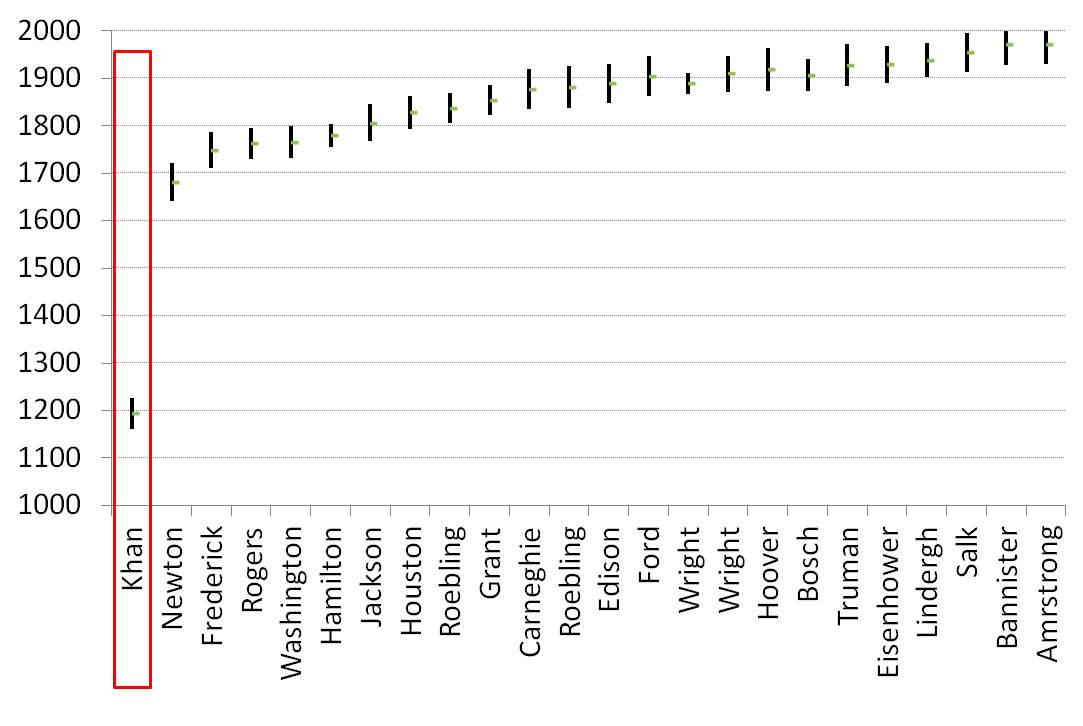
Genghis Khan's life span is a lot earlier than everyone else on the current biography list.

Genghis Khan’s life span is a lot earlier than everyone else on the current biography list.

The Mongols had better discipline, better military engineers, better equipment, and they had executed modern maneuver warfare in a day where their opponents were stuck defending walled cities.  It was not a fair competition and their victories were overwhelming and common.

When I worked as an investor this was the kind of opportunity that you looked for.  We would frequently interview many teams all investing in the same space, and you could quickly tell if there was a dominant team.  The interaction felt different.  They had developed an internal language around the space they were pursuing.  Their knowledge of the space wasn’t academic – they were deeply intimate with the space they were investing in and had a gut feel for how the supply chain would develop.

These are the teams that you want to work with – the ones that are so much better than the opposition that it almost feels unfair.

Posted in Business, History | Tagged , , , , , , , , | Comments Off on Playing a Different Game: Genghis Khan and Maneuver Warfare