How to Win Friends and Influence People: Pt 1, Ch 2 – PRINCIPLE 2 Give honest and sincere appreciation – “The Big Secret of Dealing with People”

Carnegie’s second chapter, titled “The Big Secret of Dealing with People” covers PRINCIPLE 2 Give honest and sincere appreciation.

Carnegie’s masterful persistent patter continues. Lincoln reappears as an example with a wonderful quote. We see negative and positive examples all to reinforce that sincere compliments – not idle flattery – are well appreciated by all.

Best Quote

Lincoln once began a letter saying: “Everybody likes a compliment.”

Page by Page

041

“The only way I can get you to do anything is by giving you what you want.”

“Dr. [John] Dewey said that the deepest urge in human nature is “the desire to be important.” Remember…”

042

Lincoln once began a letter saying: “Everybody likes a compliment.”

William James said: “The deepest principle in human nature is the craving to be appreciated.”

Personal example – “The hogs didn’t care about the ribbons they had won.”

043

“If you tell me how you get your feeling of importance, I’ll tell you what you are.”

044

“History sparkles with amusing examples of famous people struggling for a feeling of importance.”

045

“Some authorities declare that people may actually go insane in order to find, in the dreamland of insanity, the feeling of importance that has been denied them in the harsh world of reality.”

046

If some people are so hungry for a feeling of importance that they actually go insane to get it, imagine what miracle you and I can achieve by giving people honest appreciation this side of insanity.

047

Schwab – “I consider my ability to arouse enthusiasm among my people,” said Schwab, “the greatest asset I possess, and the way to develop the best that is in a person is by appreciation and encouragement.

048

“In my wide association in life, meeting with many and great people in various parts of the world,” Schwab declared, “I have yet to find the person, however great or exalted his station, who did not do better work and put forth greater effort under a spirit of approval than he would ever do under a spirit of criticism.”

Carnegie tombstone – “Here lies one who knew how to get around him men who were cleverer than himself.”

049

Husband with roses, “‘I can’t think of six things I would like to change about you. I love you the way you are.’”

050

“There is nothing I need so much as nourishment for my self-esteem.”

051

The difference between appreciation and flattery? That is simple. One is sincere and the other insincere. One comes from the heart out; the other from the teeth out. One is unselfish; the other selfish. One is universally admired; the other universally condemned.

052

King George VI- “Flattery is telling the other person precisely what he thinks about himself.”

053

“Try leaving a friendly trail of little sparks of gratitude on your daily trips.”

054

Emerson said: “Every man I meet is my superior in some way. In that, I learn of him.”

055

PRINCIPLE 2 Give honest and sincere appreciation.

Posted in Books, Carnegie, Methods | 1 Comment

How to Win Friends and Influence People: Part 1, Ch 1 – PRINCIPLE 1 – “Don’t criticize, condemn or complain.”

(Read a Summary of the Whole Book)(Carnegie Video Short: Don’t Criticize or Complain)

“If You Want to Gather Honey, Don’t Kick Over the Beehive”

PRINCIPLE 1 Don’t criticize, condemn or complain.

Criticizing does not work and often makes people perform worse. Avoid it. Stop doing the wrong thing in your personal interactions – it does not work.

Best Quote

Lincoln is first teed up as a repetition for use as persuasion. Carnegie also calls out his presence on the $5 bill.

“Don’t criticize them; they are just what we would be under similar circumstances.” Abraham Lincoln

Page by Page

025

“Under my coat is a weary heart, but a kind one—one that would do nobody any harm.” Crowley the murderer.

026

The point of the story is this: “Two Gun” Crowley didn’t blame himself for anything.

027

“Criticism is futile because it puts a person on the defensive and usually makes him strive to justify himself. Criticism is dangerous, because it wounds a person’s precious pride, hurts his sense of importance, and arouses resentment.”

“By criticizing, we do not make lasting changes and often incur resentment.”

“The resentment that criticism engenders can demoralize employees, family members and friends, and still not correct the situation that has been condemned.”

028

You will find examples of the futility of criticism bristling on a thousand pages of history.

029

With tears in his eyes, Taft said: “I don’t see how I could have done any differently from what I have.”

030

“There you are; human nature in action, wrongdoers, blaming everybody but themselves.

“What was the secret of Lincoln’s success in dealing with people?”

031

“And from that time on, he almost never criticized anybody for anything.”

032

“Don’t criticize them; they are just what we would be under similar circumstances.”

033

Lincoln to Meade after not pressing the fight after Gettysburg – “If I had gone up there, I could have whipped him myself.”

“Your golden opportunity is gone, and I am distressed immeasurably because of it.”

034

The next time we are tempted to admonish somebody, let’s pull a five-dollar bill out of our pocket, look at Lincoln’s picture on the bill, and ask, “How would Lincoln handle this problem if he had it?”

035

“Don’t complain about the snow on your neighbor’s roof,” said Confucius, “when your own doorstep is unclean.”

036

“Dictated but not read.”

When dealing with people, let us remember we are not dealing with creatures of logic. We are dealing with creatures of emotion, creatures bristling with prejudices and motivated by pride and vanity.

Franklin – “I will speak ill of no man,” he said, “ … and speak all the good I know of everybody.”

Any fool can criticize, condemn and complain—and most fools do. But it takes character and self-control to be understanding and forgiving.

“A great man shows his greatness,” said Carlyle, “by the way he treats little men.”

037

Hoover – ““To show you I’m sure that you’ll never do this again, I want you to service my F-51 tomorrow.”

038

Father Forgets – a sad story of parents angry who don’t show compassion to their kids.

039

Instead of condemning people, let’s try to understand them.

040

PRINCIPLE 1 Don’t criticize, condemn or complain.

Posted in Books, Business, Marketing | Tagged , , , , , | 1 Comment

How to Win Friends and Influence People: Chapter 0b – “Nine Suggestions on How to Get the Most Out of This Book”

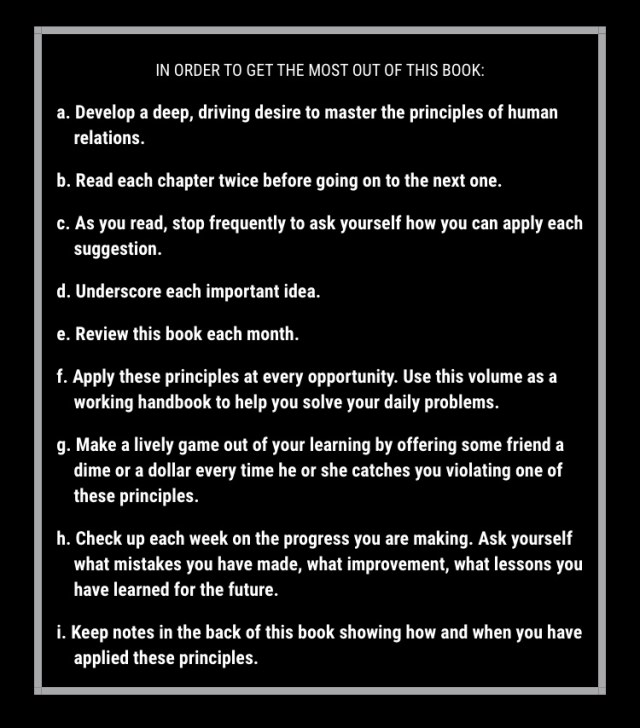
The second chapter is the pre-book workbook format. Carnegie lays out 9 ways which the reader can improve their capabilities with the material. Again, the author is in full persuasion mode – telling stories, visualizing, pacing and guiding the reader – all without lecturing!

Best Quote

This is technically part of Rule F / 6 – having rules of use improves performance:

“So, if you desire to master the principles you are studying in this book, do something about them.”

Page by Page

Page 017

#1 Just this: a deep, driving desire to learn, a vigorous determination to increase your ability to deal with people.

#2 Skim, then repeat.

#3 Stop, then digest.

018

#4 Underline, write and be active with the book.

019

#5 re-read

“Remember that the use of these principles can be made habitual only by a constant and vigorous campaign of review and application.”

020

#6 Learn by doing.

“We learn by doing. So, if you desire to master the principles you are studying in this book, do something about them.”

“You are attempting to form new habits. Ah yes, you are attempting a new way of life. That will require time and persistence and daily application.”

7 – Enlist others

“Make a lively game out of mastering these rules.”

8 – Review

“What lessons can I learn from that experience?’

021

With the paging on my device – I couldn’t see a clear highlight for Page 21!

022 – Celebrate

“You will find at the end of this book blank pages on which you should record your triumphs in the application of these principles. Be specific.”

Posted in Books, History, Marketing, Methods, Uncategorized | Tagged , , , | Comments Off on How to Win Friends and Influence People: Chapter 0b – “Nine Suggestions on How to Get the Most Out of This Book”

How to Win Friends and Influence People: Chapter 0a – Why was this book written?

Carnegie – 00a – Intro

Carnegie titles this pre-pre-amble as “How this book was written and why?” He answers the question, introduces the writing style and begins to educate the reader with that style. Carnegie is persuading in writing from this first page.

His message, which can feel both too verbose, and then suddenly just right is simple:

  • This skill is important.
  • Nobody else has covered this topic.
  • This book covers the topic, and you’re going to find it very valuable.
  • The style in which he says these 3 points is used throughout – personal examples, famous examples, positive results, negative results.

Top Quote

“The sole purpose of this book is to help you discover, develop and profit by those dormant and unused assets.”

But there are a lot of good quotes.

Page by Page Highlights

009

“But gradually, as the seasons passed, I realized that as sorely as these adults needed training in effective speaking, they needed still more training in the fine art of getting along with people in everyday business and social contacts.”

010

“In the heyday of his activity, John D. Rockefeller said that “the ability to deal with people is as purchasable a commodity as sugar or coffee. And I will pay more for that ability,” said John D., “than for any other under the sun.””

011

“But the book they need has never been written.”

“Since no such book existed, I have tried to write one for use in my own courses.”

012

“It was short in the beginning, but it soon expanded to a lecture that consumed one hour and thirty minutes.”

013

“It grew and developed out of that laboratory, out of the experiences of thousands of adults.”

“The rules we have set down here are not mere theories or guesswork. They work like magic.”

“This employer gained more profit; more leisure and—what is infinitely more important—he found far more happiness in his business and in his home.”

014

“His letter, written from a transatlantic steamer, telling about the application of these principles, rose almost to a religious fervor.”

015

“The sole purpose of this book is to help you discover, develop and profit by those dormant and unused assets.”

016

“Education,” said Dr. John G. Hibben, former president of Princeton University, “is the ability to meet life’s situations.”

Here Carnegie Baits the reader saying that he will love the book in the 1st 3 chapters – he is getting the reader to try it out.

For “the great aim of education,” said Herbert Spencer, “is not knowledge but action.”

Posted in Books, Business, Methods | Tagged , , , , , , | Comments Off on How to Win Friends and Influence People: Chapter 0a – Why was this book written?

The Goal Best Summary

Alex fixes his troubled plant with the help of his mentor, Jonah, who uses the Socratic method to explain a problem solving system.  The method they use is the Theory of Constraints that was created by the author – Eliyahu Goldratt.

ToC Teaches:

  • Systems exist to achieve a Goal.
  • Reaching the Goal requires identifying and removing Constraints (aka “bottlenecks”).
  • Constraints have common traits and can be resolved with a common suite of tools.
  • Creating a system to remove Constraints has Constraints – culture change is hard.

Want a longer summary?

Posted in Goldratt's The Goal, Theory | Tagged , , , , , , | Comments Off on The Goal Best Summary

5,000,000 Youtube Views for ‘Filtration’ – Tough Concepts the #1 Video Gets Right

Grant Thompson’s Youtube channel has over 11 million subscribers (as of June 2019) and his top video covering ‘Lego Gummy Candy’ has over 33 million views.  As ‘The King of Random‘ the channel publishes daily DIY and how-to lessons, and their July 6, 2017 episode titled, “DIY: Make Swamp Water Drinkable”  with 5,000,000 views is the number one most viewed video for ‘Filtration’.
Annotation 2019-06-24 135033

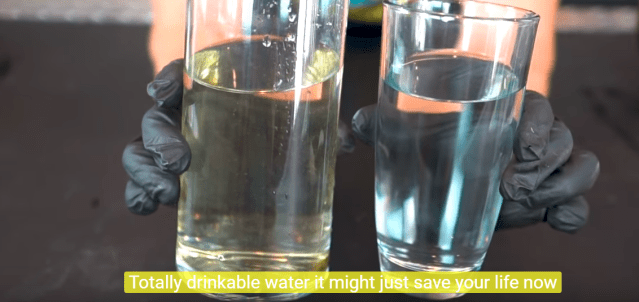
Dirt pond water on the left.  Filtered, clean, treated water on the right.  

The Youtube transcript is below, and by watching the video or reading, we can see that many of the major challenges in filtration are addressed:

1. Physical strength

Water carries a lot of force – the filter media requires sufficient physical and tensile strength.  Our narrator, Nate, begins his gradient sand bed filter with gravel to ‘absorb the force of the water’.  For anyone working with any kind of liquid filtration, strength of the filter media is important – if there is a single hole, then the fluid will flow through it and not be properly filtered.  

2. Gradient – Gradient Design

Nate starts with a fine sand filter at the bottom – supported in place by the woven / nonwoven mesh (he uses a paper towel).  He creates a gradient structure backwards, and the water flow encounters in order – gravel, smaller gravel, large sand, carbon, fine carbon and then finally fine sand.  Gradient filtration – using different size media (fibrous or particulate) to create a gradient pore structure, allows a filter to have good flow and optimum capacity.

3. Torturous Path
resizedimage550311-depth1

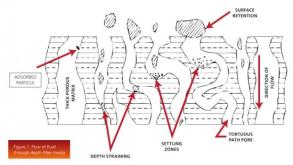
Torturous Paths fill many liquid filtration and battery separator text books.

As Nate is producing his gradient he mentions that the, “water will have to travel further, catching more material.”  Bingo! The longer and more difficult the path, the more likely small materials will be caught and the filter will also increase in capacity.

4. Settling, Flocculation, Gravity

Nathan starts his experiment by letting the water settle.  He scoops big particulate off the top.  Several times he admires the material that is left sitting together on top of the sand bed in clumps.  The narrator never adds a flocculant to promote clumping and aid filtration, but he does let the material settle and lets gravity do some of the work for the filter.

5. Flux

Three elements are designed with different media layers.  As he comes back from his 90 second commercial break, Nate comments on the different rates of completion from each of the elements.  Here we’re seeing that the flux – or flow rate – through each of the elements is not consistent.

6. Clarity – NTUs as Measurement

Nate scoops up pond water from his fish tank – and it is pretty dirty.  It looks to be over 30 NTUs.  While Nephelometric Turbidity Units (“NTUs”) are never mentioned – he frequently discusses the visual clarity (aka turbidity) of the water – the filtrate – which he ultimately drinks.

7. Fibrous Media – Paper Towel
Annotation 2019-06-23 212626.png

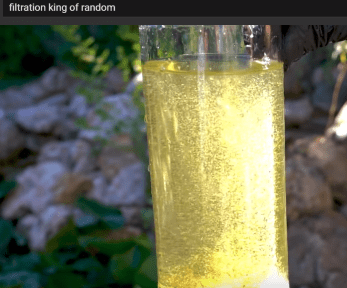
King of Random starts with dirty pond water – and makes it safe to drink with filtration.

As noted above, Nate’s finest filter layer – or at least the mechanical structure that supports the whole composite – is a paper towel.  Everything rests on that material.  It is common in filtration to have a fibrous layer as the efficiency layer – or to have some kind of synthetic / man-made material as the finest layer, such as a microporous or cast membrane.

8. Fine Pore Size, Big Surface Area

Nate hypothesizes that the cleanest water comes not from the element with the most carbon, but rather from the one with the most fine powdered carbon.  Those fine particulate materials create a big boost in pore size and a big boost in surface area – just like the fine diatomaceous earth (“DE”) used in the final clarification steps when brewing beer and championed by some of the pharma production equipment makers.

9. Element Design is Hard

Nate proceeds with three design concepts – the flux is different, the layers are different, and based on the varying amounts of yellow water – the filtration efficiency is different.  Even in a limited setting with a few designs, there is great variability in performance.

10. Dwell Time / Surface Area of the Media

“The finest carbon particles performed the best” – based on Nate’s performance.  The longer tortuous path exposes the material to the most surface area.  The finer particles give the longest path and have the most surface area.

11. Re-use, Cleaning

Nate describes how the elements can be re-sealed with bottle tops – given that they are made from plastic water bottles that contain the sand bed materials.  Cleaning matters – especially for liquid filtration.  Figuring out how to clean-in-place and work with other materials is part of getting new media qualified.

12. Sterilization

Thank goodness he boils the water!  There are a lot of ways to treat water – filtration is just one of many.

13. PPE for Fines

lungs

Please don’t laugh about lung inhalation damage!

This is a general safety issue – the narrator, Nate, is not wearing sufficient personal protective equipment (PPE) for working with small particles, and he intentionally grinds up fine powder carbon!  He also doesn’t wear any eye protection – again, this isn’t filtration specific, but it will make anyone in manufacturing cringe.

14. Not LRV

For anyone coming with a bio-pharmaceutical or protein production background with a familiarity with log-retentive values (“LRVs”) for measurement of a filter’s efficiency at a given particle size.  For example – a 99.99% efficient element is 4 LRV, add another 9 to get to 99.999% efficient and 5 LRV.

Sponsored by…

Having used many online advertising platforms it is interesting that the in line advertising roll is for a survival focused video game.  It is interesting to see what businesses look to sponsor / advertise against filtration themed videos.

Full Transcript:

This video is sponsored by Next Games, creator of AMC’s official game The Walking Dead:No Man’s Land. I put a link in the description so you can go download the game for free and it comes with a special offer! I’ll tell you about in a few minutes.


[0.13]
What’s up guys welcome back for this video today, I thought it’d be fun to take a little bit of an apocalyptic twist now if you’re to find yourself in a sudrvival emergency or zombie apocalyptic situation, One of the most valuable resources you could get your hands on would be clean drinking water you won’t last very long without it so for this video today, I thought it’d be great to show you how to use resources you already have to make clean drinking water for yourself
[0.30]
So quick update guys. I just stepped outside for a second I walked over to my fish pond – which ironically doesn’t have any fish in it – But it does have a massive amount of other kinds of life as you see here. We’ve got Mosquito larvae We’ve got these little worms flopping around all over the place We’ve got algae and all kinds of junk and other little parasites that probably will help very much in your quest for survival.
[1.01]
But I am going to drink it once we make our filter and sterilize the water We need a simple way to filter all this garbage out before we sterilize the water and to get started
We’re going to be making a simple sand – Charcoal filter now to get started making our sand charcoal filter of course we’re going to need some sand we’re getting some charcoal and we’re going to Need some kind of a plastic container like these simple little water bottles You probably have lying around
Now because sand, clay and rocks have different densities if you put them in a container with water and stir it all up The rocks will fall to the bottom first followed by the sand and the clay on top


[1.30]


any organic material left behind will float up with a surface where you can skim it off by using these layers of Separation with one chunk of dirt you can end up with nice small pebbles very fine sand and the clay which we don’t actually need For this experiment. Or you could use something like a strainer and filter out the finer sand that way as well
So now that we’ve got our fine sand our small pebbles and a small water bottle the only thing left to do is crush up some charcoal Now for this experiment. I’m using the same charcoal I used for our black-Powder experiment We made in the previous video
however If you don’t want to go to the trouble of making your own you can just look around a campfire For those large chunks of black wood they’re charred and snap in half when you press them if your charcoal is done.


[2.04]


Right it should just about crumble if you apply any kind of pressure to it Which is good because the finer we can get our charcoal the better our filter is going to work now of course my charcoal is just a mixture of small twigs paint sticks and sawdust which I like to sawdust because it’s already in fine powder form to begin with but whatever material you end up using to make your Charcoal should be just fine because it all ends up is pretty much the same stuff The goal is just to make it a very fine powder because the finer your charcoal is the better your filters can work


[2.33]


that’s beautiful
Here we are guys we have all of our filter materials prepped and ready for assembly
So let’s take our plastic water bottle cut off the bottom and put a little bit of paper towel on the bottom to catch everything As it falls in now, if you don’t have any paper towel or fine cloth You could use a bit of your shirt


[2.54]


You can use some sock any kind of cloth really that’s going to stick down the bottom and hold the charcoal in place Preventing it from slipping through so now that we have our paper towel in place We can go ahead and start adding the filter materials fineness to courses so in this case We’re going to start with the very fine charcoal powder and build that up a few inches deep Followed by as much of the fine sand as we can pack in there, and then a nice top layer of small pebbles And that’s really to protect the system from the water this splashing in and just to go one step further.
I took the bottom of the bottle and cut it into a makeshift baffle to stick it on the top and help reduce erosion As we pour the water in now This is a very basic style filter and the more material you could add the better it will work and you could also get creative.


[3.30]


With some different variations for example you could layer the charcoal and the sand
Charcoal, sand as many times as you want or you can even just cut the water bottle in half, use the top part of it To form the filter and use the bottom part to form the cup
The time has come to take our scummy pond water and test our filters to keep it work now if you look at the water Itself this has been sitting out for about 45 minutes
and you can see that already a lot of the material in there has settled down to the bottom and Relatively filtered itself through gravity we’ve got organic material and bugs floating at the top
But the water is a lot clearer than it used to be so step number one in filtering your water if you can Let your water sit out for a few hours. So most of the material can settle down to the bottom first.


[4.00]

So I’ve just made the transfer you can already see that this water is so much cleaner than this water here

[4.30]


There’s still little bugs floating around there and a lot of other nasties
But we can now take this water and pour it into our filter and cleanse it even further watch this –
So our water filters are charged and is going to take a little bit of time for the water to filter through.
[5.00]
In line advertisement!  Skip ahead to 6.35…
[6.35]
All right back to the experiment – Alright guys. We are back. We’ve been running these filters for about 45 minutes now to the point where the cups are actually overflowing
So let’s stop for a second and observe the different results between the different filters
So just by looking at the different colors of the water here It looks like the one on your right is actually the clearest and this is the one that we built in this video.


[7.00]


It’s got the layer of charcoal on the slot on the stand in the middle of the pebbles on the top and is this pretty basic Design now look if we screw the cap on We can actually contain everything inside and just set that off to the side to be used again at another time
You know what else is really crazy is if you look at the top of the filter you can actually see like the little worms, The Larva, the bugs like jumping around and floating on top.
They don’t make it past the rocks though – They just stay on the top the water we collected at the bottom is Definitely different than the water on the top now the one in the middle.  
I’m a little bit surprised about because we actually had two different layers of Charcoal
And I would have expected that to be the clearest out of all of them.
[7.35]
now what I think happened is when I was building this one I actually ran out of my really fine charcoal, and I just started putting the chunky charcoal instead so obviously
It didn’t filter the water quite as good as the really fine charcoal does this shows the finer your charcoal the clearer your water is
Actually going to be let’s take a look down inside and check it for clarity So I’ve just transferred our two large samples to two glasses.  We can look inside and check for clarity and you see the one on the left has slightly yellow tinge to it the one on
The right that looks absolutely fantastic and if you look down here You look straight through the glass you can’t see any particulate floating around whatsoever.


[8.09]


This water right here looks beautiful looks refreshing. It looks crystal clear It looks delicious in a survival situation, it’s going to be the nectar of life however There’s one thing left to do before you drink it and that’s to sterilize it.


[8.35]


Alright guys. I am back with my sterilized water. I just stuck this in the microwave for 4 minutes however There are a lot of alternative methods you could use for purifying water as well such as water purification tablets, UV stir sticks – And I’ve even heard of people sticking water in clear plastic bottles and setting them out in sunlight for 24 to 48 hours But for simplicity on this project I went ahead and use the boiling water method. 
That’s the method that’s most commonly used and after you boil water for a couple of minutes It’s pretty much enough to kill anything in the water that could hurt you so they say so here.
[9.00]
Here we are guys this is the moment of truth. We’ve got our green scummy pond water that we have transformed into sterilized charcoaled filtered water It’s filtered sanitized life-giving zero-Calorie sugar-free gluten-free dairy-free and ready to drink so this is it.
I’m actually so confident this is sterilized and ready to drink I’m just going to down the whole thing here we go.
Bangarang.
That was actually really good that tastes Probably a lot different than this taste. I mean look mosquito Larvae are still having a heyday in there So in a survival situation I choose our charcoal filter water which is made out of materials from the backyard Dirt, sand, Charcoal and look how crystal-clear that comes out this is a viable option. Guys,
This is how you survive because water is one of the essentials So there you have a guys that’s one cool trick to taking ugly disgusting contaminated water and turning it into sanitized, purified, Totally drinkable water it might just save your life.
[10.05]
Now You guys know I post videos every single day
So if you’re really curious to know whether or not this was actually safe for me to drink
click subscribe ring the bell to receive my future post notifications because if I stop posting
Well, you’ll know what happened
Thanks for joining me for this project today if an emergency pops up I hope this might help save your life
I’ll see you in the next video talk to you then
I love charcoal.
Just went into my lungs. Oh oh, oh
There they go spill it all over the place. You’re not having a mess you’re not making fun
Hey guys quick reminder
there’s a link in the description right now to download The Walking Dead no man’s land for free if you download before the end of

July you’ll unlock the character, Negan go get em Boys!

Posted in Disruption, Filtration, Industry, Innovation, Invention, Liquid, Textile | Tagged , , , , , , , , , , , , , , , | Comments Off on 5,000,000 Youtube Views for ‘Filtration’ – Tough Concepts the #1 Video Gets Right

Global Fluids: Kombucha, Probiotics and other Fermented Beverages

Kombucha, probiotics, and fermented beverages are growing fast – fast enough to catch and pass bourbon.

There isn’t a clear annual volume for Kombucha, probiotics, or active beverages – but the category is clearly growing.  That will continue – the combination of authentic, healthy, not-bad-for-you (which is not simply the opposite of ‘healthy’), convenient, and ‘new’ will help Kombucha, and the rest of this category, continue to grow.

The estimate of 100,000,000 litres is based on several pieces of information from the Kombucha Brewers Int’l trade group and a survey of retail pricing.

At this volume, Kombucha currently is 1/3 of Bourbon – which has held steady.  If last year’s phenomenal growth rate were to hold steady, then we would expect it to pass Bourbon at the close of 2024.

Kombucha will pass Bourbon – but not that quickly.  While the production process can be quickly adapted from other production processes, and both the retail channel and investors are thirsty for innovation – it will take at least until 2026 – if not a full decade – for Kombucha to win out.

However, without some truly revolutionary proven health performance, we wouldn’t expect Kombucha to ever pass the 25 billion liters of wine or even approach the nearly 200 billion liters of beer produced each year.

Posted in Business, Liquid, Marketing, Uncategorized | Tagged , , , , , , , , , , , | Comments Off on Global Fluids: Kombucha, Probiotics and other Fermented Beverages

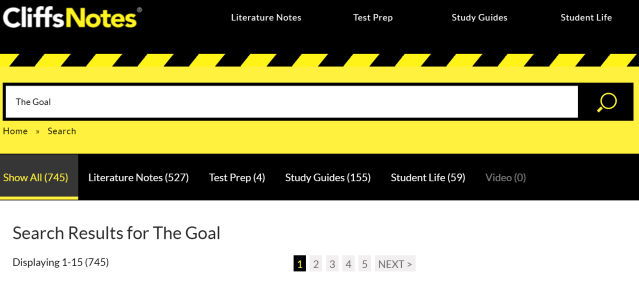
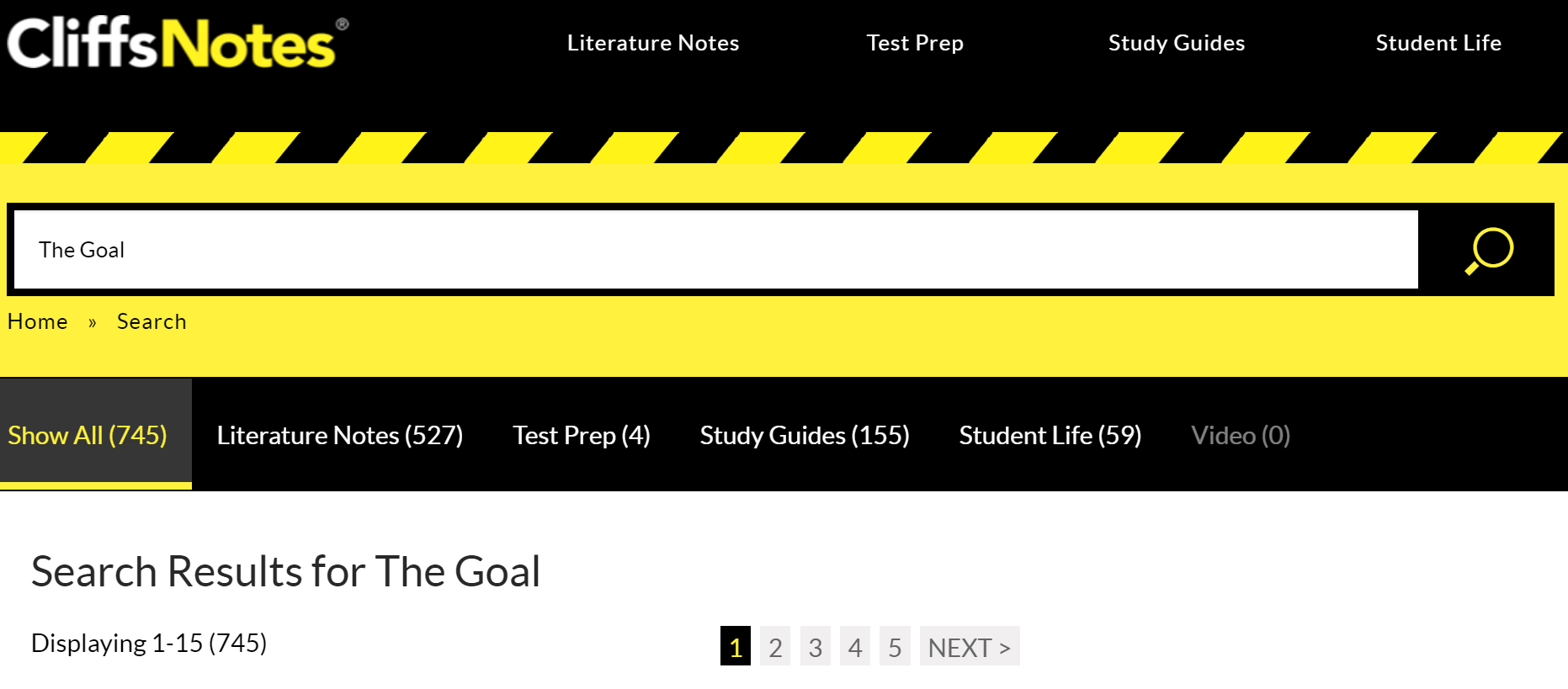
The Cliffs Notes Guide to Goldratt’s The Goal – Why Isn’t there one?

Purchasing CliffsNotes for highschool texts was a rush only outpaced by finding English copies of difficult to understand Spanish literature.  Why isn’t there one for Goldratt’s classic, The Goal?

Here are my guesses:

  • The legacy Goldratt institutions have defended the IP well – both as consultants and publishers.
  • Those Goldratt institutions are among many who have published summaries of the plot and of the major concepts.
  • There are tons of summaries online (over 100,000 words in just a few reviews) – including my own chapter-by-chapter review.
  • It is a short book – any summary would lose the nuance and educational power that can be gained by sitting down and reading the original text.
  • It’s an important book – the people who sit down to read it aren’t looking for shortcuts.  They want to know the subject matter.

The Goal is a great book – everyone should read it.  Everyone should understand the Theory of Constraints.

TheGoal_CliffsNotes

Search for “The Goal” – no results returned!

Posted in Uncategorized | Comments Off on The Cliffs Notes Guide to Goldratt’s The Goal – Why Isn’t there one?

Global Fluids and Volumes

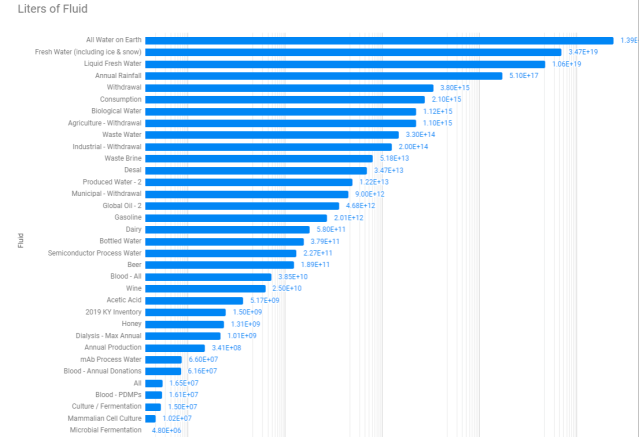
Industries that work with fluids flow through common channels, use common tools and grow using recurring strategies.  Shifting between industries requires changing the metric – such as tablespoons, milliliters or acre feet – but once interpreted, the new fluid industry will require the same need for accuracy, pumps, computational fluid dynamics (“CFD”), gravity, flow rates, filters, data modeling, cleanliness , and a host of other issues familiar to the experienced practitioner.  There are many ways to measure the size of a fluid industry – and volume of fluid produced globally provides a good estimate of the importance of the fluid. [Source information is shared via Google Sheets.]

This is an attempt to standardize those measures to get a comparable volume for the amount of fluid produced by an industry globally in a year.  There are places where I use the total global static volume – as opposed to annual production – these are indicated.  Common sizing the metrics allows comparison of the volume of fluid that an industry deals with over a year.

My focus is on production – not production capacity (often a guess), but the actual value of what was produced in a year, and not what was consumed.  The focus too is on the flow rate in a given year (similar to an income statement or statement of cash flows) and not a static ‘total’ volume (similar to a balance sheet).  Assume all measurements are annual actual production unless stated otherwise.

Fluids_Graph

Fluid #1: Oil and Fuel

34 billion barrels of oil are produced per year, resulting in 81 million barrels per day.  [Source 1: “World Crude Index Production by Year”] ~43% is converted into gasoline. [Source 3: US Energy Industry Association]

Fluid #2: Water, Wastewater and Desalination

Tying back into oil production, between 5 and 10 barrels of ‘Produced Water’ are created for every barrel of oil.

Produced water represents just a small fraction of the total volume of water on the Earth – 1.4 billion km^3 = 8,717,677,727,220,000,000 barrels.  This is a stock (balance sheet) number from the US Geological Society, sourced itself from Shiklomanov[1].  from This type of metric is often measured in km^3, the largest of the common volume metrics used for fluids.

Only a fraction of Earth’s water is fresh – 34.7 million km^3 is frozen, 10.1 million km^3 is potable and liquid.  Creating fresh water is a major endeavor – 34.7 km^3 (one millionth!) are produced each year, along with 54 km^3 of brackish ‘waste’ water. [Source 14: The State of Desalination and Brine Production, A Global Outlook]

Fluid #3: Beverages

Dairy leads the way by reported volume. Tracked and reported in tons, milk is slightly denser than water. 3.7 billion barrels are consumed per year.

Bottled water gets attention in many ways. It can easily be distributed for disaster relief. There are concerns that municipalities sell water too cheaply to bottlers. No one wants to deal with packaging waste issues. Trade associations state clear guidance – 2.3 billion barrels are consumed per year, but this is a growing industry.

Beer and wine are also well tracked because of trade and tariff concerns. Wine production has been steady with slight annual fluctuations – 160 million barrels are produced, nearly 1/10 of the 1.2 billion barrels of beer produced annually.

Bourbon – being regionally defined like champagne – is an easier liquor to track. 1.7 million barrels were produced according to the industry trade association, and interestingly there is currently a standing reserve of 7.5 million barrels. [Source 29]

Coffee and tea are attractive areas to explore – but would require a lot of extrapolation because of yield loss from the agricultural materials and variability in how they are consumed.  These are saved for later analysis.

Fluid #4: Industrial Fluids

Fluids are often categorized into several buckets – and the industrial market can be tough to measure.  Fluids can mean process water use in an industry, but it could also mean solvents, acids or something else.

Semiconductor process water is approximately 1.4 billion barrels per year.  This is based on a sustainability report by Intel, and a follow up assumption on what % of the market that Intel represents.

Acetic acid is used globally for many purposes – it is more than just vinegar.  33 million barrels were produced in 2019 based on the size of the market in dollars and an evaluation of the cost per barrel of glacial acetic acid.

Fluid #5: Biopharm and Medical

Blood supply.

The 7.7 billion people on Earth have ~5 liters each of blood – resulting in a total supply of 242 million barrels, which is shared 0.525 liters at a time as donations with a volume totaling <0.2% of that total at 380,000 barrels. [Source 25 – World Health Organization]

Biopharm.

Protein therapies harvested with the power of cells stop cancer, cure auto immune disorders and drive the growth of the biopharma industry. Harnessing the power of cells to produce protein therapies has driven global growth and represents the overwhelming portion of drugs working their way through the US Food and Drug Administration’s (“FDA”) approval process.  [Source 27 – BioProcess International]  While economically powerful, the 16.5 million liters of biopharm capacity is estimated to turn over four times annually – leading to 66 million liters of process water fluid production.

Dialysis.

Dialysis is well known in the public as a way to heal patients through cleansing of liquids – its prominence demands attention.  Unfortunately, it requires a great deal of extrapolation.  WHO publishes a clear number for annual recipients of dialysis treatment – 2,620,000 people in 2010 – with a forecast to double by 2030. Beyond that things require assumptions and extrapolations.  If 4 treatments occur per week, if the average person is 62 kg, and if this ‘Home Dialysis Calculator‘ is correct with a ‘safe’ range of 10 ml / hour / kg, then there is capacity to treat a little over 1 billion liters per year.

Feedback

I’d like to use this document.

Please do so.  You must refer to the source material – the original authors and reports I’ve identified.  If possible, please include a reference to this work.

But, you’re wrong!

That’s likely to happen.  I’ve worked in these space – but I’ve probably missed something. If you can point to publicly available information that corrects my notes, please do so.  I’m happy to talk confidentially about other numbers – but I cannot publish confidential information.

What about this Liquid / Fluid?

There are a lot of things I’ve missed.  Dyes, inks and acids are high on my list – as well as total capacity of process fluids in industrial reactors.  Please send them to me by suggesting ideas in the comments below.

Future Ideas

  • Common needs per market.
  • Common strategies.
  • Markets by dollar.
    • Volume / dollar per market.
  • Locations and units.
  • Fuel tanks by size.
  • Regional analysis.
  • River drainage.


References

[1]  Source: Igor Shiklomanov’s chapter “World fresh water resources” in Peter H. Gleick (editor), 1993, Water in Crisis: A Guide to the World’s Fresh Water Resources (Oxford University Press, New York).


Posted in Filtration, Industry, Uncategorized | Tagged , , , , , , , , , , , , , | Comments Off on Global Fluids and Volumes

8 Tools to Improve Communication

When you’re dealing with new relationships, there are many barriers to effective communication.  There are many ways to improve communication, these 8 have been consistently successful:

  1. Empathy.  What does your colleague want?  The more you can understand their desires, the better you will be at forging a good working relationship.
  2. Video chat.  Phones are great.  However, if your counterpart can use Skype, Facetime or some other face-to-face method to speak, it is easier to build rapport.  It is easier for those communicating outside of their native language to be understood.  If your colleague is confused – you can see it in their face.  Find ways to be face to face.
  3. Meeting notes.  Type notes during a call.  Summarize action steps at the top when you’re done.  Share those notes to everyone by email.
  4. 24 hours to confirm meeting notes.  Non native speakers may not have fully understood the language as it happened!  Especially in English – we can sometimes speak to fast.  Give your colleagues time to read and confirm understanding.
  5. Preparation.  Prioritize and focus on what you must get across to your colleagues.  Don’t waste time with unimportant items.  If it is an early meeting – go so far as to try to avoid asking questions.  Focus on delivering the message most important to you and identifying the message most important to them.
  6. Focus.  Make your goals clear.  If you are sharing slides – use short, focused communication.  Avoid messages that require nuance early in the relationship – focus on building a big picture foundation with clear, easy goals.
  7. Photos, diagrams and other visuals.  Use visuals that support what you are discussing.  If you’re in manufacturing, use photos of the item you are discussing.  If a flow chart is relevant, use [4] to prepare it and make sure it is clear.
  8. Build from strength.  If you’re finding that some things work better than others – then focus on building from strength.  In a past business, regional focus on certain technologies meant some approaches to quality statistics were really good.  That domain wasn’t something I knew well, but the work product around these questions was always great.  By focusing on an area where we had rapport and there was domain expertise, we could use that strength to expand our productivity to other areas.
Posted in Business, Marketing, Trust | Tagged , , , , , | Comments Off on 8 Tools to Improve Communication